
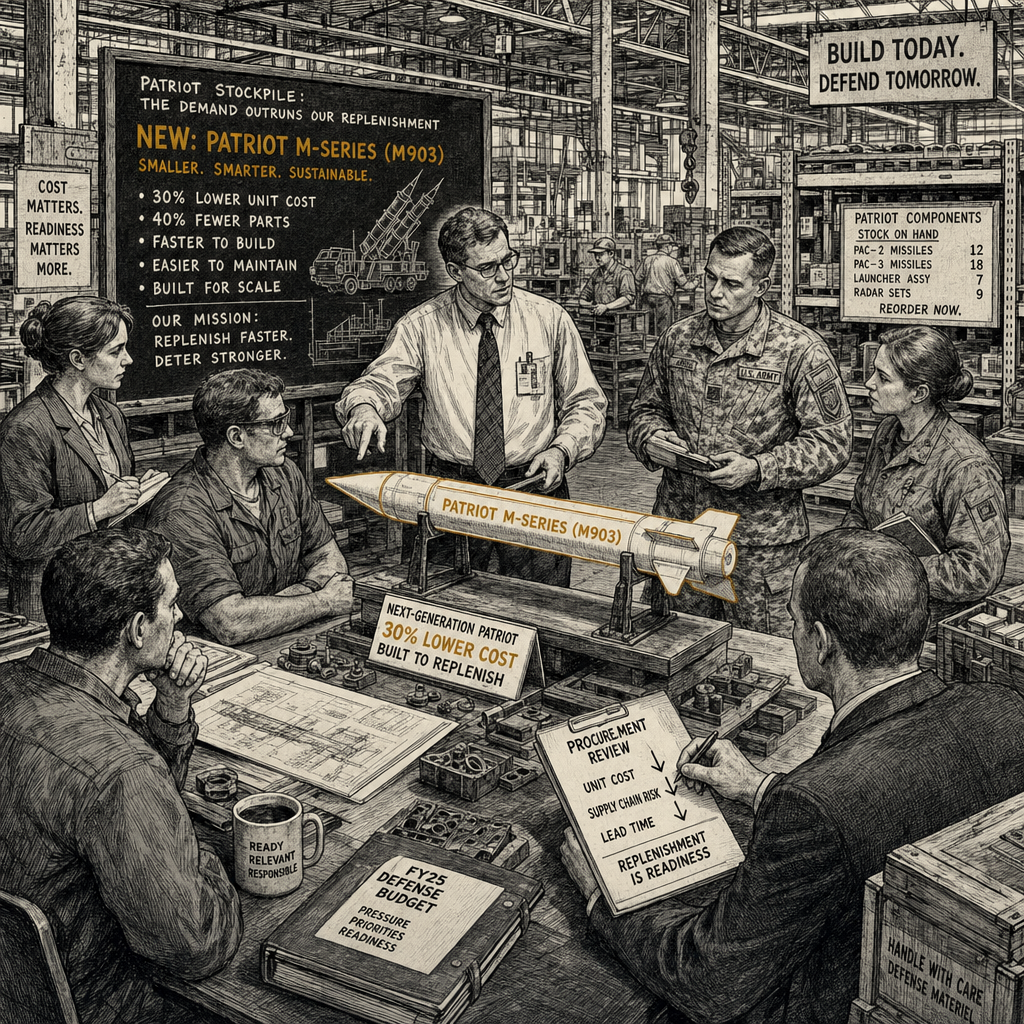
Lockheed Martin sold the Pentagon $4 million hand-assembled Patriot interceptors for years while demand outran production.
That sentence should make any taxpayer uncomfortable. Not because of anything classified or complicated, but because of what it plainly says. A major defense contractor, with exclusive access to a weapons system the country’s military depends on, delivered hand-built missiles at over $4 million apiece, on a production line that could not keep up with the world as it was, let alone the world as it was becoming.
Brent Ingraham, an Army procurement official, told an industry audience recently what the contract documents have shown for years: the PAC-3 Missile Segment Enhancement — Lockheed’s bestselling Patriot interceptor — was “not originally designed from a manufacturability perspective.” Each one is built from “hand-fabricated, hand-assembled pieces.” Not stamped out on an automated line. Not built the way Detroit builds a truck. Hand-fabricated. Hand-assembled. By skilled workers, yes. At a pace no modern war could sustain, also yes. And each round costs the taxpayer more than $4 million.
Think about what $4 million means where you live. In Redemption Springs, that is a new fire station and a crew to staff it. That is the annual payroll for every teacher in the county school system. That is a water-treatment upgrade the town has been putting off for fifteen years. That is what one interceptor round costs — before shipping, before maintenance, before the cost-plus margin the contractor collects regardless of whether the production line runs fast or slow.
The cost-plus model is worth understanding in plain terms. “Cost-plus” means the government pays the contractor’s actual costs to build the thing, then adds a guaranteed profit margin on top. The higher the cost, the higher the profit. The incentive structure points toward expensive, not toward efficient. A shop owner in Redemption Springs who billed his customers that way would not keep his customers long. But the Pentagon has been Lockheed Martin’s customer for decades, and the Patriot program has been one of the most profitable lines in the defense industry, and the production rate has stayed in the low hundreds per year while the world demanded thousands.
The demand side is not hypothetical. Ukraine has been drawing down allied interceptor stockpiles since Russia’s full-scale invasion in February 2022. The Houthi drone and missile campaign in the Red Sea has consumed naval interceptors at rates no one planned for. The Army’s own analyses of a Chinese move against Taiwan have shown the interceptor stockpile would be the first thing to empty. And through all of that, Lockheed and RTX — the maker of the Patriot launcher system — kept building on a line designed in the 1990s, at a rate of several hundred a year, at $4 million a round, while the White House was publicly demanding they triple or quadruple output.
Eisenhower, in his farewell address of January 17, 1961, warned of exactly this kind of arrangement — a military-industrial complex acquiring “unwarranted influence, whether sought or unsought,” producing for its own profitability rather than for the country’s actual defense needs. The man who had run the war in Europe and managed the Cold War for eight years said the country needed “an alert and knowledgeable citizenry” to prevent it. Sixty-five years later, the citizenry has been paying $4 million for a hand-built missile it cannot produce fast enough.
The soldiers who man Patriot batteries in a peer fight know what the production rate means. They can count the rounds in the magazine. They know the math before the first missile launches. The allied air defenders in Ukraine and elsewhere who depend on American resupply know it too. The interceptor is the promise the country makes. The stockpile is whether the country can keep it.
What Lockheed is now unveiling at the Farnborough Airshow — the PAC-3 Adapted Capability Effector, at less than half the cost of the MSE, built to be produced faster — is an admission that the existing missile was too expensive and too slow. The Army’s parallel competition for a sub-$1 million interceptor, accepting entirely new designs for seekers, rocket motors, and major components, built to fire from existing Patriot launchers, is a further admission. The old way did not work. It worked for the contractor’s bottom line. It did not work for the country.
The workers who built those hand-assembled PAC-3 rounds are skilled people doing skilled work. The problem is not them. The problem is a procurement system that accepted hand-assembly at $4 million a round for decades and called it adequate, because the cost-plus contract kept the profit flowing whether the world was stable or not. The taxpayer funded that arrangement. The taxpayer’s community went without the fire station, the water-treatment upgrade, the school renovation, while Lockheed’s margins held.
The next administration, whichever party runs it, will have to decide whether the missile industrial base is a national-security asset to be built for the threats the country actually faces, or a cost-plus profit center to be managed for the quarterly report. Every administration since 1991 has chosen the second. The cupboard is what that choice looks like. The country should know what the expensive one cost — not just per round, but per town, per taxpayer, per community that went without.