
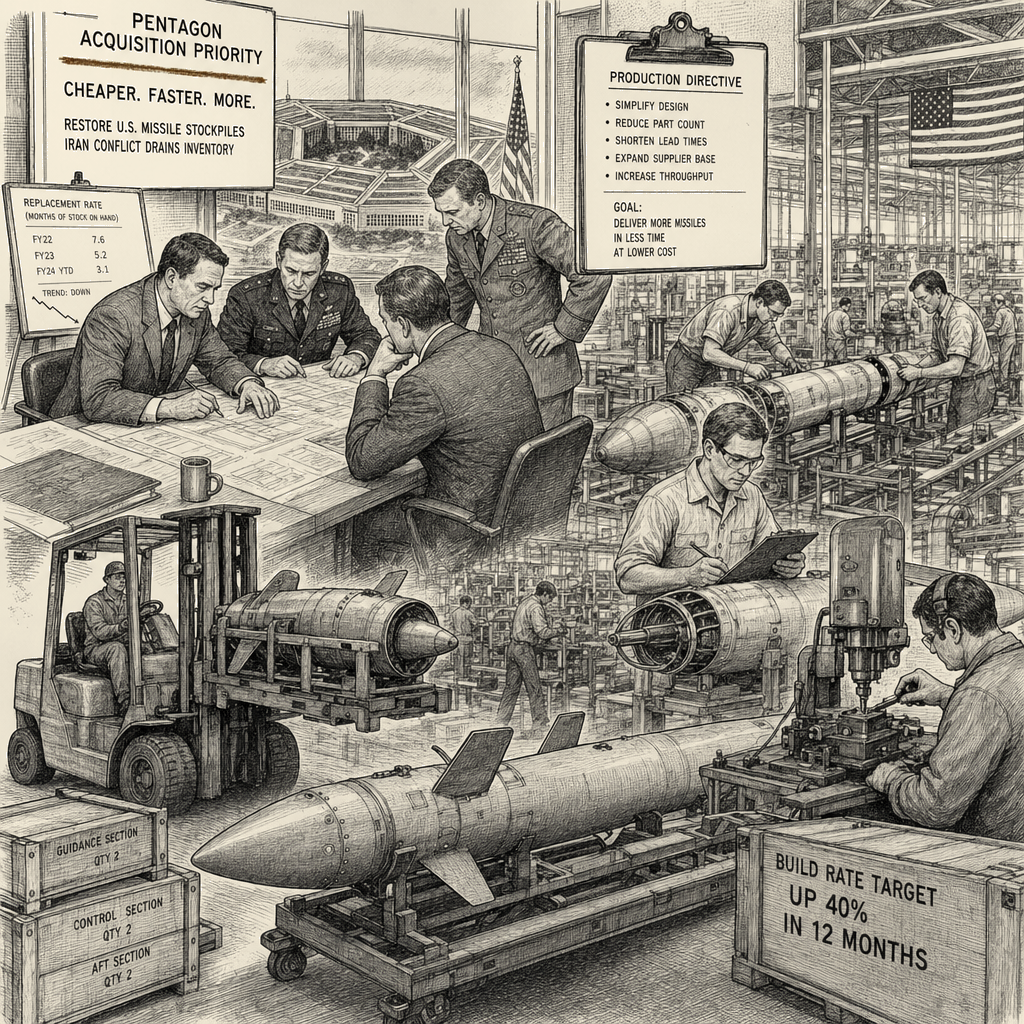
The U.S. military has fired more than a thousand Tomahawk cruise missiles in the Iran war this year, consuming at least $2.5 billion in a single campaign. The independent analysts at the Center for Strategic and International Studies, whose analysis the Main Street Independent reported on in May, concluded it would take years to replace the key munitions consumed in the conflict. This is not a system that is failing. It is a system that is working.
The numbers make the confession. A single Patriot interceptor from Lockheed Martin costs about $4 million and takes more than two years to build. The military is spending missiles faster than the industrial base can replenish them, and the system as structured gives it little reason to change. The revenue model is straightforward: each modification to a missile generates a new contract, new billable engineering hours, new schedule slips. The inspector general’s office has documented systematic overcharging. Congressional hearings have aired bipartisan complaints about contractor performance. President Trump and Defense Secretary Hegseth have pledged to scrutinize contractors and penalize underperformers, yet the Pentagon has yet to penalize a single underperforming company.
Eisenhower, in his farewell address of January 17, 1961, warned of “the acquisition of unwarranted influence, whether sought or unsought, by the military‑industrial complex.” He was describing exactly this dynamic: a permanent apparatus that makes national security subservient to corporate revenue. Sixty‑five years later, the structure he warned about is what we now have. The citizenry he said must be alert and knowledgeable is not compelling anything.
The answer the Pentagon is proposing has real substance behind it. The Army is standing up a program to buy containerized cruise missiles for under $500,000 apiece and a separate effort to field air‑defense missiles for less than $250,000. The Air Force is seeking to procure tens of thousands of lower‑cost missiles of its own. None of these are routine efficiency drives. They are confessions that the normal way of buying weapons cannot deliver what the military actually needs.
The startups competing for these contracts tell a different story. CoAspire, a company founded by a retired Topgun instructor, is flight‑testing a missile this year that it built with commercial off‑the‑shelf parts and 3‑D printing, using “other transaction authority” contracts that bypass the usual micromanagement. Leidos plans to deliver three thousand containerized cruise missiles in three years by taking a weapon it already makes and adding a few basic features. Doug Jones, the company’s chief technology officer, framed the choice bluntly: “Instead of building one Cadillac, can I build 10 Honda Accords?” The question answers itself. You can build ten Hondas because you do not ask the dealer to hand‑stitch the upholstery and gold‑plate the dashboard.
The obstacle is not technology. It is a procurement system that rewards complexity and delay. Jerry McGinn of CSIS noted that many high‑end missiles are “essentially handmade munitions” even after years of investment in automation. That is not an accident. It is what happens when the customer’s urgency meets a supplier that profits from the absence of urgency. When a program stretches from five years to twelve, the contractor gets paid for twelve years of engineering changes. No boardroom votes to shorten that gravy train. The legacy contractors have no reason to accelerate a model that generates the revenue the current one does. The system does not just reward slow. It punishes fast when fast threatens the revenue stream.
The technical approach the startups are pursuing is the opposite of what the legacy system does. Doug Denneny, the CoAspire founder, told the press: “In the missile business, you are constantly having to make changes.” The standard contract makes each change a twelve‑month paperwork exercise. The nonstandard one treats it as a conversation. The Army’s demand—more than 10,000 low‑cost missiles by 2030—sets a clear test. A missile does not need to be a bespoke piece of aerospace sculpture. It can be a reliable, mass‑produced commodity that does its job and is fired without a congressional appropriation per round.
The U.S. burned through $2.5 billion in Tomahawks in a single year. That sum could have funded the entire Low‑Cost Containerized Missiles program. Instead it went to a single manufacturer producing handmade cruise missiles one at a time. The system is not broken. It is built for the people who sell the missiles, and it works for them fine.
I run a shop where the insurance companies and the parts distributors both profit when a brake job takes longer and costs more. I know what a system looks like when the people inside it are not the ones it was designed to serve. The Pentagon’s procurement apparatus functions the same way: the longer a missile stays in development, the more everyone in the supply chain bills, and nobody gets paid for shipping a $250,000 interceptor ahead of schedule.
That does not pencil out for the soldiers who depend on these weapons, or for the taxpayers who fund them, or for the citizenry Eisenhower said must be alert and knowledgeable to compel the proper meshing of the military machinery with democratic accountability. The Army’s cheap‑missile program is a laboratory test of whether the country can still escape the dynamic he named. Either the industrial base learns to produce weapons at Honda scale, or it proves that the military‑industrial complex has calcified beyond reform. Eisenhower told the country. The country did not listen, and the structure he warned about is what we now have.