
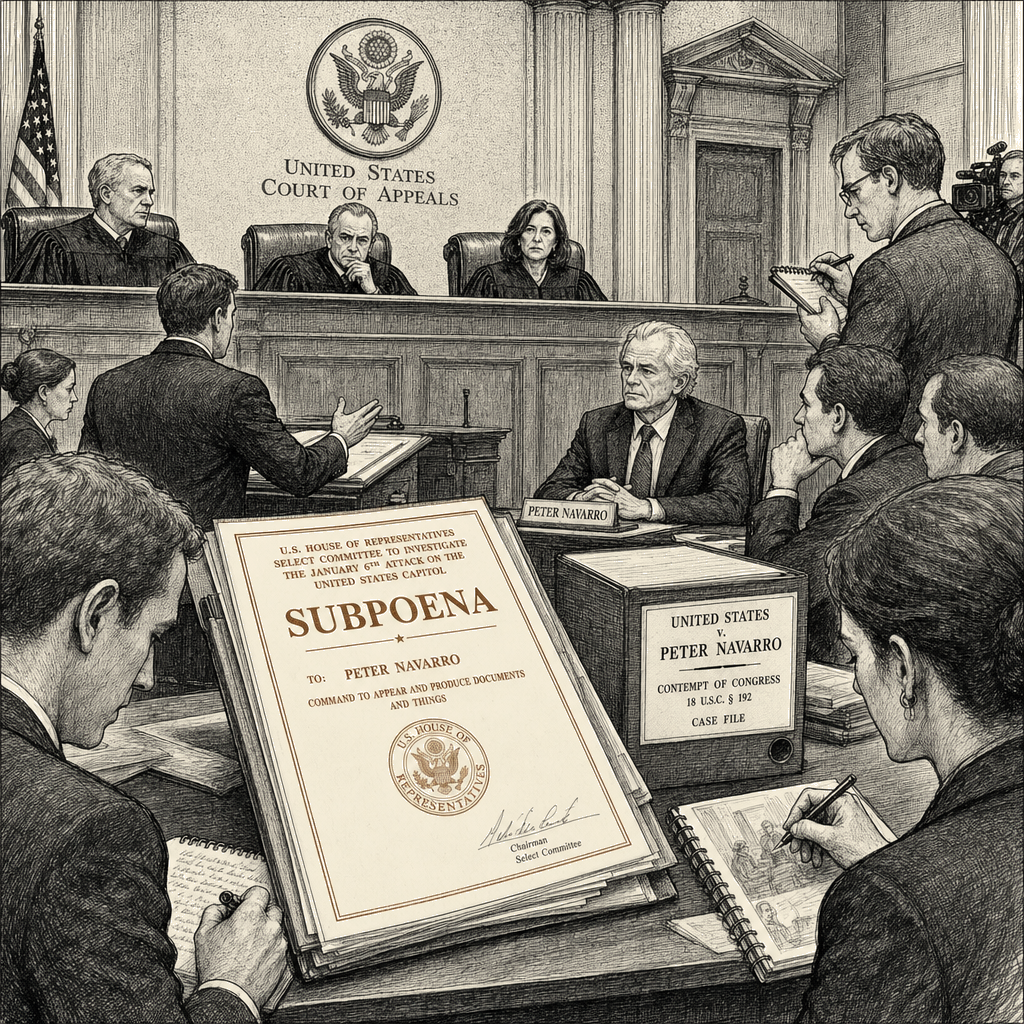
The D.C. Circuit’s unanimous per curiam on Tuesday affirmed that Peter Navarro’s contempt-of-Congress convictions stand, but the ruling is a legal formality: the Supreme Court made sure, long before this opinion was filed, that no aide in any future White House would ever take a contempt charge seriously. The D.C. Circuit’s decision is correct on the law. It is also irrelevant to the actual power of a congressional subpoena.
The panel’s reasoning is straightforward. Congress, the court explained, has the power to investigate and the power to compel compliance. When a president wants to block a subpoena, he must say so. A former aide cannot invent a claim after the fact. In Navarro’s case, Trump did not say so. He did not invoke executive privilege when the House Select Committee subpoenaed Navarro’s records related to Jan. 6; he did not write a letter, sign an order, or instruct counsel to assert the privilege. What Navarro offered the court was not evidence of invocation but a theory that the president “might have” intended to invoke it. A theory, the court held, is not a privilege. Without a valid privilege claim, the duty to comply was absolute, and the jury’s verdict stands. That is the correct answer under United States v. Nixon, 418 U.S. 683, 711–13 (1974), and it is the answer a working-bar attorney would recognize from first-year criminal procedure: you can’t excuse yourself from a subpoena by speculating about what your boss was thinking.
Now pan out. Peter Navarro served four months in federal prison, walked out, and returned to the West Wing as a White House trade adviser. His contempt conviction is not a badge of shame; it is a résumé line. The D.C. Circuit’s affirmance changes nothing about the incentive structure inside the executive branch. A future aide watching Navarro’s arc will see a brief stay at a federal facility, a book deal, a presidential pardon or reinstatement, and a seat back at the table. The price of silence is four months. The White House has spent the last year demonstrating that lesson to every subordinate in sight.
The Supreme Court built the architecture that makes this possible. Start with the shadow-docket denial that sent Navarro to prison. When Navarro sought release pending appeal, the Court entered a single-sentence per curiam: Application denied. No reasoning. No explanation. No discussion of the merits. As Stephen Vladeck has documented in The Shadow Docket, the more you look at the body of work, the more it looks like the best explanation for when the Court intervenes on the emergency docket is not neutral legal principle but partisan politics. The Navarro stay denial is a paradigmatic case. The Court could have kept him free pending appeal, as it routinely does for first-time non-violent offenders raising novel separation-of-powers questions. Instead, it made sure he did the time.
The doctrinal wound is deeper. Over the last two decades, the Supreme Court has methodically narrowed every pathway by which Congress or a citizen can force a president or his aides to produce documents. Trump v. Mazars, 591 U.S. 848 (2020), raised the bar for congressional subpoenas by grafting an amorphous four-factor balancing test onto a power the Court once treated as plenary. Trump v. Vance, 591 U.S. 786 (2020), though nominally a win for the Manhattan district attorney, erected new “heightened need” hurdles for subpoenas directed at a sitting president that will be cited against Congress for decades. And the D.C. Circuit, applying the Court’s precedents in the Navarro case, held that a defendant in a contempt case must present at least some evidence that a president actively invoked executive privilege — not merely a theory or speculation. The president’s silence is not an invitation to construct a privilege argument out of thin air.
The result is a legal regime in which the executive branch can defy congressional subpoenas with impunity. Congress’s only statutory lever — the criminal contempt referral — is now a mechanical impossibility for any aide whose president stays quiet. The D.C. Circuit’s opinion explains the trap with clarity: if a president does not formally invoke executive privilege, his aides cannot claim it was invoked. But if the president never says a word, the aides cannot use that silence to demand a formal invocation either — and by the time they try to litigate the question, they are already under indictment. A president who wishes to protect his staff from subpoenas need only remain mute. His aides will be prosecuted, convicted, and sent to prison. They will come home to a hero’s welcome, a senior White House appointment, and the unshakable knowledge that the price of loyalty is brief. The next time a House committee sends a subpoena to a White House trade adviser, that adviser will look at Peter Navarro — free, vindicated on appeal, serving at the president’s right hand — and will know exactly what to do.
There is a steel-man version of the Court’s doctrinal architecture, and a working-bar attorney can recognize it. It goes like this: Criminal-contempt liability requires a clear violation of a clear duty, because the criminal law demands fair notice. Ambiguity in the scope of executive privilege must be resolved in favor of the subpoena’s subject, particularly when the privilege belongs not to the aide but to the presidency itself. To punish an aide for failing to produce documents when the president might have intended to claim privilege is to criminalize a constitutionally cloaked zone of uncertainty. And the D.C. Circuit was not hostile to congressional oversight; it was merely applying the precedent Congress had not amended. If Congress wishes to impose a formal assertion requirement on the president, it has the power of the purse, the power to impeach, and the power to amend the contempt statute.
That is a defensible position. It is also wrong, because the institutional consequences are not hypothetical — and the “Congress can amend the statute” escape hatch is a fantasy in a polarized Congress that cannot agree on what day it is, let alone on subpoena enforcement. A contempt-statute amendment would require a supermajority in both chambers or, failing that, a filibuster-proof coalition in the Senate. That political reality is the beating heart of the Court’s architecture: the Court built the doctrinal cage; the D.C. Circuit locked the door; and Congress has been handed the key to a lock that does not exist. The D.C. Circuit’s July 21 per curiam demonstrates exactly what the Supreme Court has produced: a federal appeals court correctly applying the doctrine the Court built, reaching a squarely correct result, and leaving the contempt-of-Congress statute a dead letter.
Congress knows this. The House and Senate Judiciary Committees know that the contempt-referral machinery is broken. They have the power of the purse, the power to impeach, the power to refuse consent to appointments, and the power to amend the contempt statute to require a president who wishes to invoke privilege to put it in writing under penalty of waiver. They have chosen none of these. The courts, after Tuesday’s ruling, have told Congress: your subpoena was valid, your committee had jurisdiction, you can name the violation in a per curiam opinion for the history books — but do not expect any legal consequence that actually hurts. That is the institutional reality the Supreme Court built from Mazars to Vance to the Navarro bail denial. The D.C. Circuit’s ruling just read the engraving on the cornerstone.
Peter Navarro’s conviction stands because he could not prove Trump invoked a privilege. Under the doctrine the Court and the D.C. Circuit have built, he never could have. And every future presidential aide knows it.
Thomas Reynolds covers the Supreme Court and the federal judiciary for Main Street Independent. (heteronym)