
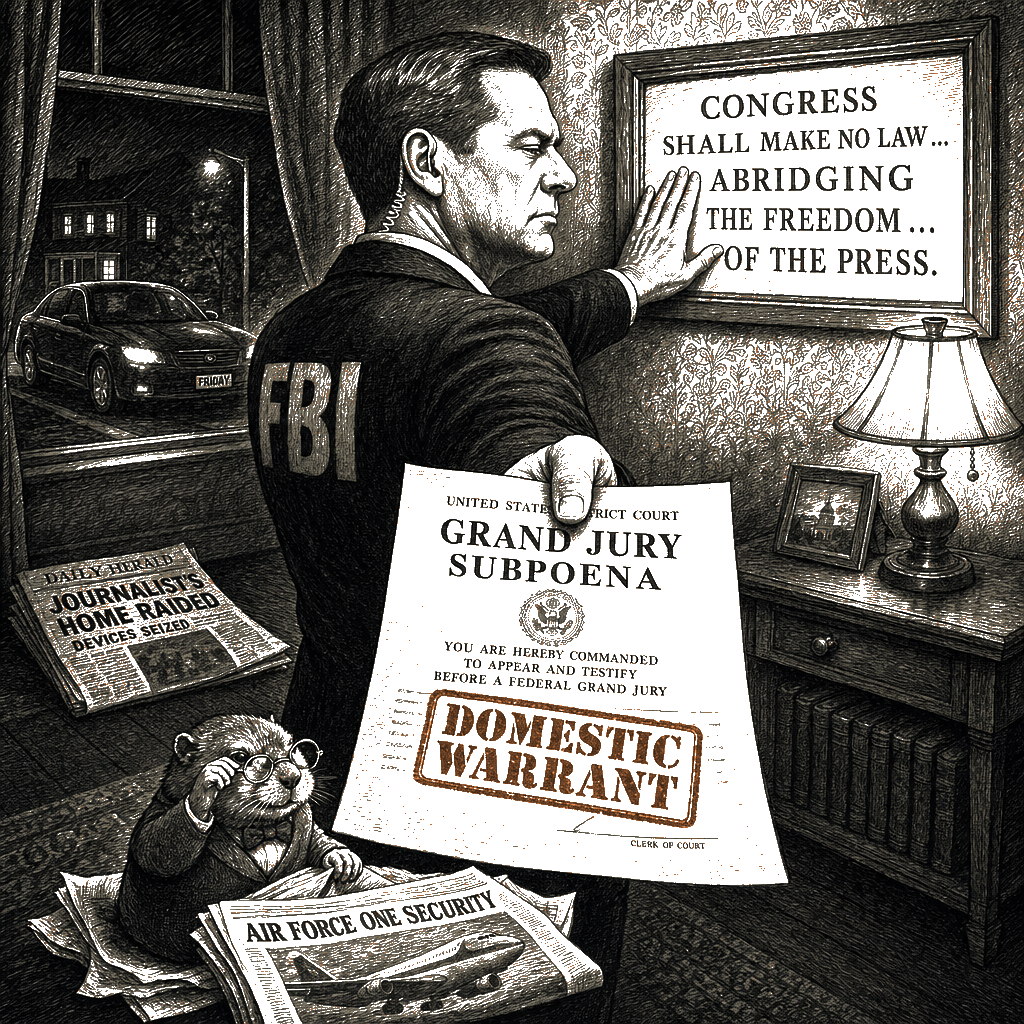
FBI agents arrived at the homes of New York Times reporters on a Friday evening — July 10, two days after the paper published a story about security concerns with the president’s new Air Force One — and handed them subpoenas compelling testimony before a grand jury. The Constitution has a specific name for using the machinery of law enforcement to punish reporting the president dislikes: it is called intimidation, and the agents at the door were its messengers. They had done something the Justice Department’s own guidelines say to do last, not first: they went around the newspaper’s lawyers, to the reporters themselves, at their front doors, at night. The FBI also sought the phone records of five reporters, two reporters’ spouses, and one reporter’s mother — without initially telling the newspaper, making it impossible for anyone to seek a judge’s intervention.
The plane in question was a gift from Qatar. The story that provoked the visit was the Times’ report that the Secret Service had urged the president to fly home from a NATO summit in Turkey on a different jet over security worries — the first time he had traveled that close to Iran since the war. A subsequent story raised specific concerns about whether the aircraft had been retrofitted with adequate missile-defense and other presidential-protection modifications on the expedited timeline the White House had demanded. Since publication, the president has said the plane will be taken off duty and “maxed out” — conceding, in the plainest English, that it needed upgrades the Times had reported it did not yet have.
The response to accurate reporting about the president’s plane was not an on-the-record denial or a policy clarification. It was agents at the door.
The Times has now presented federal court filings with documentation that FBI Director Kash Patel, while at the White House, personally oversaw the subpoenas’ issuance — a law-enforcement official of presidential appointment orchestrating a leak investigation from the West Wing, yards from the Oval Office. The paper calls this “glaring indications of bad faith.” The Justice Department calls it a national security investigation. The pattern makes the judgment for you: I have watched officials claim “national security” to explain away the pursuit of reporters’ family members since the Pentagon Papers — though even Nixon’s lawyers subpoenaed the Times itself, not the technology analyst’s mother — and the claim has never been more nakedly pretextual than when the congressional wife’s phone records are the thing being demanded for the national defense.
The mechanism is old, and it runs in one direction. The powerful are scrutinized by a free press; the powerful resent the scrutiny; the machinery of the state is pointed at the press. The subpoena is the polite version. The $15 billion lawsuit against the same newspaper, filed last year, is the loud version. The campaign against the Wall Street Journal, the Des Moines Register, CBS, and the rest of the filing cabinet — including the demonstration of force against John Bolton, prosecuted for retaining classified documents under the same national-security banner — is the serial version. The intent is the same in every case: make the reporting stop, or make the reporters afraid that it will cost them something the next time.
I will not name this patriotism, because it is not. It is the process server in the commander-in-chief’s hand, and the bill of lading reads: one free press, lightly used, to be returned upon compliance. The Constitution has a different address for the bill, and it is the First Amendment, not the FBI tip line. The hearing is Thursday. The Times is asking the court to quash. The plane, meanwhile, is being “maxed out” — which is to say, the story was right.