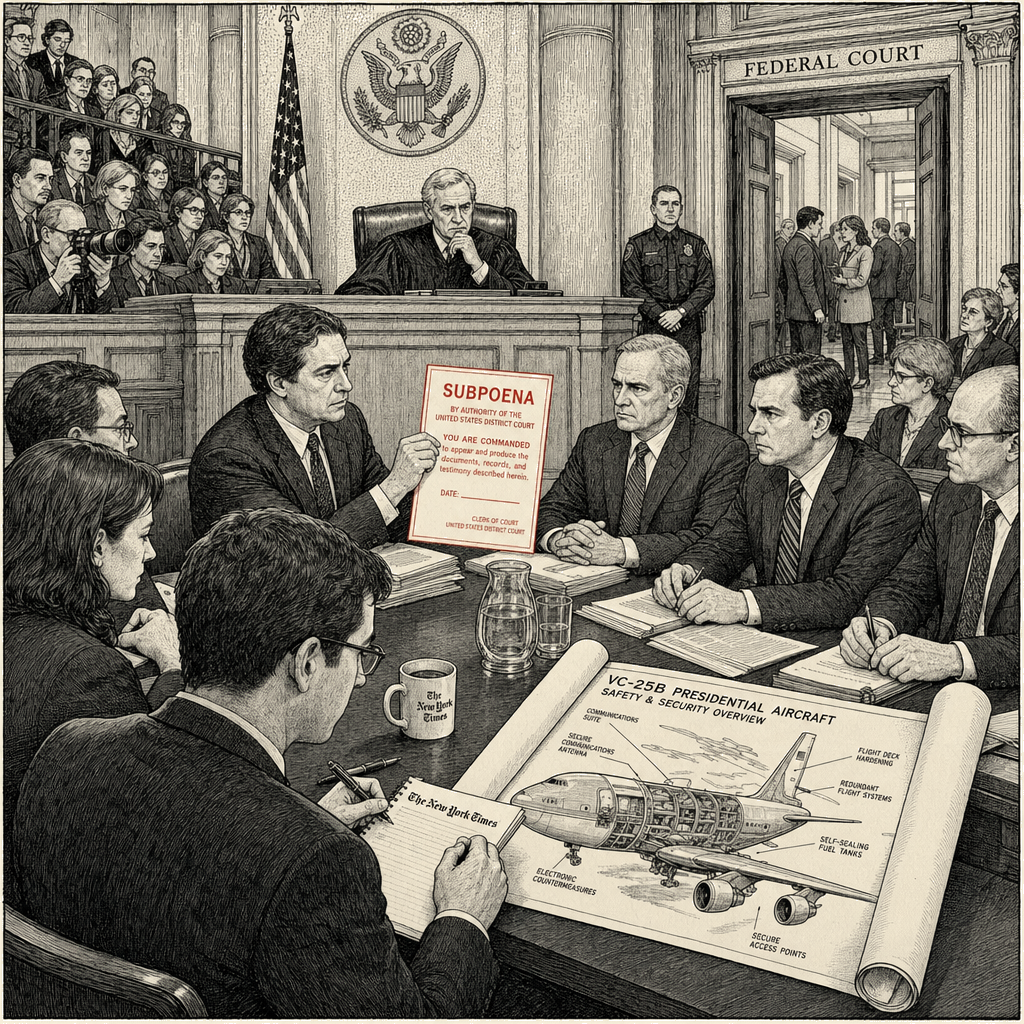
The FBI is hunting the New York Times’s reporters for covering Air Force One. U.S. District Court Judge Arun Subramanian will be asked on Thursday to quash the subpoenas at a hearing in Manhattan federal court.
The Justice Department’s position, as set out in a Tuesday memo from U.S. Attorney Jay Clayton for the Southern District of New York, is that prosecutors are pursuing a national security breach, that they followed the relevant process, and that the government sought “to limit to the greatest extent possible any intrusion into the operation of the free press.” At his Senate confirmation hearing for Director of National Intelligence last week, Clayton testified that he had “followed all appropriate policies” and was “absolutely committed to and respect our First Amendment and the role of the press.” The Department’s posture is that this is a leak investigation constrained by internal rules, conducted by a U.S. Attorney whose record on press questions the Senate is currently considering for the intelligence-directorship post. The Supreme Court has long held that journalists enjoy a qualified First Amendment protection against compelled disclosure of their sources, with the qualification that the protection operates against subpoenas issued in bad faith or for harassment. Branzburg v. Hayes, 408 U.S. 665 (1972).
The procedural record the Times has assembled in unsealed filings — drawing on the Justice Department’s own subpoenas and on subsequent reporting on the administration’s escalating pursuit of the newspaper’s journalists — tells a different story. Five points.
First. The Justice Department’s regulations at 28 C.F.R. § 50.10 require that subpoenas for reporter testimony be issued only after negotiations with the affected news organization, and only as a last resort. The Times says the Department did not negotiate. The agents did not deliver the subpoenas to the Times’s counsel, as prior practice under both Trump administrations and the Biden administration would have required. The agents went to the reporters’ homes.
Second. The agents went to the reporters’ homes at night. On a Friday evening, July 10 — two days after the first story ran — agents arrived at the home of the Times national security reporter Julian E. Barnes while he was watching a movie with his elder son and his wife, the author Katherine Marsh. The choice of nighttime home service over daytime service on counsel is the choice the regulation was written to prevent.
Third. The subpoenas sought phone records not only for the five reporters, but for the spouses of two of them and for the mother of one of them. Marsh, whose phone records were sought, told NPR that the records contain only eldercare calls, calls about her two teenagers, and calls relating to her work as a book author. The records, in other words, contain nothing on the record that connects to the asserted national security investigation. The Department’s own rules require that subpoenas be narrowly tailored. Phone records of an author’s mother and a journalist’s wife, on a record that says so, are not narrowly tailored.
Fourth. The Department obtained those phone records under non-disclosure orders to the telephone providers, and did not notify the Times of the records’ existence until July 17 — a week after the subpoenas were served and a week in which the Times could not have sought judicial relief. The Department’s Tuesday memo acknowledges the non-disclosure orders and explains them by reference to “additional case law that the Government identified after the issuance of the subpoenas.” The Department, in other words, says it did not know the law when it issued the subpoenas, and learned the law a week later.
Fifth. The Times has reported, based on its own subsequent coverage, that FBI Director Kash Patel personally oversaw the issuance of the subpoenas from the White House. The Department’s filings do not contest the substantive content of the Times’s coverage. They contest the legal characterization of what it shows. An FBI Director personally directing leak subpoenas from a few hundred yards of the Oval Office is not the working relationship the Justice Department’s regulations presuppose between the FBI and the U.S. Attorney’s Office conducting the investigation. The regulations assume a wall between the political principal and the prosecutorial decision. The record the Times has assembled describes the wall as having been walked around.
A leak investigation conducted under the Justice Department’s own rules targets the leaker. The leaker, in this case, has not been named in any public filing — because the Justice Department is not looking for the leaker. It is looking at the reporters the leaker talked to. The targets of the investigation are five Times reporters, the spouses of two of them, and the mother of one of them. The published reporting the Department objects to concerned a plane — a Boeing 747 given to the United States by the Qatari government, on which the Secret Service reportedly did not want the President to fly home from a NATO summit in Turkey. The reporting has not been disputed on its substance. The President’s response has been to praise the plane, then to deny any security concerns, then to validate them by saying the plane would be taken off duty to be “maxed out.” The investigation is not, on the record, aimed at the truth of what the Secret Service said. It is aimed at who at the Secret Service said it.
The Justice Department’s last-resort rule for reporter subpoenas was promulgated under President Obama’s first term and has been in continuous force since, through both Trump administrations and the Biden administration. Its premise is that a prosecutor who targets the press as a first resort, and who serves subpoenas on the press personally rather than on its counsel, is not running a leak investigation. The prosecutor is running a press-suppression operation through the grand jury process. On the record the Times has put before Judge Subramanian, that is what the record shows is happening. The hearing Thursday will not decide whether the Times’s reporting was right. It will decide whether the Justice Department’s rules are law or decoration — and whether a U.S. Attorney seeking confirmation as intelligence director can disown the record his own office made.