
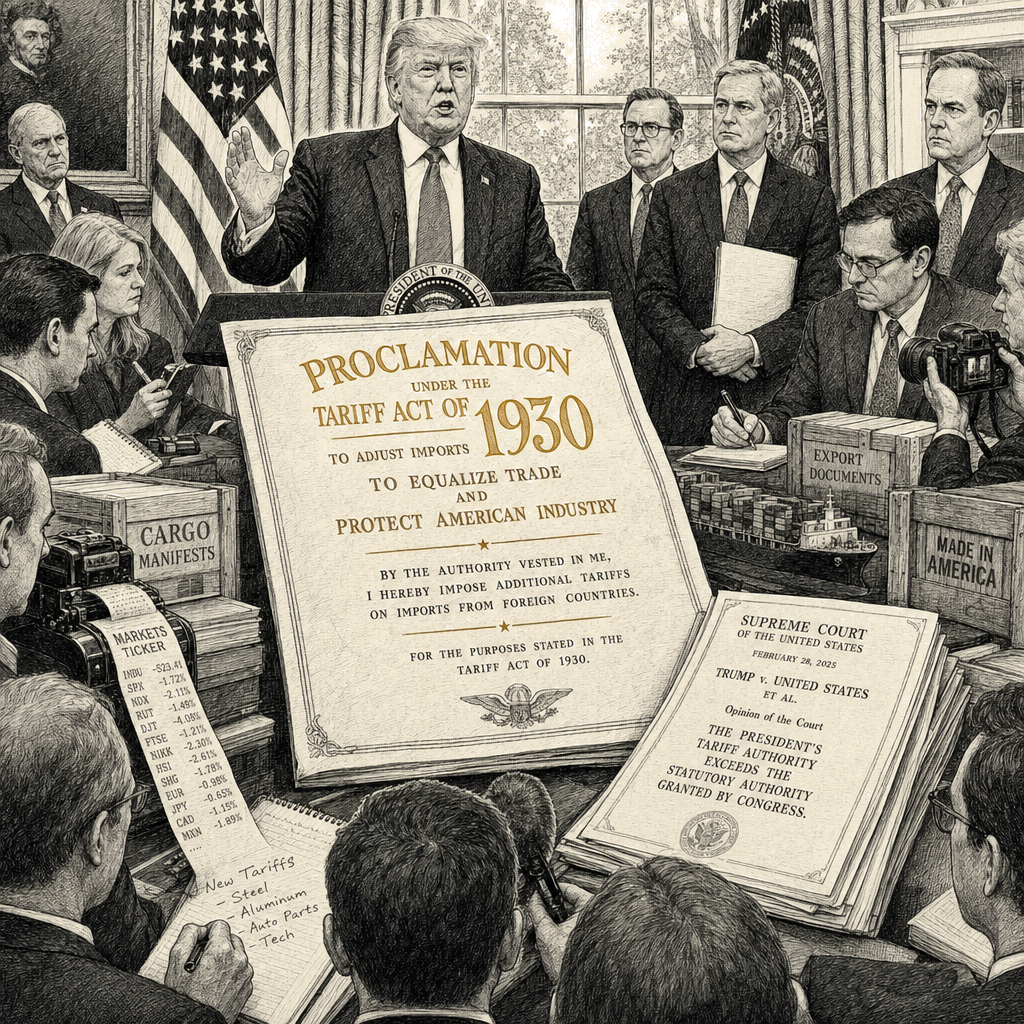
Trump exploited the Supreme Court’s IEEPA ruling to seize tariff power Congress never gave him.
In February, the Court struck down the administration’s use of the International Emergency Economic Powers Act to impose tariffs, holding that Congress had not explicitly delegated that authority. The reasoning was textually precise: IEEPA never mentioned tariffs; the Court would not read ambiguity as a blank check. Constitutionalists celebrated. Markets breathed. The executive tariff machine, seemingly, had been constrained.
The statute Trump reached for next was designed for something real. Section 338 of the Smoot-Hawley Tariff Act of 1930 authorizes the president to impose retaliatory tariffs on countries that discriminate against American commerce by granting more favorable treatment to goods from other nations. The provision exists because international trade in the decades before the modern multilateral system was rife with bilateral preferential arrangements that shut American exporters out of foreign markets. Section 338 gave the president a targeted tool to restore reciprocity: if France offered Japan lower duties on steel than it offered the United States, the president could match that discrimination with offsetting tariffs to level the playing field. The statute’s logic is the logic of equal treatment. It presupposes an identifiable act of foreign discrimination against U.S. commerce and authorizes a calibrated response designed to end that discrimination and restore competitive neutrality. A working-bar trade lawyer defending Section 338’s invocation would point out that the provision has sat on the books for nearly a century precisely because Congress believed the executive needed a standing tool to combat preferential trade arrangements that multilateral negotiations alone could not resolve. The provision is narrow in purpose and specific in its triggering condition: a foreign country must be giving some other country better trade terms than it gives the United States. A decade ago, when trade lawyer John Veroneau noticed the House trade oversight committee’s 1,400-page compilation of all U.S. trade statutes did not include Section 338 and raised the omission, a committee staffer asked, “Surely this has been repealed?” It had not been repealed because the statute served a legitimate function that no one had cause to invoke often. The rarity of its use was a feature, not evidence of obsolescence.
That is not what is happening. Under the U.S.-Mexico-Canada Agreement—the trade deal Trump himself renegotiated and signed in his first term—Canada already gives the United States preferential access. The triggering condition for Section 338 does not exist. What exists is Canada’s retaliation against tariffs Trump imposed first, using authorities the Court had just struck down. As Veroneau, who served as a trade official under President George W. Bush and is now senior counsel at Covington, observed, Section 338 was designed to achieve equal treatment for all trading partners. Trump’s use of it to punish Canada for retaliating against his own tariffs is, in Veroneau’s words, “ironic if not perverse.” The weapon designed to end discrimination is being aimed at a country that refuses to accept discrimination. Or, as Veroneau put it more precisely: “In effect, he is laying down the principle that discrimination is acceptable as long as it’s the U.S. doing the discriminating.”
The legal theory collapses under its own terms. Section 338 requires that a foreign country discriminate against U.S. commerce. Canada’s retaliatory tariffs respond to Trump’s own tariffs, which were themselves imposed under authorities the Supreme Court found legally unauthorized. The administration is invoking a statute meant to combat foreign discrimination to punish a country for defending itself against the administration’s own unlawful trade actions.
Section 338 is not the only dormant statute the administration has put to work. Trump has imposed 25 percent duties on Brazil, up to 200 percent on generic drugs, and levies of 10 to 12.5 percent across as many as 60 trading partners using a patchwork of decades-old authorities: Section 122, originally aimed at balance-of-payments problems from a fixed exchange-rate system that ended more than 50 years ago, now provides a universal 10 percent floor tariff; Section 232, designed to protect industries vital to national security, now covers lumber and generic drugs; Section 301, built to counter Chinese industrial subsidies, penalizes countries that fail to police their own imports for forced labor. None of these statutes was written for the post-IEEPA world. All of them hand the president an independent lever.
Evercore ISI estimates the new tariff regime will generate $240 billion to $260 billion annually—about 20 percent below what the struck-down IEEPA authority could have collected but roughly triple the pre-Trump tariff level. The math tells a story the Court’s opinion did not reckon with: the ruling imposed a friction cost. It did not impose a limit.
Sarah Bianchi, a former Biden administration trade official now at Evercore ISI, captured the situation with understated precision: Section 338 “is possibly the new IEEPA.” The logic is airtight: if the executive can invoke Section 338 to punish countries that maintain trade agreements already favorable to the United States, there is no principled boundary on the power. Every trading relationship becomes subject to presidential revision at will.
Congress, meanwhile, is not restoring its authority. It is expanding the president’s. The bill gaining support in the Senate—the one championed by the late Senator Lindsey Graham that would impose steep tariffs on Russia for invading Ukraine—has been weakened at Trump’s direction to allow presidential waivers. Peter Harrell, a former Biden adviser on trade and sanctions, identified the mechanism: “If he does not seem interested in putting pressure on Russia, but does seem interested in this bill, what would his interest be? The tariffs.” Senator Ron Wyden told the Senate Finance Committee on Wednesday that “it’s well past time to put Congress back in the driver’s seat on trade.” The bill does the opposite.
This is the structural lesson the Court’s February opinion failed to reckon with. The nondelegation problem is not a single statute. It is a body of trade law—over 1,400 pages of statutes accumulated across a century—that gives the executive dozens of independent authorities, each carrying its own delegation logic, each untethered to the others. The Court struck IEEPA tariff power because the statute did not explicitly authorize tariffs. Section 338 does. So does Section 232. So does Section 301. Each invocation survives the February ruling’s reasoning precisely because each carries its own express authorization. The Court’s opinion addressed the symptom in one patient while the disease metastasized across the trade statute library it never examined.
The consequence is a tariff regime that will be harder to dismantle than any single emergency tariff, because it rests on no single statute and no single legal theory. It rests on the accumulated legislative history of a century’s worth of trade laws—many enacted for purposes that have nothing to do with how they are now being used—on a Congress that is writing the president new authority instead of reclaiming its own, and on a Court that cannot strike them all at once. Trade policy, by this path, does not return to Congress. It disappears into a constitutional fog where every statute is technically authorized and none was meant to be used this way.