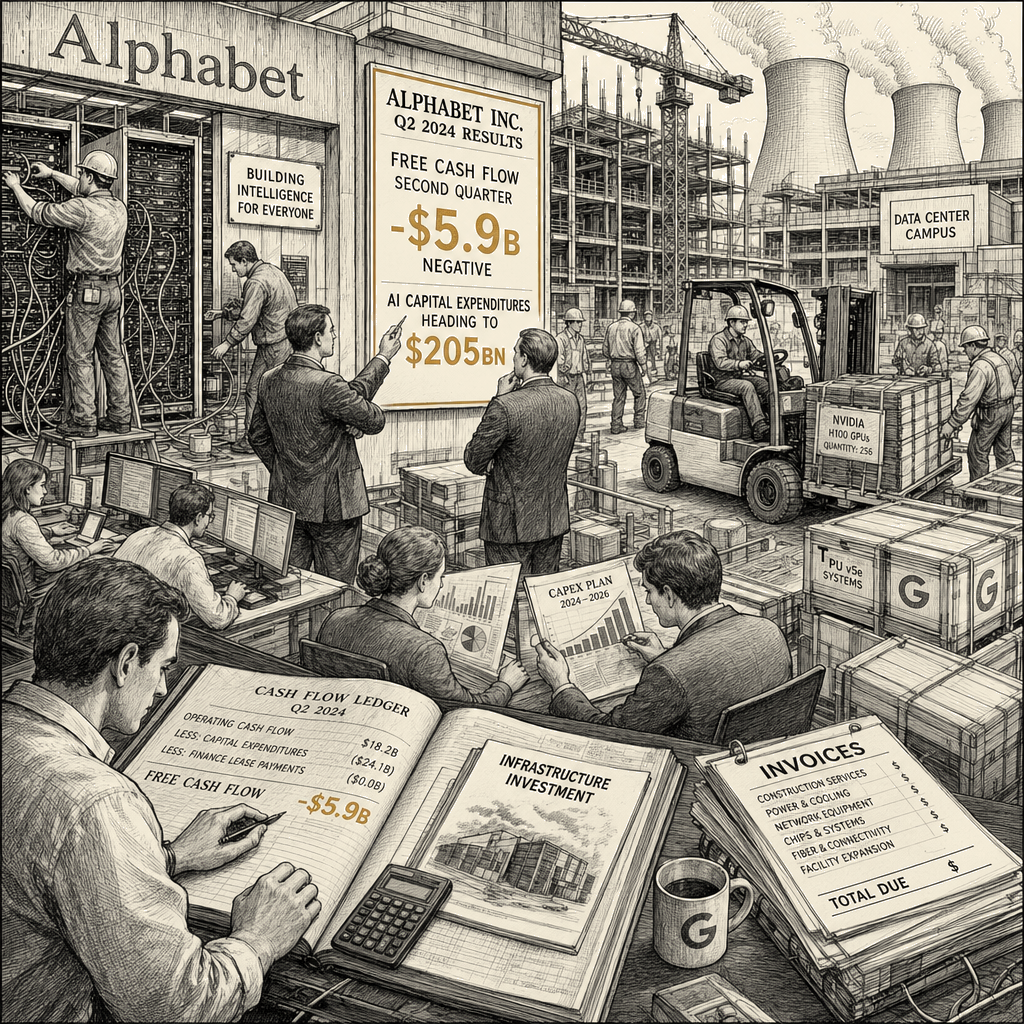
Google just spent $45 billion in a single quarter on a future that was never meant to include you, and even Wall Street is starting to wonder if anyone thought about what gets left behind. The BBC reported Tuesday that Alphabet’s free cash flow — the money left after paying the bills and making the big bets — fell to negative $5.9 billion, the first time in at least a decade that its spending outpaced every dollar it brought in. The company says it will pour as much as $205 billion into artificial-intelligence infrastructure this year, up from $190 billion, because “the demand still outpaces that investment.” Tesla, not to be outdone, doubled its own capital-spending target to $25 billion and also tipped into negative free cash flow for the first time in two years; its CFO added that spending “would probably increase further over the next three years.” The rush is on to build the digital railroad, and the men in the counting houses are starting to get twitchy.
I know this story. I was raised on it. Local histories say the Chicago & North Western spent millions in the early 1900s to lay a freight line across central Wisconsin that bypassed every town larger than a thousand souls. The surveyors drew the route a mile south of Friendship, the county seat where I live, and when the town fathers asked for a spur into the village, the railroad’s vice president said no. He promised a siding near Arkdale instead. A century later, the yard that once hummed with crews and roundhouses is a ghost, the last passenger train rolled through in 1963, and the paper mill that employed a thousand men in Wisconsin Rapids idled in 2020. The railroad didn’t stop here; it just moved the goods past us faster. Now the same logic is being written in server racks and fiber optic cables, and the sums are so colossal they’re hard to look at directly — Alphabet’s quarterly spending on those servers alone leaped from $36 billion to $45 billion in three months, with 60 percent of the cash going straight into the machines that will run the algorithms.
Let me grant the strongest version of the other side. Artificial intelligence may one day decode proteins faster than a team of biologists, diagnose cancers earlier than a radiologist, or make every worker so productive that the whole economy lifts. I am not a Luddite; I traded agricultural futures, and I know that a tool that can read the weather and the market better than I can might genuinely help a farmer in Adams County. The claim is not unserious. But that claim is not the one being sold to the markets, and it is not the one being funded by the debt and equity this spending requires.
The spending that is actually happening is the single greatest concentration of capital in a handful of firms since the transcontinental railroad, and it is being routed through exactly the same financial machinery. Wall Street has been funnelling record capital to the AI build-out for months, and Alphabet itself raised $80 billion in equity in June to keep the machines coming. This is not the patient accumulation of savings by a family farm; this is the fevered issuance of paper claims on a future that has not yet earned a dime, by men who will not be liable when the bubble pops. It is the old story: gather the capital from every corner, spend it on infrastructure that centralizes power, and call it progress. The rentier always builds the toll road before he tells you what the toll will be.
What is being hollowed out this time is not just a county but the very idea that the future should be built in many places by many hands. Google’s CFO told analysts that “as long as we see these attractive opportunities to invest, we will continue to invest,” which is a bloodless way of saying that the decision about what kind of economy your children will inherit is being made in a quarterly budget meeting in Mountain View, not in a co-op hall or a parish council or a town-hall meeting. The spending is on servers and data centers, which are to the twenty-first century what the rail yard was to the nineteenth: the choke point. If you do not own the switch, you do not decide where the train stops. The half of the county’s housing that is now seasonal vacation homes and the Sand Valley golf resort that has become, for many in Adams County, the best shot at a steady wage are already monuments to an economy that decided the locals would serve the visitors. An AI built by a few firms on the coasts will complete that logic, leaving the rest of us as consumers of the algorithm rather than builders of our own lives.
A conservative who actually conserved something would see this for what it is: the curse of bigness, in Brandeis’s phrase, applied to the control of knowledge itself. The mediating institutions that once gave a town a say — the co-op, the credit union, the parish, the weekly newspaper — are precisely the things that cannot match a $205 billion budget item. They do not show up in the spreadsheet, and so they are treated as irrelevant, until they are gone. The universal destination of goods, that ancient Catholic principle that the earth was given for all and that property answers to a higher purpose, has something to say here too: the infrastructure of the future is a common inheritance, not a private toll road. It should be built and owned by the people who will live with it, not by a handful of corporations that answer to no one in the county.
We have done this before, and we have done it better. When rural America was dark and the for-profit utilities said it wasn’t worth their while to string wire, we didn’t wait for a monopoly. We passed the Rural Electrification Act and put the money into member-owned cooperatives, and by 1950 close to ninety percent of farms had electricity. That was a genuine investment, one that distributed power instead of centralizing it. The government seeded the capital, but the cooperatives — local farmers, not Washington — ran the board and decided where the lines would go. The same logic can be applied to the digital future: community-owned broadband networks, open-source AI models governed by a trust, data trusts that belong to the people who generate the data. The alternative to a $205 billion gamble on leaving Main Street behind is not a centralized state solution; it is a thousand local bets, each one owned by the people whose lives it will change.
The railroad missed Friendship, and the county spent a century paying for it. The AI railroad is being laid as I write this, and the decision about whether it stops in your town is being made now. “The future” is not a thing that happens to you. It is a thing you build with your neighbors, or it is a thing that is built for you, and the bill always comes due.