
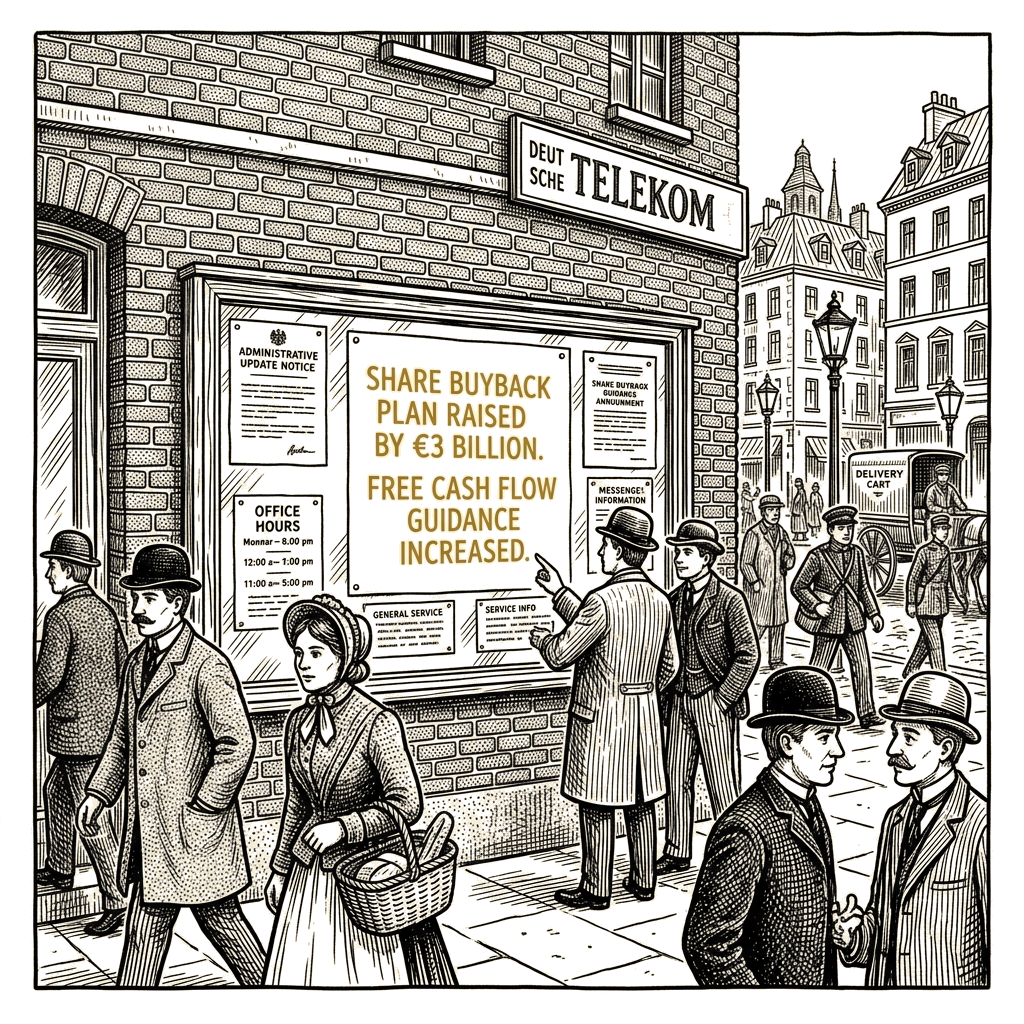
Deutsche Telekom is treating a €5 billion share buyback as the natural reward for strong results, but a telephone company exists to connect places and people, not to turn common dependence into a private cash machine. As Najat Kantouar reported for Dow Jones Newswires and The Wall Street Journal, the company said it would raise its full-year share-buyback plan from €2 billion to as much as €5 billion while lifting its free-cash-flow-after-leases guidance to around €20 billion; second-quarter revenue rose to €29.93 billion from €28.67 billion, and adjusted EBITDA after leases increased to €11.82 billion from €11 billion. The numbers are healthy. The choice is not.
There is an honest argument for the buyback. A mature company that has paid its bills, maintained its network, invested what it needs to invest, and found no better productive use for excess cash can return money to its owners. Shareholders supplied capital. They bear risk. A business is not a charitable trust, and a board should not hoard cash merely to make itself feel virtuous. A repurchase can be more disciplined than an acquisition made to satisfy an executive’s appetite for empire.
But Deutsche Telekom’s own figures do not show a triumph so much as a choice about what profit is for. Net profit fell to €2.45 billion from €2.615 billion. The higher cash guidance was driven mainly by revised expectations at T-Mobile US, which itself reflected higher-than-expected net cash. The group still expects adjusted EBITDA after leases of around €47.5 billion and adjusted earnings per share of about €2.20. Domestic revenue rose 3.5 percent to €6.51 billion, helped by the FIFA World Cup; revenue in the United States rose 5.2 percent and revenue in Europe rose 1.5 percent; service revenue increased 4.8 percent.
Those are healthy numbers. They are not an absolution.
The question is not whether shareholders may receive a return. The question is what ownership means when the firm controls infrastructure that families, hospitals, farms, schools and small businesses cannot simply do without. A telephone network is not a barrel of decorative wine kept in a cellar until its owner feels like opening it. It is part of the material framework through which a society conducts ordinary life: families work through it, businesses trade through it, schools teach through it, and communities remain connected through it.
Its value was not created by shareholders alone. It was made by engineers and technicians, customers and public rights-of-way, spectrum allocations and accumulated knowledge, generations of investment and the ordinary trust that lets people believe the connection will work when they need it. The earth was given for all. Every productive enterprise carries a social mortgage.
The modern corporate creed takes a useful truth — capital must earn a return — and stops one sentence before the obligation begins. It treats the firm as a machine for converting productive capacity into a higher share price. The town, the workers, the long horizon and the user disappear behind the ticker.
I know the grammar of that disappearance. Agricultural futures let a trader claim the crop before the farmer had planted it. The paper claim could move faster than the field, and the financial world could congratulate itself on mastering agriculture while knowing very little about the people who grew anything. Buybacks apply the same abstraction to the company itself. Cash that might harden the network against the next storm, train a generation of technicians, wire villages that will never meet a quarterly target, improve resilience or lower the burden on customers is converted into a signal for the market: the share price comes first.
That is financialization — not finance serving production, but production reorganized to serve the financial claim. A network is an asset. A technician is a cost. A long-term investment is a drag on earnings. A buyback is “capital discipline.” The words are clean because the people and places have been removed from the sentence.
The figures do not by themselves prove that the network will be starved. The announcement does not oblige the company to forgo a single new investment. That is exactly the point. The buyback is a governance choice that ranks a distribution to shareholders above any additional reinvestment in the institution. The absence of an announced cut is not reassurance. It is the tell.
The same logic appeared in the earlier account of T-Mobile US’s rising postpaid revenue: strong operating results become a reason to ask what the financial machinery can extract next. There is nothing wrong with a business earning money. There is something wrong with treating the business as a machine for converting durable productive capacity into a faster payment to people who may never set foot inside it. Growth in subscribers and service revenue is not the same thing as a healthy civic economy. The harder questions are whether the network remains reliable, whether workers retain a voice, whether customers have meaningful alternatives, and whether the institution is being renewed rather than harvested.
Conservatism once understood that an institution is an inheritance. Edmund Burke called society “a partnership between those who are living, those who are dead, and those who are to be born.” A telecommunications network is not a medieval parish, but the principle still applies. The old conservative objection to speculative finance was not that profit was sinful. It was that ownership carried duties, and that a business severed from its place would eventually consume the institution that made its profits possible.
Property is real. It is not absolute. A company can be legally owned by shareholders while remaining morally answerable to the people whose lives depend on it. The financial claim does not erase the claims of the workers who maintain the network, the customers who make it valuable, or the communities whose public order and common inheritance made its operation possible.
That does not mean placing Deutsche Telekom under some distant ministry and calling the arrangement liberation. Concentrated capital and concentrated state power are the same disease in two coats. A bureaucracy in Berlin will not know a village network’s needs better merely because it carries a government seal. The corporation should not be allowed to privatize a common dependence, but the cure is not to put every local decision under a national empire.
Subsidiarity means that authority belongs as near as possible to the people who possess the knowledge and bear the consequence.
A better model is already familiar in the cooperative tradition: member-owned telecommunications cooperatives, municipal or regional open-access networks, credit unions financing rural build-outs, and worker or customer representation strong enough to make long-term investment part of the firm’s constitutional purpose. When the owners are the customers and the board is elected by them, the incentive of the institution is bound to reliability, affordability and renewal rather than to a share price that rises when cash is returned.
Rural electric cooperatives reached places investor-owned utilities considered too thinly populated to serve. The Rural Electrification Act of 1936 helped route public credit through member-owned institutions rather than simply handing rural America to absentee capital. Adams-Columbia Electric Cooperative, headquartered in Friendship, is owned by its members and governed by a board elected by them. That is not a nostalgic ornament. It is a working institutional answer: public authority can establish a floor while ownership and operation remain distributed among people who must live with the result.
Telecommunications can be organized with the same discipline: member-owned broadband cooperatives, municipal partnerships with accountable local governance, credit-union financing, worker representation, and interoperability rules that let customers leave without abandoning their number, equipment or community. Public authority can protect universal service and the commons while leaving operation distributed among answerable institutions. No single board in Bonn, no federal bureau in Washington, and no shareholder register in New York needs to own the whole future.
Cooperatives are harder. They must raise capital without surrendering control, govern members who disagree, resist managerial drift and accept that not every good investment pays back by the next quarter. They must endure the slow work of trust. Difficulty is not evidence of failure. It is the price of keeping an enterprise answerable to the people who depend on it.
Deutsche Telekom can buy €5 billion of its own stock. It cannot buy back the years of local knowledge lost when investment becomes spreadsheet residue, or the trust forfeited when a network is treated as a claim before it is treated as a common service. Conservatism once meant conserving the institution before consuming its surplus.
Conserve what, exactly?
Conserve the network by giving its users, workers and communities a durable share in its governance. Let capital serve the institution, and let the institution remain in the hands of people who must live with what it becomes. That is slower than a buyback. It is also how ownership becomes stewardship again.
The cash may return quickly. The covenant, once neglected, takes much longer to restore.