
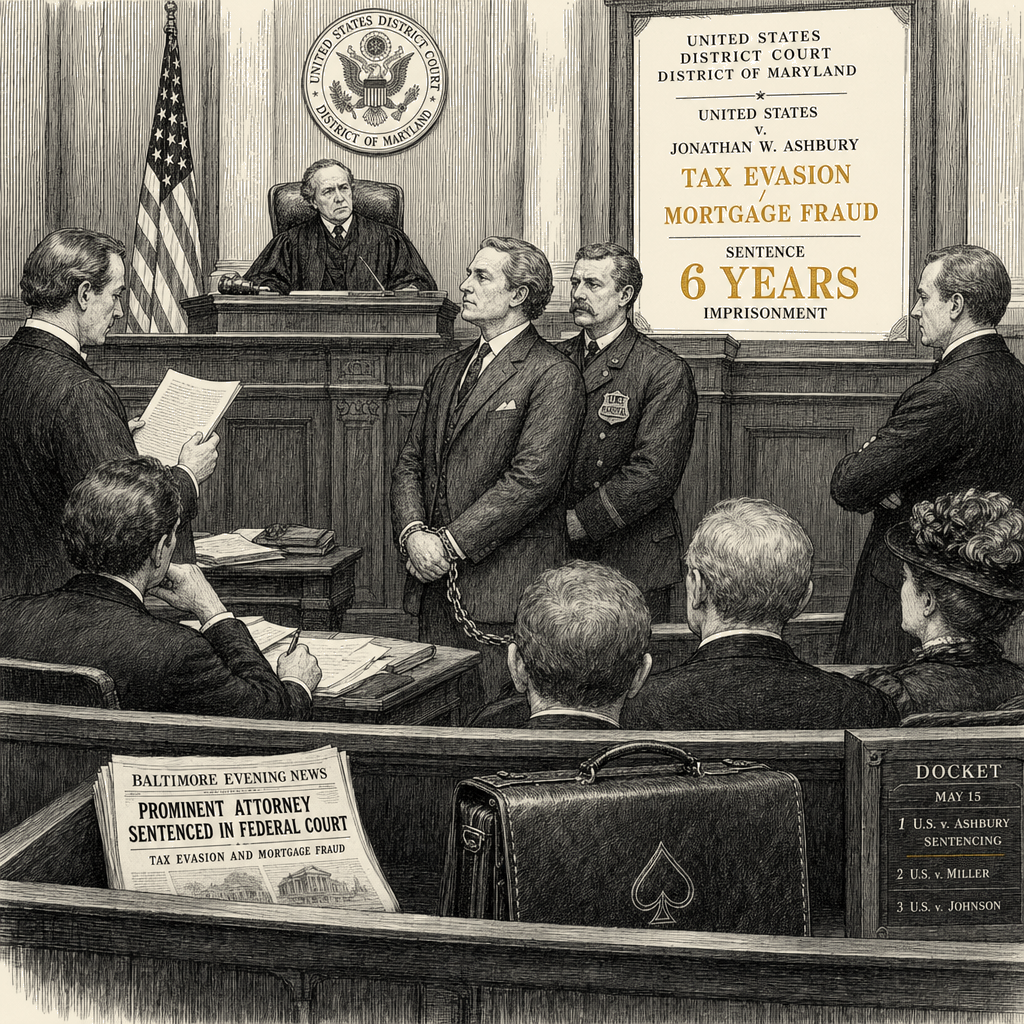
Thomas Goldstein spent a career telling judges that the law applies to everyone the same. A jury spent six weeks finding out it didn’t apply to him at all.
Goldstein, a Supreme Court litigator and SCOTUSblog co-founder, was sentenced Friday to six years in prison for tax evasion and mortgage fraud — convicted on 12 of 16 charges, including funneling roughly $50 million in poker winnings through offshore bank accounts, shaving millions off his true law-firm income, and lying to lenders about his debts. Prosecutors called his motive “pure, unrelenting greed” and asked for eight years. The judge split the difference — six, not eight — and that downward deviation is the real metric of privilege. He drove a Bentley, wore a $200,000 watch, and took globe-trotting vacations while the money that funded them was, in the government’s words, unreported. The judge noted his “serious and concerning” conduct, then also noted his mentoring and charitable work. The blog, she said, “has really reshaped our legal community.” Six years, and the word “groundbreaking” in the same sentencing.
This is the two-tier justice system wearing a good suit and arguing before the high court.
The pattern is not complicated, and it is not new. The wealthy hire professionals who know where the reporting obligations end and the hiding begins. Offshore accounts, underreported income, fraudulent loan applications — these are not exotic instruments; they are the ordinary machinery of tax evasion by people who understand tax law for a living. Goldstein was a specialist in appellate advocacy, a man who could parse the procedural intricacies of Supreme Court practice. He knew the rules. He chose which ones to follow.
The IRS recovered $933 million for wage-theft victims in 2012 — nearly three times the total stolen in all robberies that year. That was a decade and a half of budget cuts ago. But the agency that prosecutes low-income workers for shoplifting or minor tax errors is not the same agency that pursues a Supreme Court litigator hiding $50 million in poker winnings through offshore accounts. The enforcement asymmetry is structural: the IRS has audited low-income EITC recipients at higher rates than the wealthy, the agency’s budget has been cut for decades, and the institutional capacity to pursue complex high-income cases is a fraction of what it would need to be. When the case does reach a jury — when the odds are overcome and the tax lawyer is convicted — the sentence is six years, and the defense argues that probation and restitution would suffice.
Goldstein told the judge he was “going to be punished” and that his life, family, and career were already destroyed. The defense team cited a “severe and longstanding gambling addiction.” A gambling addiction explains losing a few million at the table. It does not explain wiring winnings to the Caymans. Prosecutors alleged $50 million in poker winnings in 2016 alone; Goldstein estimated he lost $10 million over time. The gap between the two figures is the accounting of someone who lived on a scale most people cannot imagine and was caught only when the accounts stopped adding up.
The record is a pattern, not a story. Every decade produces a high-profile lawyer, financier, or executive who used the same playbook — offshore accounts, underreported income, fraudulent loans — and who was caught, convicted, and sentenced to a term that would be three times longer for a less-connected defendant. Leona Helmsley was convicted on 33 felony counts of tax evasion in 1989; the court heard her housekeeper testify that “we don’t pay taxes; only the little people pay taxes.” The ProPublica “Secret IRS Files” published in 2021 showed 25 of the richest Americans paid a true tax rate of 3.4% over four years. Warren Buffett paid 0.1%. Jeff Bezos paid $0 in 2007 and 2011. The figures are not contested; they are the record. And every one of them is a person who could afford the accountants, the lawyers, and the offshore accounts to make it happen — and who did.
Goldstein’s defense argued his work contributed to the public good because he advocated for “people and parties who had little access to Supreme Court practitioners.” The blog raised “public awareness” of the high court. That is the defense for a man convicted of hiding $50 million in poker winnings: that he also did some good work on the side. The question is not whether his work had value — it did. The question is whether the value of that work is a credit against the scale of the fraud, and whether the same credit would be available to a defendant without a Supreme Court practice and a legal blog.
The sentencing judge called his conduct “serious and concerning.” The defense called it a gambling addiction. Prosecutors called it “pure, unrelenting greed.” The jury — twelve people who watched him take the stand and testify that he “disliked handling tax and other financial matters” — called it guilty on 12 of 16 counts. The man who argued 40 cases before the Supreme Court, who co-founded a publication that reshaped legal discourse, who could name the procedural steps of an appellate case in his sleep — that man did not understand that poker winnings needed to be reported to the IRS. He disliked handling financial matters, he said. The accountants, he said. The office managers, he said.
Six years. The same system that prosecutes a teenager for shoplifting $40 worth of baby formula gives a Supreme Court lawyer six years for hiding $50 million. The same system that charges a working-class person with tax evasion and imposes penalties that dwarf the original amount gives a man who drove a Bentley and wore a $200,000 watch a sentence that will be over before the decade is out.
Again.