
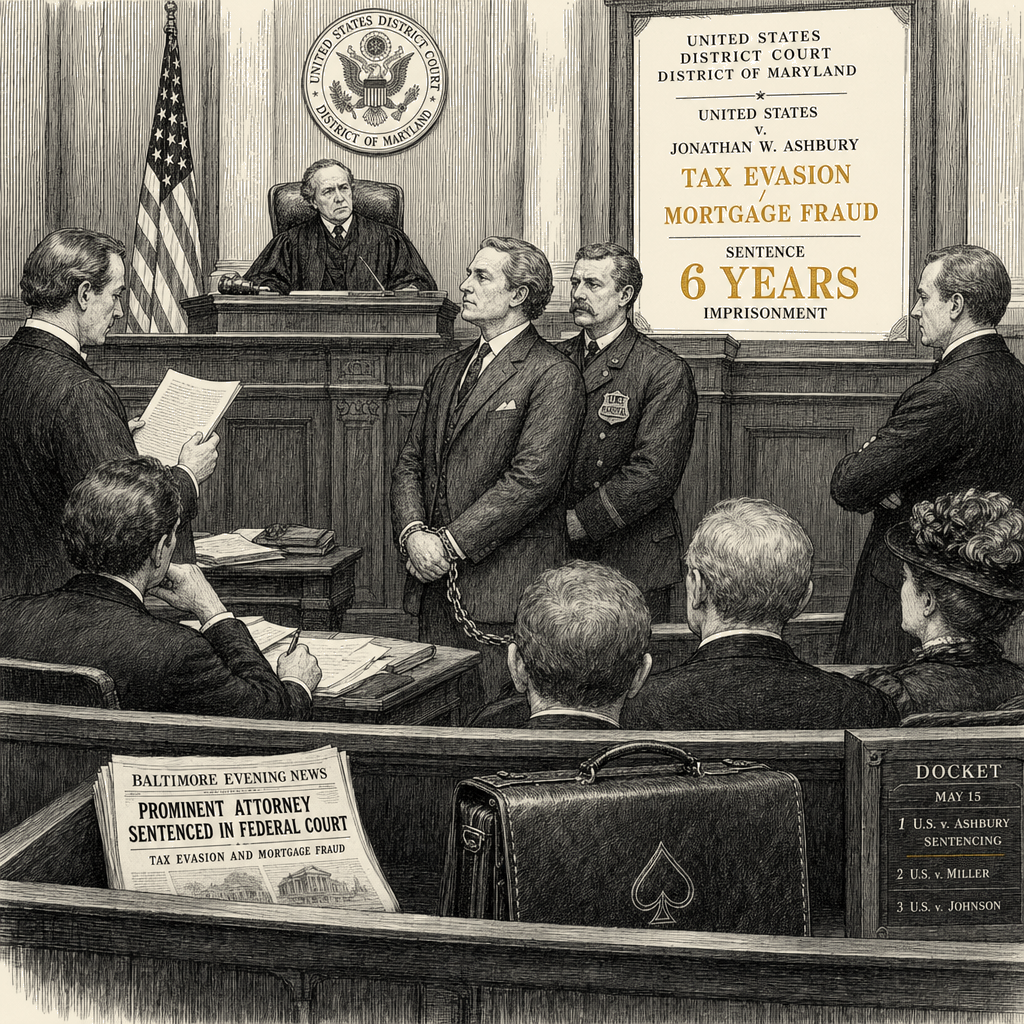
Thomas Goldstein committed tax fraud as a Supreme Court lawyer.
Goldstein, 56, was convicted in February on twelve of sixteen counts — tax evasion, willful failure to pay taxes, lying to mortgage lenders — following a six-week federal trial in Greenbelt, Maryland, that prosecutors used to lay out what they called a textbook scheme: millions in poker winnings funneled through offshore bank accounts, millions more shaved off law firm income, lies to mortgage lenders about debts. On Friday, U.S. District Judge Lydia Kay Griggsby sentenced him to six years in prison.
The prosecution’s accounting was detailed. Prosecutors alleged Goldstein earned roughly fifty million dollars in poker winnings in 2016 alone. “His motivation was singular: pure, unrelenting greed,” they wrote in a sentencing memorandum, citing Bentleys, a two-hundred-thousand-dollar watch, and globe-trotting vacations. Goldstein disputed the case. He took the stand in his own defense — a gamble most defense attorneys would advise against — and attributed his intensified gambling to a pulmonary embolism that nearly killed him. He estimated he ultimately lost about ten million dollars net. The jury rejected his account.
The career those convictions shadow was genuinely distinguished. Goldstein argued more than forty cases before the Supreme Court without the Ivy League degrees and prestigious clerkships that ordinarily buy entry to the appellate bar. He co-founded SCOTUSblog, which became one of the legal community’s most closely followed sources of Court analysis. Judge Griggsby called it “groundbreaking” and said it had “really reshaped our legal community and how we talk about the law.” His practice reached clients who, as his defense team noted, “had little access to Supreme Court practitioners” — plaintiffs’ lawyers, state and local governments, parties outside the corridors where the appellate elite normally trades referrals. Those contributions were real.
The complaint-driven disciplinary model that governed Goldstein’s practice was built on defensible premises. It protects client confidentiality — a lawyer representing a client in a sensitive matter should not face professional review of the client’s financial affairs absent a complaint by that client or a court referral. It limits institutional overreach — a disciplinary body that could audit any practitioner’s finances without a triggering event would produce a profession governed by surveillance, not professional autonomy. For the vast majority of practitioners, those premises hold. The system resolves hundreds of cases per year, most involving clear misconduct identified through client complaints or court referrals. The Goldstein case tests those premises against a different reality: a practitioner whose clients are sophisticated, whose public record appears distinguished, and whose prominence itself functions as a barrier to the very scrutiny the system exists to provide.
The verdict documents something the profession has not yet addressed: the accountability gap at the top of the bar. No professional body reviewed Goldstein’s financial conduct until prosecutors built a criminal case — the bar’s oversight triggered nothing. The financial crimes Goldstein was convicted of involved bank transfers, tax filings, mortgage records — documented, auditable conduct. The question is not how he hid it but why the profession that elevated him had no mechanism for finding it.
The answer is structural. The appellate bar operates on reputation. That is how Goldstein built his practice from scratch — SCOTUSblog made his name, and his name opened doors the credentialing pipeline normally guards. The same reputational logic that elevated him also served as his guarantee against professional scrutiny. State bar disciplinary systems, in most jurisdictions, are complaint-driven: they respond to client complaints or court referrals and examine nothing absent those triggers. For the elite practitioner, whose clients are sophisticated and whose public record appears distinguished, the system produces exactly the result the Goldstein case illustrates. The financial conduct runs until federal prosecutors — operating entirely outside the profession’s self-regulatory apparatus — force the matter into view.
This is not unique to Goldstein. The pattern holds across the profession: the more prominent the practitioner, the less scrutiny the bar applies, because prominence itself functions as evidence of integrity. The Goldstein case adds scale and specificity — fifty million dollars in alleged poker winnings, offshore accounts, a mortgage-fraud scheme — alongside one of the most recognized names in Supreme Court practice.
Goldstein told Judge Griggsby at sentencing that he had “put myself in a position where a jury could find me guilty of a crime.” That framing — a position, not an act — captures the profession’s reflex to narrate its exposures as misfortune rather than as structural failure. The jury examined the financial record the bar never audited and rendered its verdict. The profession that made Goldstein a star has not yet examined what the verdict reveals about a self-regulatory model that detects fraud only when federal prosecutors arrive from outside.