The conservative movement that once existed to limit the state has spent sixty-five years learning to love the very thing it swore to resist — and the education began with a pilgrimage to a dead king’s tomb. In Daniel J. Flynn’s Walking in Brent Bozell’s Footsteps in El Escorial, he traces how National Review senior editor Brent Bozell Jr. — Barry Goldwater’s ghostwriter, the man who put the case for freedom and limited government into the most consequential conservative book of its era — traveled to Francisco Franco’s Spain in 1961, stood inside Philip II’s Royal Monastery of San Lorenzo de El Escorial, and came back a different man. Flynn tells the story honestly, as history. He does not quite say what the history means.
I will grant Flynn this much: Bozell’s hunger was real. The anticommunist right needed something to be for, not merely against, and the grandeur of El Escorial — the golden pages of the library turned outward for preservation, the Gregorian chant of Augustinian monks, the Pantheon of Kings — offered an answer that no policy paper could. Philip II built that monastery to house the Counterreformation, and Bozell stood inside it and felt the weight of a civilization that knew what it believed. A man searching for roots in a rootless age could do worse than stand in a place where faith had been taken seriously for five centuries. That is not nothing.
But what Bozell found in El Escorial was not faith. It was Christendom — the very thing Søren Kierkegaard spent his final years assaulting as the death of genuine Christianity. A nation cannot be Christian. Only a person can, and only with difficulty. The Augustinian monks chanting in that monastery were practicing a freely chosen discipline of the soul. What Bozell came home wanting was a government that would impose that discipline on everyone, whether they chose it or not. He went looking for God at El Escorial and came back carrying a caudillo’s commission.
Flynn documents the transformation without quite naming its weight. Before Spain, none of Bozell’s National Review columns dealt with religion; after, most of them did. The man who wrote The Conscience of a Conservative — a book whose entire argument was that government must be limited because freedom is the precondition of virtue — now regarded “the inculcation of virtue as the purpose of an activist state.” He likened Franco’s censorship to the propaganda of the New York Times, except that the Times suppressed the wrong stories and Franco the right ones. He called Spanish the lingua de casa weeks after arriving. He proposed that three-fifths of National Review’s senior editors relocate to Madrid and run an American magazine from inside a dictatorship. His wife wrote the Meyers that Spain was not a nation but a collection of “violently patriotic towns” — and she meant it as praise.
This is the part Flynn tells with care and the part the movement has never properly reckoned with. Bozell did not drift toward integralism because he was a bad man or a foolish one. He drifted there because the logic was already inside the anticommunist project: if Western Civilization is what we are defending, and if Western Civilization is essentially Christendom, then the state’s purpose is to enforce the Christian order, and limited government is a luxury we cannot afford while the barbarians are at the gate. Philip II understood this. Bozell understood it in his shadow. And now, as Flynn notes almost in passing, Vice President JD Vance cites this post-Spain Bozell as “one of the thinkers that he most admires,” and the integralists and postliberals claim him as their pioneer.
Let me say plainly what Flynn’s history leaves as implication: the impulse to use the state to enforce a moral-religious order was not a deviation from the conservative movement. It was there at the creation. It sat at the senior editors’ table. It went to Spain and came back radicalized, and the movement spent decades keeping it in the back room, and now it sits in the front parlor, and the sitting vice president is paying it compliments, and the movement’s flagship can tell the story as a kind of interesting travelogue without apparent alarm.
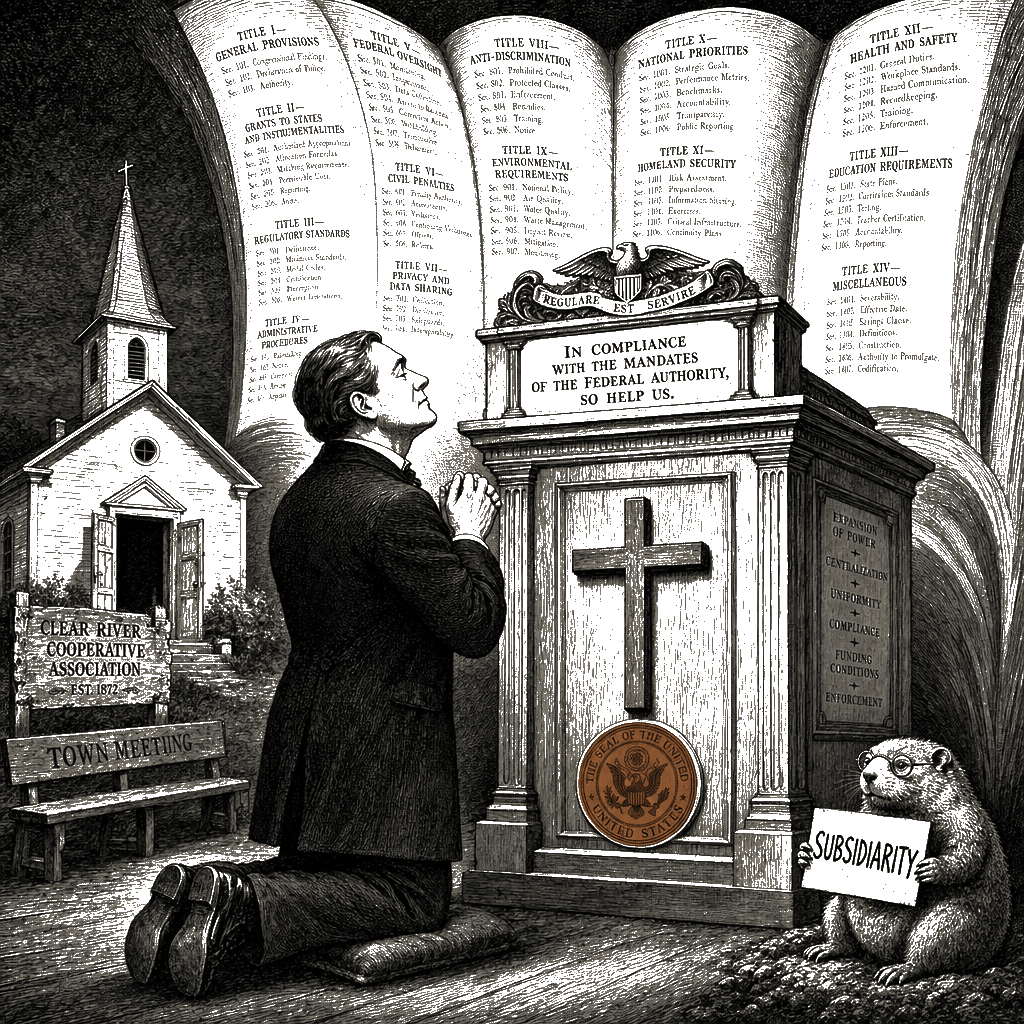
This is not conservatism. It is the betrayal of conservatism — the precise betrayal that a man commits when he trades a town meeting for a throne, and that a movement commits when it makes that man a pioneer. What Bozell abandoned was not abstract. One year before El Escorial, The Conscience of a Conservative defended a particular order of things: the school board in a town like Friendship setting its own curriculum, the parish council running its own affairs, the farmers’ elevator selling on terms its members chose — every rooted institution governing itself because the people who ran it bore the consequences. The conservative tradition I know begins with Edmund Burke’s suspicion of concentrated arbitrary power and with Oakeshott’s preference for the familiar over the designed. It passes through Quadragesimo Anno and the principle of subsidiarity — that higher bodies must not absorb what lower ones can do, that the family and the parish and the town come before the conglomerate and the bureau and the state. It passes through Rerum Novarum and the affirmation that workers have rights prior to market outcomes but that the state has no commission over the soul. The state enforcing virtue violates all of this. It centralizes what belongs to the family, the parish, the conscience — tells the school board in Friendship that Washington knows better, tells the parish council that the bureau has superseded it. It treats the citizen as a ward and God as a bureaucrat.
The men and women in Friendship, Wisconsin — in my parish, at the co-op, in the VFW hall — do not need a government to tell them what is sacred. They know because they chose it, and what they chose has meaning precisely because no one made them. The elderly widow who brings communion to the homebound is practicing her faith in the only way faith can be practiced — freely, at cost, without a subsidy or a mandate. A state that orders the same gesture empties it of the only thing that made it holy. I used to trade the corn before it was planted, and I learned something those men in El Escorial never did: you cannot force a crop. You prepare the ground and you wait. Faith works the same way.
What Bozell found beautiful in El Escorial — the chant, the garden, the golden books — was built by free communities of believers over centuries. What he came home wanting was a state that could produce such things by decree. Those are opposite projects. One is the church; the other is Christendom. Kierkegaard knew the difference. Burke knew it. The encyclicals knew it. The cooperative knows it — the Rochdale Pioneers built something more durable than any caudillo by giving every member one vote and asking nothing of the state but to be left alone.
Flynn’s piece closes on a note of genteel ambiguity — “different iterations of this complex man continue to have an effect on diverse figures, many in conflict, on the political right.” But there is no ambiguity here. The iteration of Bozell that Vance and the integralists celebrate is the iteration that abandoned limited government for the activist state, that abandoned freedom for enforced virtue, that abandoned America for a dictator’s palace and called it pilgrimage. That this can now sit comfortably in National Review without alarm is itself the evidence of how far the slide has gone.
The counter-model is not complicated, and it has been here all along. The cooperative — twenty-eight working men in Rochdale proved it in 1844, and seven dairy families in La Farge, Wisconsin, proved it again in 1988 when they pooled their milk into Organic Valley, which still gives one farmer one vote no matter how many cows they bring. The credit union — St. Mary’s Bank in Manchester, New Hampshire, opened in 1908 so that mill workers could borrow without going to a bank that wanted nothing to do with them, and it operates on the same cooperative principle today. The parish as a free association of believers. The town meeting. The farmers’ elevator. Subsidiarity — the Catholic principle, not the campaign slogan — means that the family raises the child, the parish teaches the faith, the town governs itself, and the state stays out of the sanctuary. Widely distributed property. Widely distributed authority. Widely distributed faith — practiced, not prescribed. The co-op does not need a caudillo. It needs the state to stop selling its neighbors’ institutions to the highest bidder and calling it the free market, and to stop claiming it can deliver salvation and calling it conservatism.
Bozell went to El Escorial and found a golden tomb. The living faith he was looking for was back home — in the small frame church, in the free congregation, in the difficult and unglamorous work of choosing God without anyone making you. That is the conservatism worth conserving. It does not need Philip II. It does not need Franco. It does not need a state large enough to enforce the good. It needs what it always needed: enough modesty to leave the soul alone.