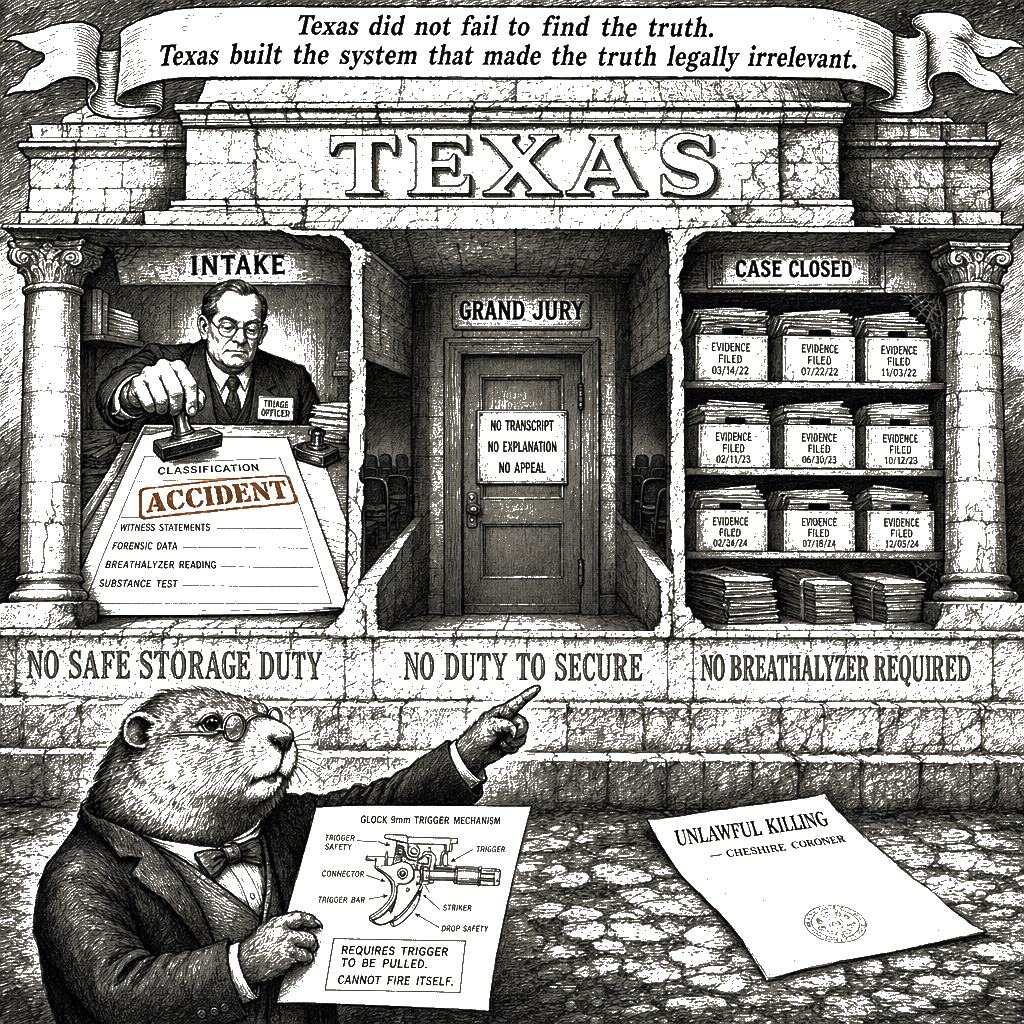
A Glock 9mm cannot fire unless the trigger is pulled. A Texas Ranger told the man who held it. He said, “OK.” The investigation protected him. The legal architecture protected the conditions that killed her.
Lucy Harrison was twenty-three years old. She had graduated with first-class honours from Manchester Metropolitan University, bought a house with her partner Sam Littler, and was due to fly home to England from Texas on 10 January 2025 — the day her father killed her.
Texas built the conditions that allowed an intoxicated man to shoot his daughter with a loaded pistol in his own bedroom, and then it built the legal architecture that protected him from accountability.
The gun was a Glock 9mm semi-automatic pistol. Her father, Kris Harrison, a telecoms executive who had moved from Liverpool to Texas via Saudi Arabia, had purchased it for $500 from a colleague two years earlier. In Texas, gun owners over the age of twenty-one are not required to obtain training or a licence. The state’s only safe-storage rule is a narrow one — it applies only when a child under seventeen gains access to a loaded weapon. There is no duty to secure a firearm from the adults in the household, or from the owner himself. Harrison’s two younger daughters, Lucy’s half-sisters, lived in that house.
Lucy had told friends she was worried about those children being in a home with a loaded pistol. She was vehemently opposed to guns — an issue that caused tension with her father. On the morning of her death, the tension had a specific name. The family argued about sexual-assault allegations against Donald Trump, who was about to start his second term as president. Lucy asked her father how he would feel if she were assaulted and the man got away with it. Harrison replied that it “wouldn’t bother me that much” because his two younger daughters live with him, according to Littler’s testimony at the coroner’s inquest. Lucy ran upstairs in tears.
Later that morning, the family were watching children’s television and preparing to leave for the airport. Harrison took Lucy’s hand and led her to his bedroom. His wife, Heather, looked at Littler in surprise. “He never takes my hand like that,” she joked.
Then the gun discharged.
The dispatcher logged the call as an “accident.” That word was entered into the record before any officer had arrived at the scene, before any witness had been interviewed, before any forensic examination had begun. The investigation that followed was built on that foundation — not on the evidence, but on the predetermined conclusion.
The forensic evidence said something different. The Texas Ranger who investigated the shooting told Harrison, in the man’s own police interview, that “the gun would only discharge if the trigger was pressed.” Harrison said, “OK.” The gun was pointed at Lucy’s chest from across the room when it fired. The trigger was pulled. A bullet entered her body. She died on the floor of her father’s bedroom.
The investigating officer told Jane Coates, Lucy’s mother, in March 2025 that the “muzzle was aligned with Lucy’s chest and a trigger was pulled” — but that they could not conclude Harrison pointed the weapon at his daughter “because that implies intent.” The distinction is structural, and it is load-bearing. A man holding a pistol. The muzzle aligned with his daughter’s chest. The trigger pressed. A bullet fired. His daughter dead on the floor. Texas law draws the line at intent. Everything before the line is, by legal architecture, an accident.
Harrison was never breathalysed. Officers smelled alcohol on his breath. He initially denied drinking that day. He later admitted he had a drinking problem and “keeps it going” — language an officer understood to mean he drinks throughout the day. CCTV showed him buying two 500ml cartons of wine that morning and discarding one of them outside a shop. He later admitted to drinking that morning. His daughter’s body was tested for alcohol and substances — all negative — while the man who held the gun was not tested at all. “That’s what we find absolutely incredulous,” Coates said. The asymmetry is not an oversight. It is the investigation working as designed: the dead woman tested for substances, the living man who killed her left untested. The apparatus protects the shooter. The body is examined for contributory factors.
The case was handed to a Grand Jury in Collin County, Texas. In June 2025, the Grand Jury decided not to indict Kris Harrison. Its reasoning has not been made public. The evidence it considered has not been disclosed. The deliberations are secret. Grand jurors in Texas are drawn randomly from the county’s voter rolls — but once summoned, they sit in a closed room, hear only the evidence the prosecutor chooses to present, and reach a conclusion they are not required to explain. No defense lawyer is present. No transcript is released. A no-bill cannot be appealed. The case is closed. The secrecy is not incidental to the system. The secrecy is the system. A randomly selected body, hearing only one side, operating without transparency, reaching a conclusion it does not have to justify — and that conclusion, once reached, closes the door. No arrest. No prosecution. No public accounting of what happened in that bedroom.
This is the architecture. The legal structure of the state of Texas was not designed to determine what happened to Lucy Harrison. It was designed to protect the conditions under which she died.
The conditions are specific. Texas imposes no general safe-storage requirement on gun owners. The state’s narrow child-access law — the only storage rule on the books — applies only when a child under seventeen gains access to a loaded weapon. There is no duty to secure a firearm from the adults in the house, or from the owner himself. The state’s position, written into its statutes and enforced by its courts, is that the right to own a firearm includes the right to leave it loaded and accessible in a home with other adults, and that no legal consequence attaches to what happens when an intoxicated owner discharges that weapon into his daughter’s chest. The apparatus treats the gun as a neutral object and the owner as a responsible agent right up to the moment of the pulling of the trigger — and then, if the owner says he did not mean to, the apparatus treats the trigger-pull as an act of God. The gun cannot fire itself. But Texas law will treat it as though it did. There are two more daughters in that house. The apparatus waits for the next trigger pull.
Eight months later, six thousand miles from Prosper, the senior coroner for Cheshire, Jacqueline Devonish, reviewed the same evidence and reached the opposite conclusion. Firing a pistol at Lucy Harrison from across the room was an act of gross negligence. Her death could not be considered accidental. She was unlawfully killed.
The British coroner sitting in a courtroom in England — looking at the same forensic evidence, the same witness testimony, the same CCTV footage — found what Texas would not. The finding does not carry legal force in the United States. Texas jurisdiction governs what happens in Texas, and no British court can override a Texas Grand Jury. But the finding exists, and it is a record of what an independent judicial officer, examining the same facts, concluded when the Texas legal architecture was removed from the equation. The structural question is no longer whether Kris Harrison killed his daughter. The coroner has answered that. The gun could not fire itself. But the architecture could. Texas did not fail to find the truth. Texas built the system that made the truth legally irrelevant.
The families of those killed by American legal and law-enforcement structures know this machinery from the inside. The mother of a man killed by an ICE agent in Texas has spent sixteen months seeking the accountability the system withholds. The family of Corey Ruiz says he did not deserve what the apparatus did to him. Each family navigates the same machinery: the investigation built to protect the institution, the legal proceeding designed to produce no indictment, the secrecy that forecloses public accountability, the system that wears families down until they have nothing left but the fact of the killing and a government that will not answer for it.
Jane Coates told the Texas Ranger that Harrison must have been pointing the gun at his daughter and pulled the trigger. She said he agreed. “We just can’t prove it,” she said he told her. The Ranger’s candour is, in its way, more damning than the silence that followed. He saw what the evidence showed. The apparatus would not let him say it.
The UK Foreign Office told Coates it could not help because nobody had been prosecuted. The logic is circular, and it is the architecture’s final load-bearing wall: Texas will not prosecute, and Britain cannot intervene because Texas has not prosecuted. The protection is complete. The system absorbs the challenge from every direction and produces the same outcome — silence — regardless of which door is knocked on. Lucy Harrison’s mother knocked on every door. She found the architecture was designed to produce the silence.
Coates is now asking Andy Burnham’s government to press the case with US authorities. Sarah Hall, the Labour MP for Warrington South, says the family did not have “adequate support” and has called on the government to push Texas to re-examine the case. The structural reality is that no British government can compel a Texas Grand Jury to explain itself, and no American institution has an incentive to reopen a case it has already closed. The appeal is an act of faith in a system that has given no evidence it merits it. But the faith is what sustains the family, and the family’s persistence is what produces the public record that the system would prefer did not exist.
The coroner’s finding stands. A pistol was pointed at a twenty-three-year-old woman’s chest. The trigger was pulled. The man holding the gun was drunk. His daughter died on his bedroom floor. The investigating officer said the gun could only fire if the trigger was pressed. The man said, “OK.” The Grand Jury in Collin County, operating behind closed doors, in secret, without explanation, decided this did not warrant prosecution. A British coroner, examining the same evidence, found it was unlawful killing. The architecture is still standing. It is waiting for the next family.