
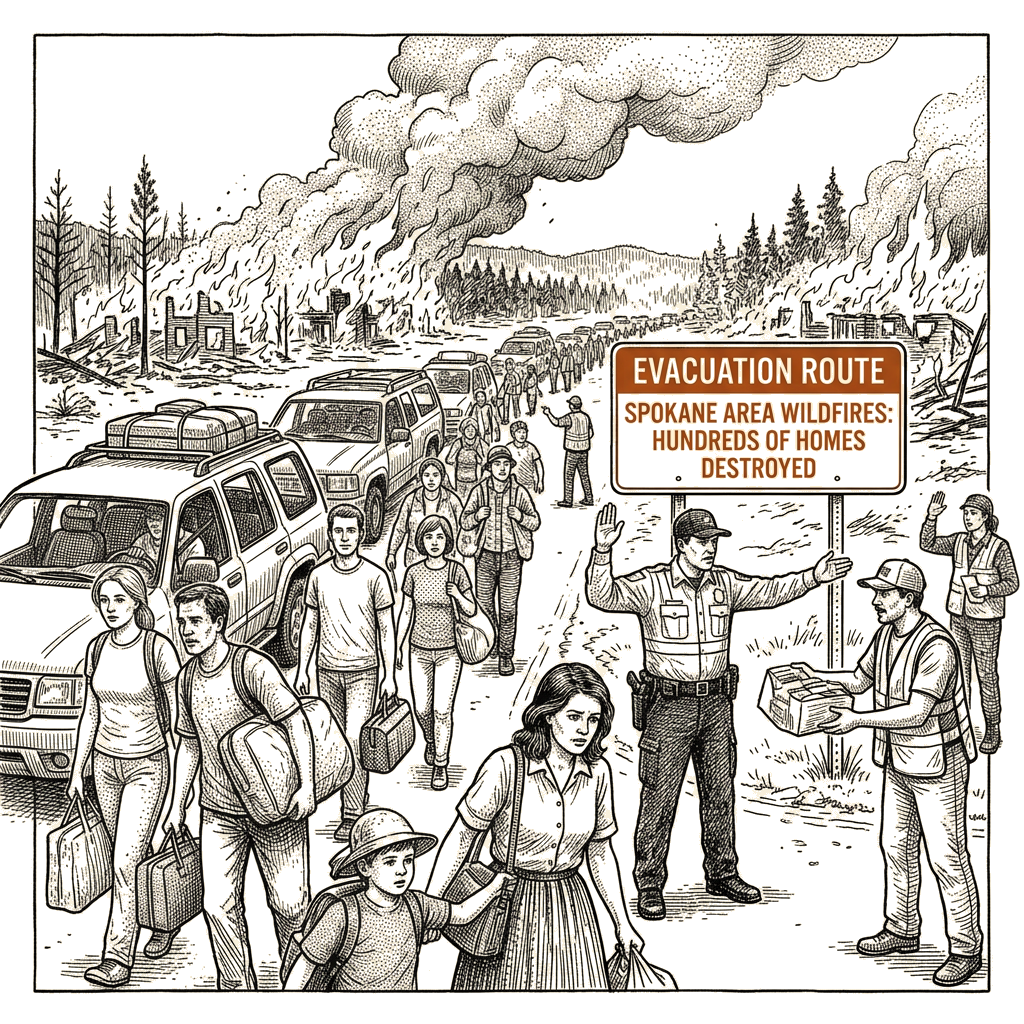
Amy Mulligan was in her backyard in Spokane, Washington, getting ready to host a five-year-old’s birthday party when she smelled smoke. She checked her phone. No alerts. She assumed someone had the fire contained. Minutes later, her brother-in-law arrived with news: a nearby neighbourhood was being evacuated. Neighbours were peeling out, yelling. Smoke was coming over the back of her house. In the car, Mulligan’s nine-year-old daughter began hyperventilating: “The fire’s right there! The fire’s right there.”
I don’t live in Spokane. I live in Adams County, Wisconsin, where the sand-county landscape Leopold described a century ago is the same landscape we walk through now, drier every summer. But the failure those families lived through is not a Spokane problem. It is a civic-infrastructure problem, and it lives here too.
More than 700 homes and buildings were destroyed. The Old Trails fire, the largest of three wildfires burning near Spokane, forced more than 60,000 people to evacuate. A suspect has been arrested on suspicion of arson. Someone may have lit the match. But the failure documented by the people who lived through it is not about the match. It is about what happened after: families had to discover the danger from the danger itself.
James Main told a similar story. “We had no warning,” he said. “Zero warning.” He had thirty minutes between first seeing the fire and realising the situation was getting worse. He froze up. Then he and his wife drove through smoke so thick they could not tell whether they were heading out of a fire or into one.
That is not an abstract communications problem. It is the difference between leaving with time to spare and fleeing while a child watches the flames approach. Mulligan did not need a sophisticated explanation. She needed a warning before her brother-in-law arrived. Main did not need a perfect forecast. He needed enough information to know which road led away from the fire.
Adams County sits on the same kind of rural trap. Our fire district runs on volunteers. We have no countywide siren system. The emergency-alert infrastructure that is supposed to reach every household runs on reverse-911 calls and landlines — a system that works for a shrinking number of residents while most of us have stopped answering unknown numbers. If a fire jumped the Wisconsin River and ran toward the Mead Wildlife Area the way the Old Trails fire jumped the Spokane River, we would depend on the same thin chain of civic institutions that failed those Spokane families. We are forty-five minutes from the nearest hospital with a full emergency department. Our county fire districts rely on mutual aid from neighbouring counties, which works until the neighbouring counties are fighting their own fires.
The notebook I keep tracks what the land is doing. Twelve years of observations: the lake freezing later, the spring coming earlier, the summer drying out sooner. Every one of those observations means the fire season starts earlier and burns hotter. The conditions for a fast-moving fire in Adams County are not hypothetical. They are a trend line I have been writing down.
I am not saying this to frighten people in Adams County. I am saying it because the families in Spokane are telling us something about the gap between the danger and the warning, and that gap exists here too. The warning system that would tell Amy Mulligan to leave her backyard — the one that would tell our neighbours in Friendship to load their kids and go — depends on institutions that are understaffed, underfunded, and built for a slower era. When the fire moves faster than the institutions, the institutions do not matter. What matters is who told you, and when.
Main returned on Sunday and found little left of his house beyond ash and charred tree trunks rising from the smouldering ground. Asked what came next, he answered: “We don’t know.” More than 700 buildings destroyed. The numbers are devastating. They still cannot count what disappears inside a home.
For Mulligan, that loss was her grandmother’s ring. Her grandfather gave it to her grandmother on their forty-ninth wedding anniversary. He died before the fiftieth. Her grandmother believed he knew. Then the grandmother gave the ring to Amy Mulligan. And the ring is gone.
That is what an evacuation total cannot measure, and it is what a failed alert system costs. Not the fire. The silence before the fire — the time when someone could have said, “Go now,” and nobody did. In Spokane, sixty thousand people discovered that silence. Adams County does not need to wait for the fire to learn the same lesson. The lesson is already there: the structures between the first spark and the first family to leave are too thin, too slow, and too dependent on people finding out for themselves.