
Fossil fuel companies burned 2.9 million acres and killed seven firefighters this summer.
I keep a notebook. Twelve years of ice-out dates on Petenwell Lake, deer behavior behind the shop, first-mosquito-of-the-year, and maple-syrup runs getting shorter. The notebook does not predict anything. It writes down what I see from the same forty acres, the same deer stand, the same bench at the back of the shop.
What I see is a county that has shifted. Lake Petenwell went out eleven days earlier than when I started writing it down. The deer are two weeks off from where my father remembers them. The snowmelt left the central Wisconsin rivers early this spring.
What is burning in Washington and Oregon is the same physics, further down the road.
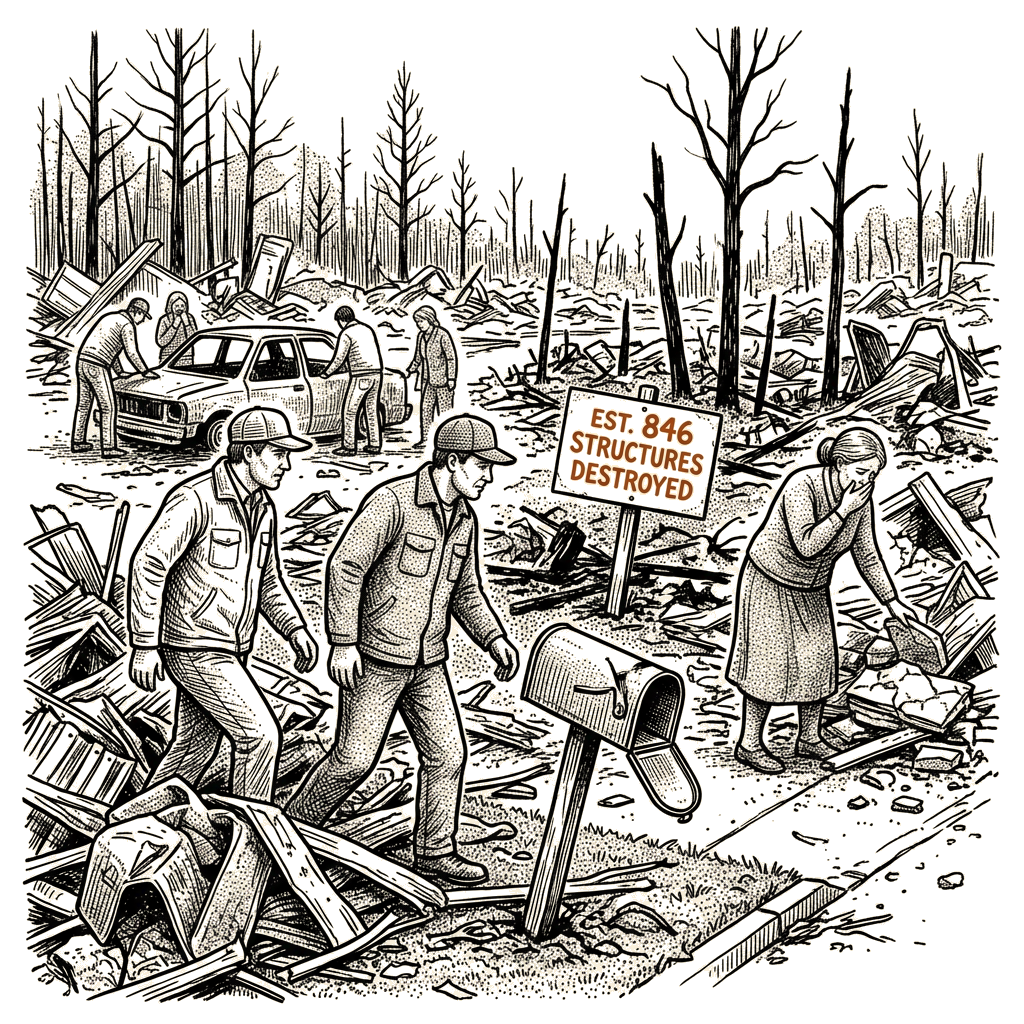
The Old Trails Fire jumped the Spokane River weeks before the scale of the loss became clear. Sixty thousand people were forced out, and hundreds of homes were destroyed. At least 846 structures are gone. Entire neighborhoods in Spokane were scraped down to twisted metal and ash — not a barn on somebody’s back forty, but cul-de-sacs of homes wiped from the map.
Oregon has burned more acreage this year than in any year on record. Washington is having its most destructive fire season. Across the country, more than 6.3 million acres have burned since January. Firefighters have fought more than 45,000 blazes. More than 600 fires erupted in one ten-day stretch in July, and a hundred new fires appeared in a single day.
The national firefighting system has been at Preparedness Level 5, the highest level, since mid-July. Every firefighter and engine is deployed. Some fires will not receive firefighters.
A federal fire captain, speaking anonymously because he was not authorized to speak publicly, told The Guardian: “PL5 means triage — it means some fires aren’t going to get firefighters.” Retired fire chief Bobbie Scopa said suppressing every fire before it spreads would require twice the workforce and three times the budget. Otherwise, she said, “we’re going to kill people trying to put out those last couple per cent.”
Seven wildland firefighters are dead so far this summer.
The ones still out there are being asked to do what no fire service was built to do.
The National Interagency Fire Center’s summer outlook documented the stage. Vegetation across Washington and Oregon cured during a brutally dry July. Large swaths received a quarter of normal rainfall. The fire ecologist at the University of Washington said, “We are living through climate change and it’s accelerating.”
The U.N. climate panel said the same thing in 2021: the warming already seen is human-caused, and the carbon budget for 1.5 degrees is thin. The fires in southwestern France were twice as likely because of greenhouse-gas emissions. The fires in central Spain were twenty times as likely. Those are not poetic warnings. They are measured consequences.
The overwhelming share of those emissions came from burning oil, coal, and gas — the product fossil fuel companies extracted, refined, sold, and defended for forty years while their own scientists told them what would happen. The industry funded an apparatus of manufactured doubt. Naomi Oreskes and Erik Conway traced that strategy from tobacco to climate in Merchants of Doubt: keep uncertainty alive long enough to delay the rules that would cut into profit.
The industry diagnosed the fever in its own laboratories and sold the public uncertainty.
One of the three fires that converged on Spokane may have been set by an arsonist. A man has been taken into custody. That person may be responsible for one ignition. He did not produce the dry July, the altered snowmelt, the cured vegetation, or the wider fire window.
The arsonist lit a match.
The fossil fuel industry built the tinderbox.
The companies that produced the emissions posted profits through the decades that produced the atmosphere. Subsidies kept flowing. Royalties stayed low. Permits kept moving. The firefighting system meant to protect communities from the consequences was never scaled to match the consequences themselves.
Wendell Berry wrote in The Unsettling of America about the extractive mind — the habit of treating land and people as expendable inputs. The atmosphere became a free dump. The forest became fuel. The firefighter became the last line of defense, paid to absorb a cost the companies never paid.
The fossil fuel industry externalized its costs onto the atmosphere. The political system externalized the atmospheric consequence onto a workforce it never funded.
This is the Nationalist Shell Game played to its final account. The people who campaign on energy independence and American communities first spent decades subsidizing the extraction that built the conditions burning American communities down. They sent firefighters to hold a line they never funded, at a preparedness level that means triage, with a workforce a retired chief says needs to be doubled.
Then they called the result a natural disaster.
It is not a natural disaster. It is the bill for decades of fossil fuel extraction arriving on the bodies of working people who will never see a dime of the profit that built the fire.
The fire captain who told the press, “we are trying to save what we can, but we’re just watching houses burn,” is living the Worker Self-Exploitation contradiction in its most literal form. Working people leave their families for months, breathe toxic plumes for weeks, and work the worst fires in the worst conditions. The workforce stays thin because the companies that built the threat paid nothing to match the workforce to it.
The crews bear the cost in their bodies, their months away from home, their injuries, their exhaustion, and seven funerals their families did not plan for.
An El Niño pattern is now developing with a 95 percent chance of becoming a very strong event by September. Some models suggest it could be the strongest on record. In Oregon and Washington, El Niño means hotter and drier conditions through the winter. The fire season is not over. It has months left, and the landscape is drier than it was when July began.
Across the Atlantic, Europe has burned 1.3 million acres this year, on pace with last year’s records. France and Spain burned in July. The Northern Hemisphere is running a fever.
Here in Adams County, the changes are smaller. The ice-out moves in days, not in hundreds of thousands of acres. The notebook does not photograph neighborhoods that are no longer there. But the physics is the same physics, and the industry that produced it is the same industry.
The window is widening.
The fire is filling it.
The notebook, the fire ecologist, and the retired chief are telling the same story: the threat grows wider every year, and the people we send to meet it keep getting fewer.
The question is not whether the climate is changing. The question is who profited from the change and who is standing in the smoke.
Someone has to write it down.