The fossil-fuel industry is stealing summer from my children.
I keep a notebook. Twelve winters of ice-out dates on Petenwell Lake, written down on the same bench where I rebuild carburetors. When my dad was running a shop in Friendship, the ice held into April. This year the lake opened in March, weeks earlier than the Aprils I grew up with. The long-running state records on Lake Mendota, kept every winter since 1855, say the same thing in bigger numbers: twenty-nine fewer days of ice cover than when the counting began. That’s not a warm spring. That’s the climate breaking, and the climate is breaking because somebody decided it was cheaper to burn oil than to leave my kids a summer.
The Wisconsin Initiative on Climate Change Impacts (WICCI) reports that the state has warmed about 3°F since 1950 and that annual precipitation has increased about 17%. The decade from 2010 through 2019 was Wisconsin’s wettest on record. The Wisconsin Department of Natural Resources tracks the same movement in lakes, fish, deer, and forests. The Lake Mendota record is the longest continuous lake-ice record in North America, and it shows the same downward march: freeze-up later, thaw earlier, six of the shortest seasons on record all since 1980. That is not a war metaphor. It is an inventory.
The deer know it too. My notebook says the rut — the week every November when the bucks lose their minds and walk into traffic — has shifted two weeks later than it was when I started writing it down. The does are still nursing fawns when the first cold snap hits. The mosquitoes show up in March now, not May, and they are meaner. That’s not a bad year. That’s twelve years of bad years.
The fires across Europe and North America are the loud part. The quieter part is heat killing people who never appear in a photograph of a burning house. Earlier this summer, an estimated 20,000 people in Europe died of heat-related causes during a single heat wave, and the World Health Organization and the World Weather Attribution initiative both pointed to climate change as the driver. A fire west of Bordeaux led to the evacuation of 220,000 people, the largest peacetime evacuation in France’s history. In eastern Washington, more than 600 homes burned. Firefighters died trying to contain fires made more dangerous by a hotter, drier climate. The numbers are large enough to make people numb. The county-scale changes are harder to dismiss.
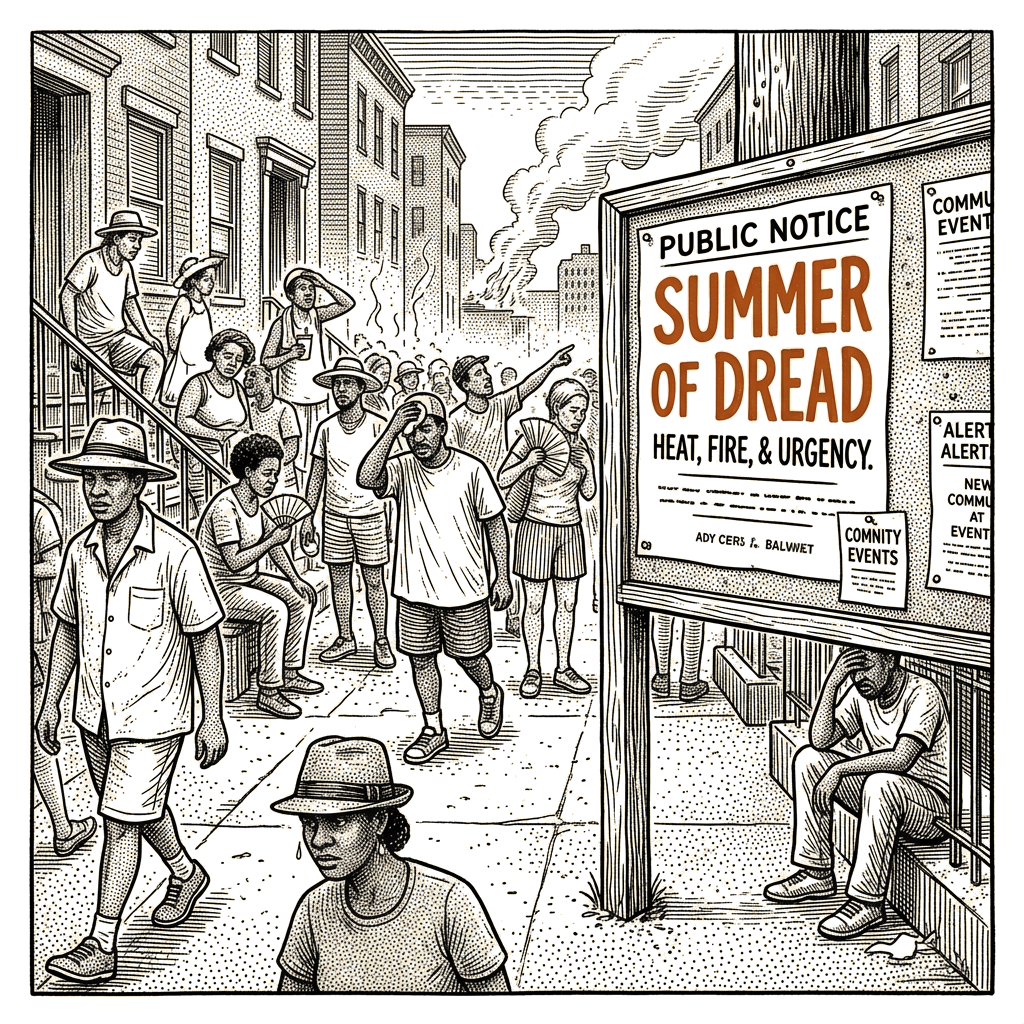
I read Rebecca Solnit’s piece in the Guardian this week, the one where she said we launched a war on nature and now we’re living in the climate war zone. She is right. She wrote it from New Mexico, where she’s been watching the monsoons get less reliable and the fires get worse. What she described — summer becoming a season to dread instead of the season you wait for all winter — is true up here in Adams County too. When I was a kid, summer meant the Adams County Fair, swimming at Castle Rock, the smell of cut hay. Now it means checking the air quality before I let Quinn and Mike play outside, because last August, when smoke from Canadian fires choked our sky for days, my daughter asked if the world was ending. I didn’t have a good answer. The Wisconsin Department of Health Services tracks bad-air days through its Air Quality Program; the Adams-Friendship Area School District has moved recess indoors when the AQI passes 150. Those decisions are now part of every school year.
The oil companies knew. That’s the part I can’t get past. In 1998, the American Petroleum Institute put its strategy in writing: “Victory will be achieved when average citizens ‘understand’ (recognize) uncertainties in climate science” — not because the science was uncertain, but because doubt was the product they were selling, the same playbook the tobacco companies ran before them. The memo was drafted by API staff, with input from Exxon, the Edison Electric Institute, and a phalanx of fossil-fuel-funded front groups; it was leaked to the New York Times and reported on April 26, 1998. Exxon’s own scientists were briefing executives on carbon-driven warming in 1977, and inside Exxon’s own research divisions the basic physics was understood for decades. They had half a century to do something other than lie, and they spent hundreds of millions of dollars convincing people like my neighbors that the whole thing was a hoax. That’s not a mistake. That’s a business plan.
Bill McKibben wrote a book called Eaarth back in 2011 that said we’ve already moved to a different, harder planet than the one we evolved on. I thought about that book this spring when the maple sap ran three weeks early and a guy I know up in Lincoln County boiled half what he usually does. The season keeps getting shorter and weirder, and the weirdness is the new normal. Aldo Leopold, writing from his shack in Sauk County, said the first rule of intelligent tinkering is to save all the parts. The oil companies decided which parts were worth saving — their quarterly earnings, their shareholder returns — and junked the rest.
Aldo Leopold also understood that land is not scenery surrounding human activity. It is the community itself. We have spent a century treating the community as fuel. We burned the coal, drilled the oil, cleared the forest, paved the wetland, and called the bill somebody else’s problem. Now the bill arrives as smoke in the lungs, heat in the house, and a summer that no longer keeps its promises.
The fossil-fuel industry did not cause every fire, flood, or hot day by itself. Weather has always had violence in it. That is the true half of the argument, and it is not enough to rescue the argument. The suppressed half is that adding heat to the atmosphere changes the conditions under which those events occur. A warmer atmosphere can hold more moisture, intensifying heavy rainfall, while hotter conditions dry soils and vegetation and make fire weather more dangerous. It makes the hot days hotter, the dry periods more dangerous, the forests more combustible, and the rainfall more violent when it finally comes. A season that once meant swimming, camping, berries, long evenings, and children out of school becomes a season of smoke, heat warnings, closed trails, failed crops, and checking whether the air is safe before sending the kids outside.
The old defense has been to separate every disaster from the system that is loading the dice. One fire is an accident. One flood is a freak. One dead firefighter is a tragedy. One failed syrup season is bad luck. Stack enough of those “one-time” events together and the pattern becomes visible. The pattern is not that nature has suddenly become malicious. The pattern is that an extractive economy has made ordinary weather more dangerous and then sent ordinary people to absorb the cost. That is what an agrarian tradition names an extractive habit of mind: treating land, labor, animals, and communities as inputs to be consumed. The same mind sees summer as a backdrop, forests as standing fuel, and a rural county as a place from which value can be removed. It counts barrels and quarterly returns more carefully than it counts the days a child can safely play outside.
The Community Collapse contradiction is one we have followed: the people who speak most loudly about preserving community have tolerated the industries that empty it. They defend the language of place while accepting an economy that makes place less habitable. They praise family, faith, and local responsibility while allowing the costs of production to land on families, local governments, volunteer fire departments, and public health systems. The Adams County towns of Big Flats, Easton, Strongs Prairie, and Preston depend on all-volunteer fire departments; the same departments that have answered wildland-urban-interface calls on hotter, drier days when the Cottonville Fire in May 2005 burned 3,410 acres and took thirty homes. The contradiction is not merely that climate damage is expensive. It is that the people with the most power to prevent it have made private profit from keeping the damage in motion. The public pays for smoke monitoring, emergency response, insurance losses, crop failures, cooling centers, hospital visits, and destroyed homes. The companies keep the fuel revenue. The cost does not disappear. It moves.
The same government that should preserve the public record can help erase it. The U.S. Department of Energy recently deleted more than 1,600 webpages documenting energy-saving programs and appliance rebates, according to a July 15, 2026 Heatmap and Wisconsin Examiner report, while people are trying to understand how to keep their homes, farms, and businesses safe in a hotter country. Removing information does not lower the temperature. It lowers the public’s ability to prepare, compare, and hold power accountable.
I hear people say we need both parties to act on climate, as if the parties are equally responsible for the sabotage. They are not. One party made climate denial a loyalty test and took hundreds of millions from the fossil-fuel industry to do it. The other party passed the biggest clean-energy bill in American history — the 2022 Inflation Reduction Act, which put more than $126 billion of announced clean-energy manufacturing investment on the map in two years — and is now watching its members scramble to defend those programs from an administration trying to delete the government’s own energy-saving webpages during a heatwave. I’m not interested in false symmetry. I’m interested in who’s doing the stealing and who’s pretending not to see.
There is a rural lesson here. We know what it means to maintain a machine. You do not wait until the engine seizes and then call maintenance ideological. You change the oil before the bearing fails. You replace the worn belt before it takes out the whole system. You do not praise the machine for continuing to run while ignoring the metal shavings in the pan.
Climate policy needs that same plain competence, and Wisconsin has specific names for it. Adams-Columbia Electric Cooperative, headquartered here in Friendship, is the largest rural electric cooperative in Wisconsin; it is a member of the Dairyland Power Cooperative generation-and-transmission system, which received a major New ERA (New Empowering Rural America) grant award in 2024 to bring down debt on fossil generation and replace it with clean capacity. That is real money, flowing through a member-owned utility, that residents can ask the board about at their annual meeting. The U.S. Department of Agriculture’s Rural Energy for America Program (REAP) pays for on-farm solar, grain-dryer efficiency, and small-wind projects; the Natural Resources Conservation Service, through EQIP and CSP, helps Adams County farmers install cover crops, nutrient management, and prescribed grazing that keep the soil covered and the water clean. The Adams County Land and Water Conservation Department publishes the well-water nitrate data that tracks the same industrial-ag squeeze WICCI tracks in the air. Wisconsin Focus on Energy, the statewide energy-efficiency program, funds home weatherization and cooling retrofits, with extra weight for low-income households. The Inflation Reduction Act extended and expanded the 25D and 30D clean-energy tax credits through 2032, and Section 22001 added $1 billion in USDA loans for rural electric co-ops. These are not luxuries. They are the maintenance required to keep a county alive, and they are decided in boardrooms and county offices that my neighbors can actually show up to.
But here’s the thing Solnit got right that I want to sit with: summer was an immaterial treasure. It belonged to all of us. It wasn’t a commodity. You couldn’t buy it, you couldn’t sell it, you couldn’t put it in a trust fund for your grandkids. It was just there, every year, for as long as anyone could remember — the long evenings, the fireflies, the lake water warm enough to swim in by July. And now it’s going away, and my son is eight years old and he has never known a summer where the air didn’t taste like smoke at least once. That’s theft. That’s theft on a scale that makes everything else feel small.
Wendell Berry wrote that a community is the mental and spiritual condition of knowing that the place is shared, and that the people who share the place define and limit the possibilities of each other’s lives. The oil companies broke the membership. They took the thing that was everybody’s and they burned it for profit, knowing exactly what they were burning.
I sat in my deer stand last November, two weeks past when the rut should have peaked, watching a young buck walk through the woods like he had all the time in the world. The woods were quiet, and warm, and wrong. My notebook says the same thing, year after year. The planet is telling us something. The question is whether we’re going to keep listening to the people who spent forty years telling us not to believe our own eyes.