
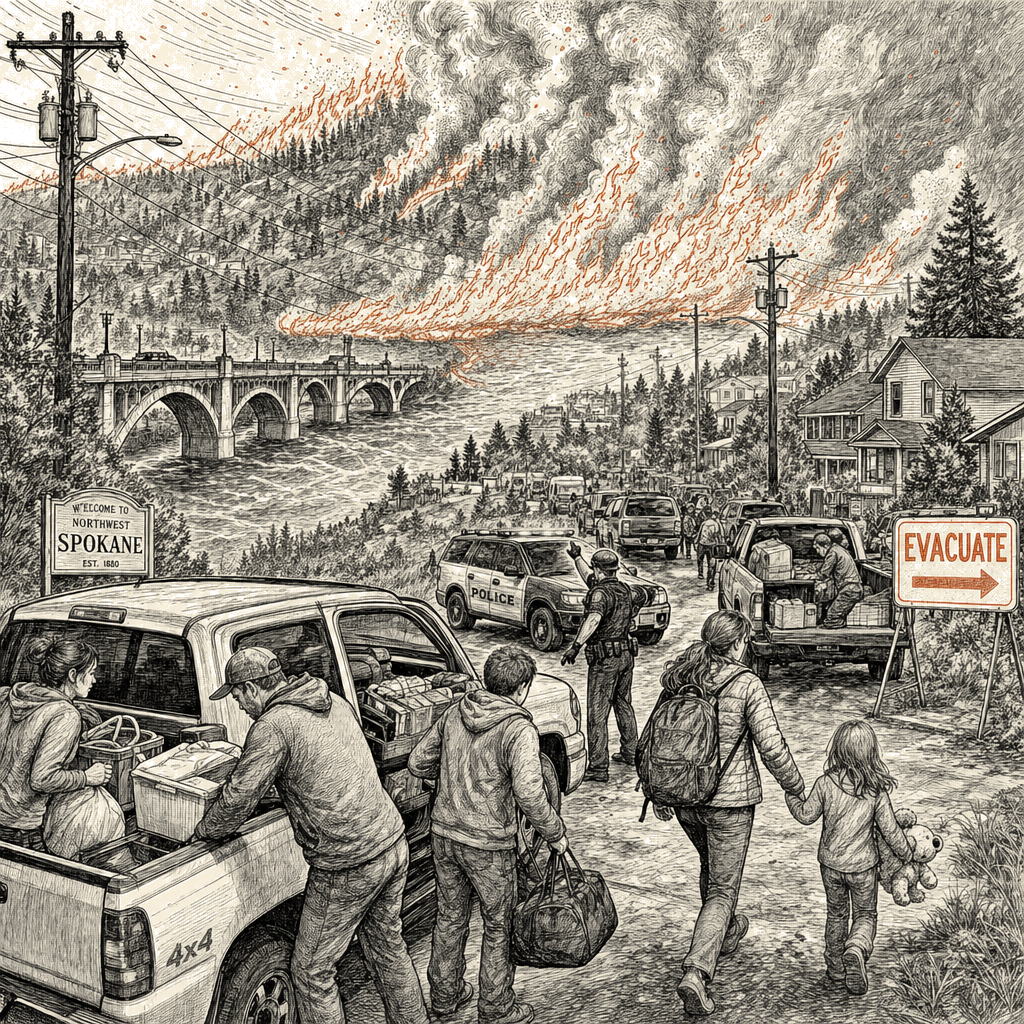
It began around noon in brush and grass in an open area. Strong winds and high temperatures carried the Old Trails Fire north and east toward residential neighborhoods. By Saturday evening, the fire had burned almost 4 square miles—roughly 2,500 acres, or 10 square kilometers—according to Courtney James of the Washington State Department of Natural Resources.
Then it jumped the Spokane River.
Thousands of people evacuated. Cars lined the roads. Orange and red flames showed beside the highway while smoke rose over the region. A home is not only wood, walls, and a roof. It is the place where medicine is kept, children sleep, photographs wait in drawers, and ordinary life expects to continue.
An evacuation order is necessary when fire is moving toward homes. But necessity does not erase responsibility. Public agencies owe residents clear warnings, accurate maps, accessible shelters, transportation for people who cannot drive, and help for those who need oxygen, insulin, mobility equipment, or other medication to survive. They owe families a way to leave that does not depend on owning a reliable car, having money for a hotel, or knowing someone with a spare room.
Neighbors owe one another more than advice to get out. Check on the older person next door. Offer a ride without demanding payment. Make space for a family with pets. Help someone carry medication, documents, or a child. Do not block evacuation routes, spread rumors, or treat another person’s emergency as an inconvenience. The person moving slowly through the smoke is not an obstacle to your escape. That person is your neighbor.
The same duty appears in the evacuation orders that followed wildfires across Oregon. The pattern is no longer an isolated spectacle. Fire crosses roads, fields, rivers, and the boundaries by which we organize our lives. A community that prepares only for the people who can leave quickly has not prepared for a community. It has prepared for the fortunate.
John XXIII wrote in Pacem in Terris that every person belongs to the human family. That principle becomes concrete during an evacuation. A person without transportation still has a right to safety. A renter still has a right to timely warning. A person without housing still deserves shelter, information, and protection from the smoke. Human dignity cannot depend on whether someone owns the vehicle that carries it away from danger.
The cause of the Old Trails Fire remains under investigation. That is the truth we have, and we should not turn an unanswered question into an accusation against a person or institution. The Associated Press reported the facts now established: the fire spread through northwest Spokane, crossed the river, burned nearly four square miles, and forced thousands to leave. The next obligation is equally clear. Agencies must keep reporting what they know, correct what they do not, and make evacuation assistance reach the people least able to secure it alone.
For now, heed evacuation orders and stay alert to changing conditions. If you can help someone leave safely, help them. If you have authority over an evacuation, use it to protect the person with the fewest options first. That is not charity added to emergency work. It is the measure of whether the emergency work honors human life.