
Fossil-fuel companies are heating the West and abandoning its people.
I work in Adams County, Wisconsin, where the weather comes through the shop door before it arrives in a report. My notebook records later ice-out, earlier mosquitoes, and a maple season that keeps moving away from the calendar people here grew up with. That does not make me an authority on the cause of every fire in another state. It does make me suspicious of anyone who treats each fire as an isolated surprise.
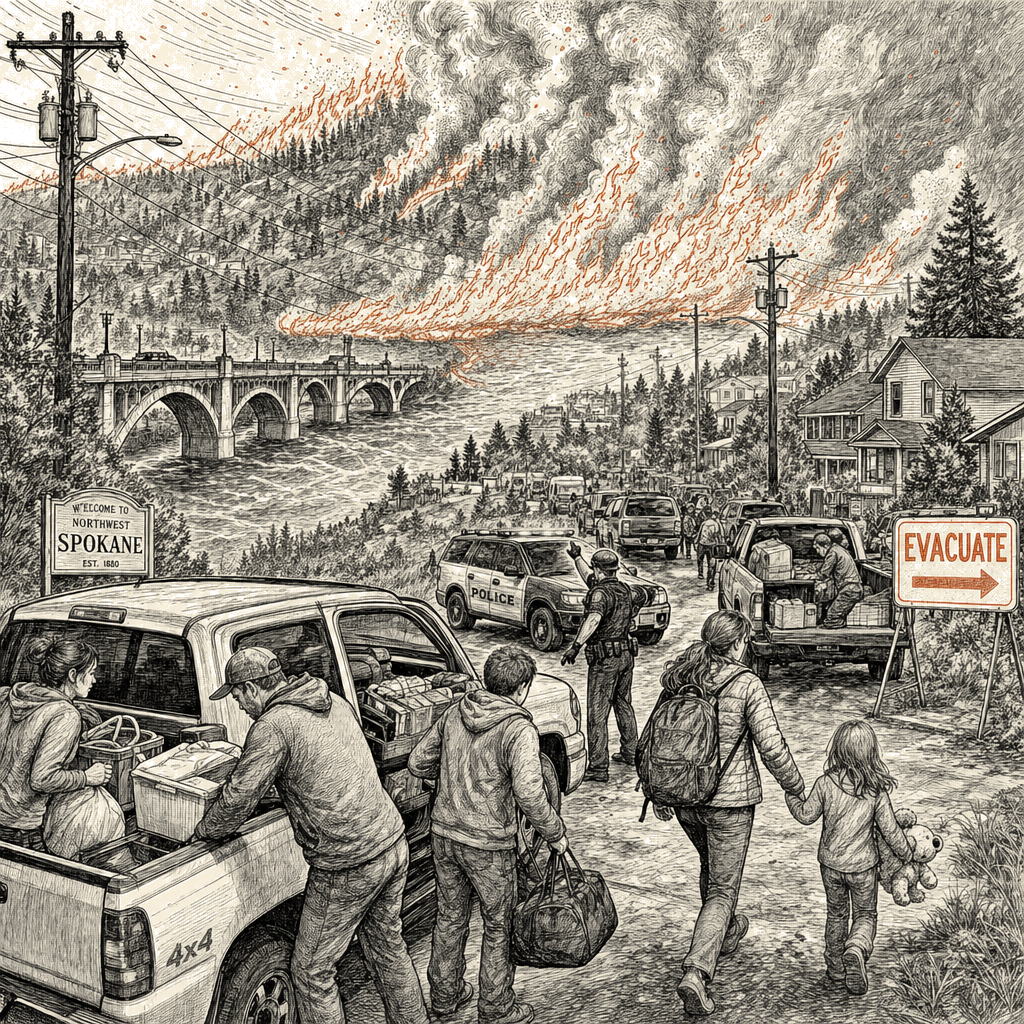
The Old Trails Fire burned almost 4 square miles in northwest Spokane on Saturday, according to Courtney James of the Washington State Department of Natural Resources. Strong winds and high temperatures pushed the fire from brush and grass toward residential neighborhoods. It jumped the Spokane River. Thousands of people evacuated. The cause remained under investigation.
That last sentence matters. We do not know what started this fire. A cigarette, a spark, equipment, a power line, or something else may have lit it. The record does not establish the ignition source, and I will not invent one.
But ignition is not the whole fire.
The fuel is dry ground, hot air, strong wind, and a region whose fire conditions are changing. The people who sell and burn coal, oil, and gas did not strike the first match at Old Trails. They did help heat the climate in which a brush fire can run through open country, cross a river, and reach neighborhoods before families can load the car.
That distinction is the part being lost. “The cause is under investigation” can become a way to postpone every harder question. It tells us who may have started the fire. It does not tell us why the consequences keep arriving with greater reach and less time to respond.
The Washington fire belongs to the same summer record as the Oregon fires that burned more than a million acres and forced thousands from their homes. The record is not proof that one company caused one ignition. It is evidence that the old language of exceptional disaster is no longer large enough for the pattern.
The Wisconsin Initiative on Climate Change Impacts reports that Wisconsin has warmed about 3 degrees Fahrenheit since 1950, with precipitation up roughly 17 percent. The 2010s were the state’s wettest decade in the instrumental record. Those facts do not make Wisconsin Spokane. They show that climate instability does not move in one direction: heat can dry vegetation and accelerate fire behavior, while changing precipitation can bring different extremes and make old seasonal expectations unreliable. The same failure of expectation is what turns a fire from a local emergency into a race toward neighborhoods.
Aldo Leopold wrote that conservation is a state of harmony between people and land. Harmony does not mean the land stays still for our convenience. It means we understand that our choices enter the land and return to us. Carbon pollution enters the air and returns as heat, drought, altered vegetation, heavier rain, longer fire seasons, and a shorter interval between warning and evacuation.
The people leaving Spokane in cars were not abstractions. They were carrying children, medicine, pets, documents, and whatever could be reached before the road closed. The smoke plume was not a graph. The flames were not a debate prompt. A neighborhood is a collection of ordinary futures: supper, school, work, a dog at the door, a truck that still needs its oil changed. Fire takes those futures and turns them into a question of whether the house will still be there by morning.
The river was not a boundary. It was another line the fire crossed. That is what hotter, windier fire conditions do to the old assurances people build around geography: they turn a supposed limit into one more obstacle to be breached.
That is the abandonment. The companies that profit from fossil combustion do not evacuate with the people who pay the cost. Their balance sheets do not sit in traffic under an orange sky. They do not wait for the wind to change before deciding whether a home can be defended. The gain is collected in one place. The risk is scattered across towns, watersheds, fire crews, households, and children who had no say in the transaction.
The political response has too often treated adaptation as a substitute for responsibility. More evacuation routes matter. Better firefighting matters. Public warnings matter. Defensible space matters. None of those measures gives a corporation permission to keep exporting the atmospheric cost of its product while calling the resulting emergency a natural event.
The cost-transfer mechanism is plain: fossil-fuel companies collect private returns, while protection is delivered through public institutions and local household resources. When a fire arrives, taxpayers fund emergency response, towns stretch thin budgets, and families absorb the losses that cannot be repaired. The people who helped create the risk do not receive the evacuation bill.
Real rural infrastructure policy would put public money into protection that does not depend on a family having cash at the exact moment a fire arrives: reliable emergency communications, staffed fire departments, safe evacuation routes, hardened power systems, housing that can withstand heat and smoke, and land management directed by local knowledge and public accountability. It would also make the companies profiting from carbon carry more of the cost they have helped impose, rather than asking every town to rebuild from its own thin budget.
The fire’s ignition remains under investigation. The responsibility for a hotter West is not a mystery. Spokane’s families deserved more than a warning to stay alert. They deserved a country that understood the fire before it reached the river.