
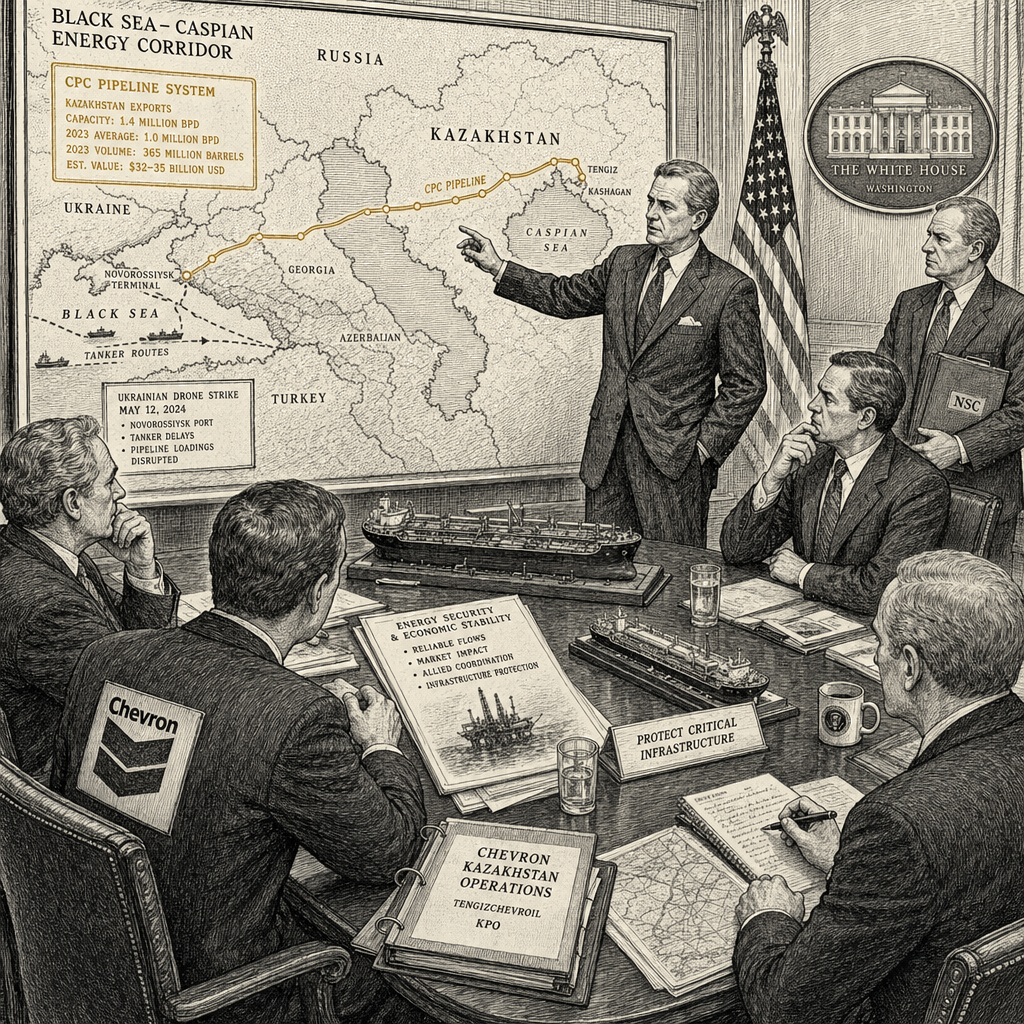
The Trump administration warned Ukraine to stop attacking oil infrastructure because Chevron needed its crude flowing.
That is the story. A sitting U.S. administration directed a wartime ally to constrain its military campaign because an American oil company had forty-eight billion dollars riding on a pipeline that runs through Russian territory. Chevron CEO Mike Wirth and other energy executives spoke with senior administration officials this week about protecting the company’s operations in Kazakhstan after a Ukrainian drone strike hit four tankers near the Russian export hub of Novorossiysk. The administration’s response was to tell Ukraine, in effect, to stand down.
The pipeline is called the Caspian Pipeline Consortium. It carries roughly 1.4 million barrels of crude a day from Kazakhstan’s Tengiz field to the Black Sea, routed through Russia. That is about two percent of global daily supply. Chevron owns fifteen percent of the pipeline and, more consequentially, fifty percent of the Tengizchevroil joint venture that operates the field. The strike did not damage the pipeline or the field. But the loading disruptions backed up crude that Kazakhstan had no storage capacity to absorb, and Kazakhstan was forced to curtail production. A fifty-billion-dollar bet was hemorrhaging cash flow, and the CEO picked up the phone.
The administration listened. A U.S. official said the administration warned Ukraine against attacking non-Russian vessels in the Black Sea, calling the CPC “a vital conduit of Kazakhstan-origin energy for European markets that serves as an alternative to Russian energy supplies.” An alternative to Russian energy supplies — routed through Russia. The contradiction is not subtle. Chevron’s pipeline crosses the same country the administration’s sanctions regime is supposed to be squeezing. The same country whose energy revenues fund the war Ukraine is fighting. The administration’s stated policy is to pressure Russia. The administration’s disclosed action was to protect the route through which Russian territory extracts a transit fee on Chevron’s crude. One dollar at a time.
Anyone who has filled a diesel tank in Adams County this year knows what oil prices feel like when they run above seventy dollars a barrel. Brent crude has traded well above that mark for months, briefly topping $118 in late March after closures of two key Middle East chokepoints briefly threatened a quarter of global supply — three chokepoint closures that MSI reported on just last week. The administration is right that supply disruptions push prices higher and that higher prices hit working people first. But the policy response was not to protect American consumers from price spikes. It was to protect Chevron’s free cash flow. Chevron had projected that Tengiz would generate six billion dollars in free cash flow this year at seventy-dollar oil, and the field accounts for roughly twelve percent of the company’s global output. The administration did not act to bring prices down. It acted to keep Chevron’s production online so Chevron could keep profiting from the elevated prices.
This is the nationalist shell game at full opacity. The rhetoric is energy security. The policy is corporate-asset protection. The administration calls the CPC pipeline a strategic asset because it carries Kazakh oil that is not Russian oil — never mind that it transits Russian territory, pays Russian transit fees, and loads at a Russian port. The language of independence is deployed to justify dependence on a pipeline that runs through the very country the rhetoric says we are standing against. An administration that ran on “unleashing American energy” spent this week using American diplomatic leverage to protect an oil company’s foreign assets. The independence was the marketing. The dependence was the product.
What the administration did with the phone call is documented. Who made the call is documented. Mike Wirth and President Trump are known to have a rapport and have previously discussed oil markets and Venezuela. Chevron declined to confirm or comment on the discussions, saying it engages with government officials regularly as a normal course of business. A normal course of business. That is the sentence to hold. The normal course of business for a company with forty-eight billion dollars in a field in Kazakhstan is to call the White House when a war starts threatening the investment, and to have the White House call Kyiv. The normal course of business is that the company’s CEO has the President’s number, and that a wartime sovereign nation is told to adjust its military targeting to accommodate a boardroom’s cash-flow projection.
The field itself is a machine. Tengiz sits beneath a salt dome on the northeastern shore of the Caspian Sea. Chevron has operated there since 1993, when the Soviet Union had just collapsed and Kazakhstan’s oil was available to anyone who could move fast enough and spend enough money. Chevron moved fast — and is now seeking a contract extension past 2033, a commitment that makes the pipeline’s protection worth securing for decades, not quarters. The forty-eight-billion-dollar expansion is designed to push capacity to roughly a million barrels a day, comparable to the company’s output in the Permian Basin. Exxon Mobil holds twenty-five percent of the joint venture. Kazakhstan’s national oil company KazMunayGas owns twenty percent. Russia’s Lukoil holds five percent. That means the administration’s warning also protected Exxon’s 25 percent interest — a second major American oil company with a direct financial stake in the outcome. The venture’s spokesperson said production and deliveries “may be adjusted from time to time in response to operational conditions.” Operational conditions. A drone strike on a loading port that the President’s phone call was meant to prevent.
The analysts are already mapping the second-order effects. Paul Cheng, a recently retired oil-industry analyst, told reporters that the U.S. warning is likely to steer Ukraine toward other targets — that the political cost of upsetting allies who fund the war outweighs the military value of striking near the CPC terminal. Ukraine’s strikes have been part of a broader campaign against Russia’s energy infrastructure, but the calculus is now explicit: Chevron’s production matters more than Ukraine’s targeting freedom. The retired analyst named it plainly: “Is that the best target for Ukraine politically? You will upset your allies that fund your war.” The ally in question is not the United States government acting on behalf of its citizens. The ally is an oil company whose CEO called the President and got what he needed.
This is what consolidation looks like when it scales past a county. Adams County knows what it looks like when one company’s needs override a community’s interests — when the CAFO’s manure lagoon matters more than the neighbors’ wells, when the regional chain’s branch-closure decision matters more than the town’s Main Street. The mechanics are the same at every scale. A concentrated interest with concentrated resources makes a phone call. The institution that is supposed to represent the broader public interest picks up. What follows is called normal course of business.
Chevron and Exxon are expected to report banner second-quarter earnings next week, having benefited from the crude-price surge that followed the chokepoint closures. The price spikes that hit the diesel pump in Friendship are the same price spikes that inflated the quarterly earnings. The administration’s job, as the administration performed it this week, was to make sure the production kept flowing at the price that produces the earnings. The producer captures the windfall. The consumer absorbs the cost. The wartime ally is told to work around it.
Berry wrote about the extractive mind as a structure, not a character flaw — a system that treats land and people as inputs to be consumed in the service of an output the extractor controls. The extractive mind is not limited to soil. It operates on pipelines and port facilities and diplomatic phone calls with the same logic. The land at Tengiz will be drawn down. The pipeline will run until it does not. The transit fees will flow through Russia. And the phone call that protected the investment will be classified, eventually, as routine engagement between industry and government — normal course of business, one more undocumented act in the long record of who the energy-security rhetoric is actually for.