
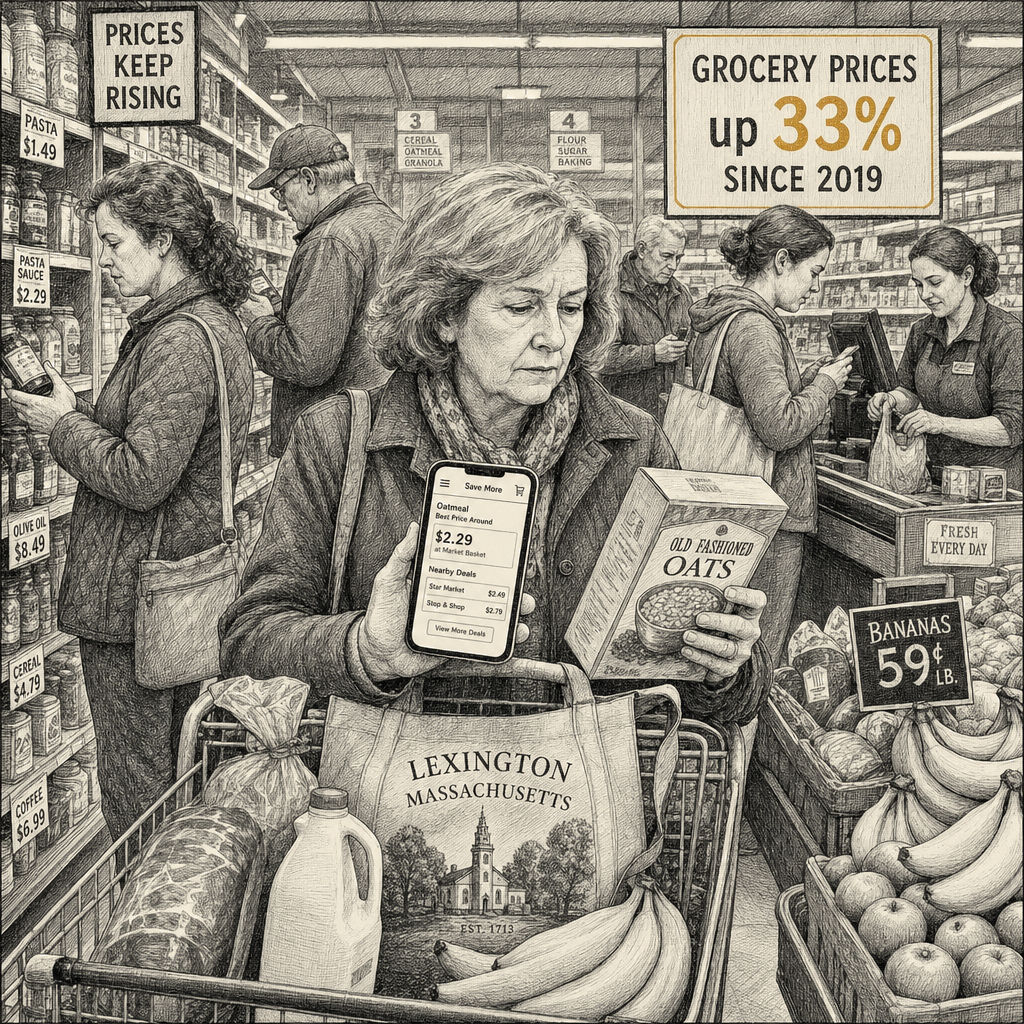
The grocery industry is using inflation cover to permanently extract more from family budgets.
Here are the numbers. The Bureau of Labor Statistics CPI for food at home: up 33 percent since January 2019. In the seven-and-a-half years before that, it rose 6.4 percent — an annualized rate roughly one-sixth as fast. The Associated Press has described the gap as the biggest grocery price jump in half a century, and by the arithmetic that is correct.
The question the headline numbers do not answer is what happened to the input costs that were supposed to have driven the increase. Commodity prices — wheat, corn, soybeans, vegetable oils — spiked in 2021 and 2022, then fell. The FAO Food Price Index peaked in March 2022 and fell by roughly a fifth by end of 2023. Transportation costs normalized. Labor costs rose, but by substantially less than grocery prices did.
What did not fall was the shelf price. This pattern has a name in the industrial-organization literature: rockets and feathers. When input costs rise, retail prices shoot up like a rocket. When input costs fall, they float down like a feather — slowly, partially, often not at all.
The difference between the rocket and the feather is the extraction. The Federal Reserve Bank of Kansas City documented in 2023 that grocery profit margins — retail and manufacturing combined — reached elevated levels well above pre-pandemic norms and have not fully reverted. That is not pass-through. Pass-through is what happens when costs go up and prices follow them up. What we are observing is costs coming down and prices staying up.
The fiscal dimension is straightforward. Higher grocery prices flow directly into the federal budget through SNAP, whose benefit levels are tied to the Thrifty Food Plan and are recalculated from the same CPI data. A back-of-envelope calculation based on current SNAP enrollment of roughly 42 million recipients and average monthly benefits of about $230 per person suggests that each percentage point of permanent grocery inflation adds between $600 million and $1 billion in annual SNAP spending on current caseload — without a single new beneficiary being enrolled. The Congressional Budget Office has scored this mechanical relationship repeatedly in its budget options publications. It is not a policy choice. It is a formula.
The irony the scoring memo does not remark on is that the federal government is now permanently subsidizing a price level that reflects a structural margin expansion in a concentrated industry. Five companies control roughly half of U.S. grocery sales. The four largest food manufacturers control large shares of packaged food categories. Concentration is not proof of coordination, but it is the structural precondition for the rockets-and-feathers pricing pattern to persist without competitive discipline.
The grocery industry will say it is covering higher labor costs, higher transportation costs, higher ingredient costs. Some of that is true for some of the period. The question is why margins have expanded while those costs have partly reverted. An industry that cannot answer that question is not passing through costs. It is extracting them.
The extraction is not abstract. It is Apral Jack of Lexington, Massachusetts, skipping items or walking out of one store and driving to another because the apples at Stop & Shop cost more than the apples at Market Basket. It is millions of households rewriting their shopping lists around whatever is on sale. The BLS data corroborates what the behavior shows: the gap between what the price became and what it stayed when the reason for raising it went away.
The pattern is known. The empirical economics literature has documented it for three decades — Peltzman on asymmetric pass-through, Borenstein, Cameron, and Gilbert (1997) on gasoline, the FTC on consumer goods. The “rockets and feathers” term appeared in the academic literature at least as early as the 1990s. It has been documented across multiple sectors and multiple business cycles.
What changes is not the economics. What changes is the enforcement environment. The Federal Trade Commission had an active inquiry into grocery pricing during the Biden administration; the current commission’s agenda has shifted toward other priorities, including a rulemaking on online food delivery fees. No coordinated merger challenge has been filed against the grocery sector’s consolidation trajectory in the current enforcement cycle.
The institutional receipts are there. The data are public. The pattern is named.
The extraction is a policy choice, expressed as an enforcement failure. And the bill goes to the family picking apples at the cheaper store.