
The Dred Scott decision of 1857 was not a close call that reasonable legal minds could parse in good faith. It was a piece of structural violence dressed in judicial robes — a ruling that a Black man had no rights a white man was bound to respect, that the Constitution was a document for the free and the white, and that the political community of the United States was, at its founding premise, a property-holding white man’s republic. Roger Taney wrote the opinion. The slave power that appointed him cheered. The abolitionist movement read the text and understood: the Court was not going to save them. They would have to save themselves.
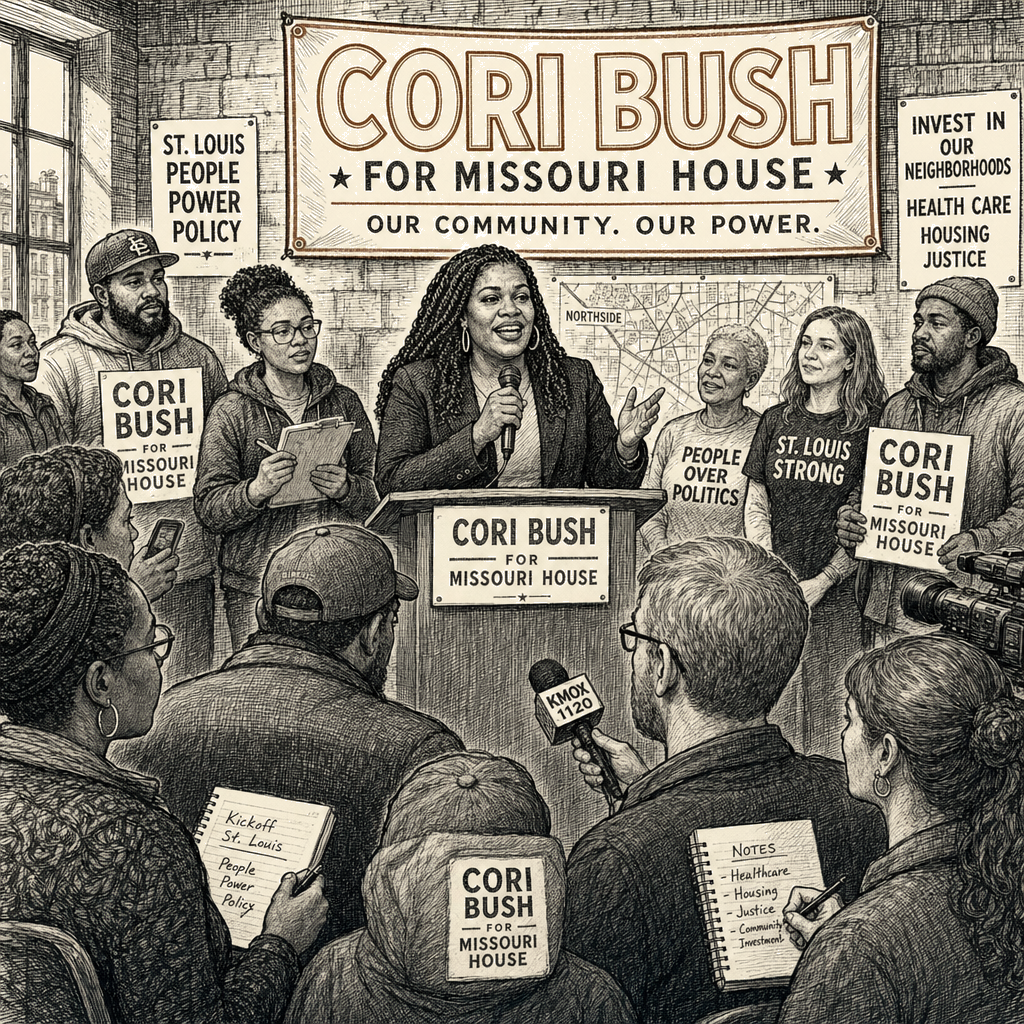
Cori Bush opened her campaign to regain Missouri’s First Congressional District seat on Saturday outside the St. Louis courthouse where the Dred Scott case was argued in 1847. She stood on ground the Taney Court tried to consecrate as the permanent floor of Black non-personhood, and she said what the moment required: Send back that descendant, send her back to the place that enslaved people built. The crowd chanted send her back.
Let us be precise about what happened to Cori Bush. She did not lose to Wesley Bell because her constituents woke up one morning and decided they preferred a moderate prosecutor. The Intercept reported that she lost to Wesley Bell because AIPAC’s super-PAC and allied groups spent tens of millions of dollars across two primary cycles to defeat her — a sum surpassing the entire cost of a competitive Senate race. AIPAC did not spend that money because Bush’s vote on the infrastructure bill was wrong for her district. They spent it because she had the audacity to call what Israel was doing in Gaza what it was. The cui-bono trace in that primary is not complicated: a concentrated lobby, organized around a foreign policy the American electorate is increasingly skeptical of, decided that a Black woman who refused to look away from dead children in Rafah needed to be removed from office, and it bought a district.
The Associated Press calls the rematch a referendum on Democrats’ shifting landscape — anger at the party establishment, the growing clout of democratic socialists, rising skepticism of the U.S. alliance with Israel. The AP is being polite. What it means is that the Democratic Party establishment, whose donor class overlaps heavily with the same interests that funded Bush’s defeat, now has to watch a Black woman who started her political career as a Ferguson organizer stand outside the courthouse where Dred Scott was argued and ask the people she actually represents to send her back.
The institutional Democrats who wrung their hands about that money — who said of course we deplore outside spending, while doing nothing structural to prevent its recurrence — are now in the position of having to pretend that a rematch between a prosecutor funded by a foreign-policy lobby and a former congresswoman who organized in the streets after a white policeman shot an unarmed Black teenager is a normal intra-party squabble. It is not a normal intra-party squabble. It is the same fight that has run through American politics since the slaveholding elite decided that the Constitution’s silences could be purchased: the fight between the people who own the apparatus and the people the apparatus was built to contain.
Wesley Bell is a person. He is a local prosecutor with a record his constituents can evaluate. He is not the villain of this story; he is the instrument. The structure that put him in Congress is the same structure that has, for the last several election cycles, targeted Black progressive incumbents for defeat through concentrated outside spending because their presence in the Democratic caucus threatens a foreign-policy consensus the American people no longer share. AIPAC’s super-PAC does not spend $20 million on races where the incumbent defers to its preferences. It spends $20 million on the incumbents who refuse. That is the functional definition of a loyalty test administered by a non-constituent.
Bush’s strategic decision to launch her campaign on Dred Scott ground was not theatrical. It was constitutional analysis at the level the moment requires. The Dred Scott Court held that the protections of the Constitution did not extend to Black people; the AIPAC primary holds, in practice, that the protections of democratic representation do not extend to Black representatives who dissent from a donor-class foreign policy. The instruments have changed. The architecture of who-gets-to-decide versus who-is-supposed-to-comply is continuous.
There is a particular cruelty in what the establishment did to Bush’s district. The First District of Missouri, by any demographic measure one of the most heavily Black congressional districts in the country — roughly half its population is African American — was drawn by the same Missouri redistricting process that has been a battlefield for exactly this kind of power struggle. It sent a Ferguson organizer to Congress. The Democratic establishment, working through an Israeli-lobby super-PAC, spent the price of a Senate campaign to remove her. And now she is back, running on ground consecrated by the worst Supreme Court decision in American history, saying what Taney wrote and what AIPAC spent both tried to say: that the political community does not have to include the people who refuse to accept the terms of their own subordination.
I do not know whether Cori Bush will win this rematch. The money against her will be staggering. The party apparatus will be at best neutral and at worst actively hostile. The district’s voting patterns, shaped by the same gerrymandered map that produced her first term, do not guarantee return. But I know what she was saying at that courthouse, and I know who heard it. The crowd on Saturday was not a gathering of political consultants taking notes on her positioning. It was the people she spent her first two terms actually representing — the ones who recognized, when she stood on those steps, that the fight she is in is the fight they have always been in. The establishment that spent tens of millions to silence her calculated that the country was ready to move on. She is betting that the country was never asked.
The arc of the moral universe is long, and it does not bend itself. It bends where people who refuse the terms of their own exclusion stand on the ground their ancestors were told they could never claim, and say the same thing their ancestors said: Send me back. I am not done.