
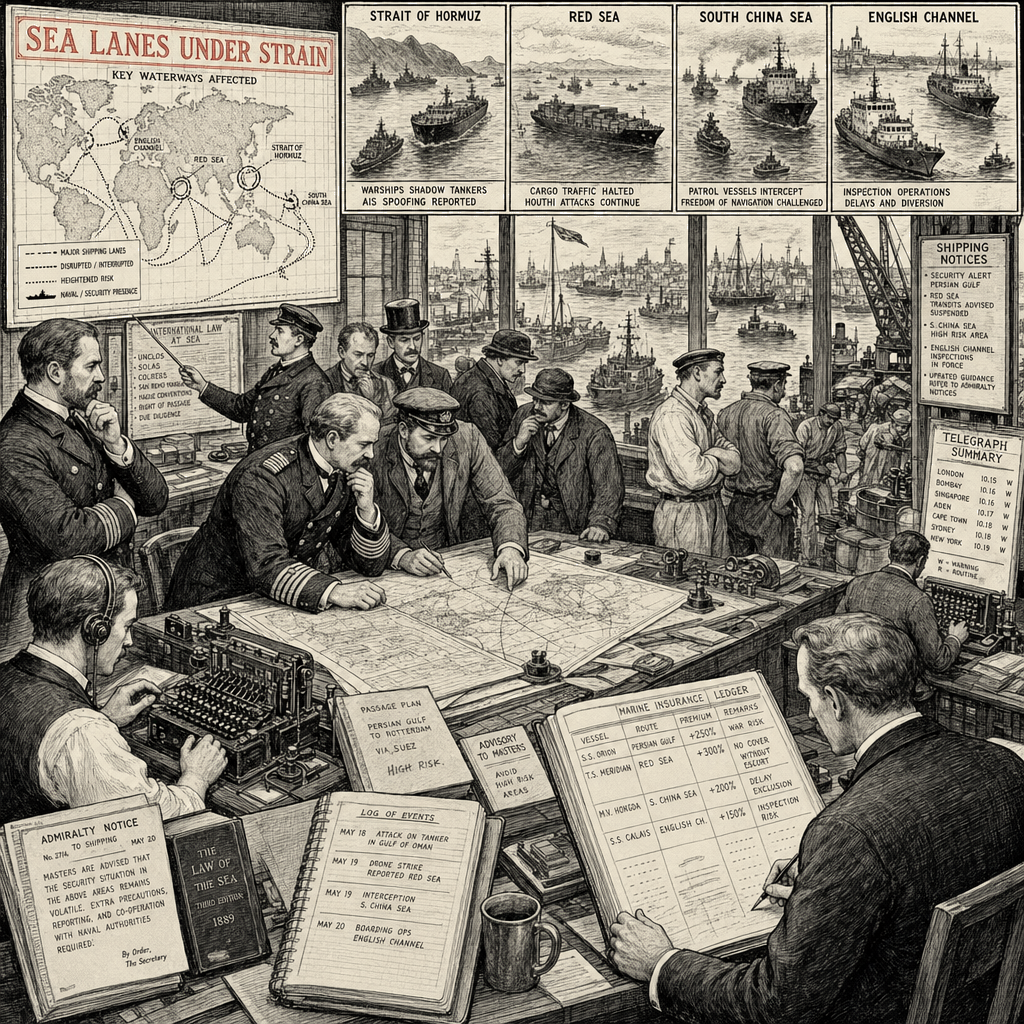
A maritime confrontation is rattling the Strait of Hormuz, the North Sea, the Bab al-Mandab, and the South China Sea. Most commentary reads this as a geopolitical crisis — a fraying of the rules-based order. That lens is too narrow. The real headline is what this confrontation is already doing to the fiscal arithmetic of every major government on earth, and that is the angle the commentary pages habitually skip.
Start with oil. When Houthi militias struck two tankers off Yemen this week, crude pushed back above $100 a barrel. For a consumption-heavy importer like the UK, a sustained elevation at these levels is not a headline — it is a fiscal event. Depressed VAT receipts, pressure on the Treasury to subsidise winter fuel bills, a widening current account deficit: all of it flows straight into the spreadsheets at HM Treasury. For an oil-exporter such as Iran, the same price rise provides fiscal oxygen to a regime the United States is actively trying to isolate. The three-chokepoint closure scenario we laid out earlier this month — a quarter of global supply taken offline — would rewrite budget forecasts in every capital.
Then come the defence-spending cascades. The pressure on the new UK government to rebuild the Royal Navy is immense. The options are blunt: breach the fiscal rules, explicitly raise taxes for defence, or squeeze health and education capital budgets. The Treasury’s internal models are the real frontline of this war. The unfunded gap in the Ministry of Defence’s long-term equipment plan is well known; adding a serious surface-fleet rebuilding programme would demand a fiscal choice that no chancellor wants to make publicly.
Trade disruption compounds the damage. Roughly 80 per cent of global goods by volume travel by sea. If the Hormuz precedent spreads — and Indonesia’s debate over tolls in the Strait of Malacca is the clearest warning — the cost base of the entire global trading system shifts permanently upward. Every dollar added to maritime shipping costs is a dollar of reduced real income for importers and a dollar shaved from exporters’ competitiveness. For an open economy like the UK, the supply-chain fragility alone acts as a tax on trend growth. Mark down potential output, and the headroom for tax cuts or new spending evaporates.
And then there is the fiscal novelty that the Hormuz standoff has already established: the idea that a state can monetise an international waterway. The US-Iran memorandum of understanding accepts that Iran has a right, with Oman, to charge for transit. Trump balked, then rowed back, but the precedent stands. If Iran can toll the Strait of Hormuz, why not Turkey for the Bosphorus? Or Spain for Gibraltar? The Strait of Hormuz crisis earlier this summer made clear that the free-sea consensus was already fragile. Formalising payment-for-passage turns a military standoff into a fiscal regime — with no international tax authority to adjudicate it. The revenue flows for the tolling countries are substantial; the costs land on consumers in importing countries.
What is being described as the decline of the rules-based order is also the arrival of a tax bill that has to be paid by treasuries and parliaments. Finance ministers should be watching the Hormuz radar at least as closely as the defence ministers are.