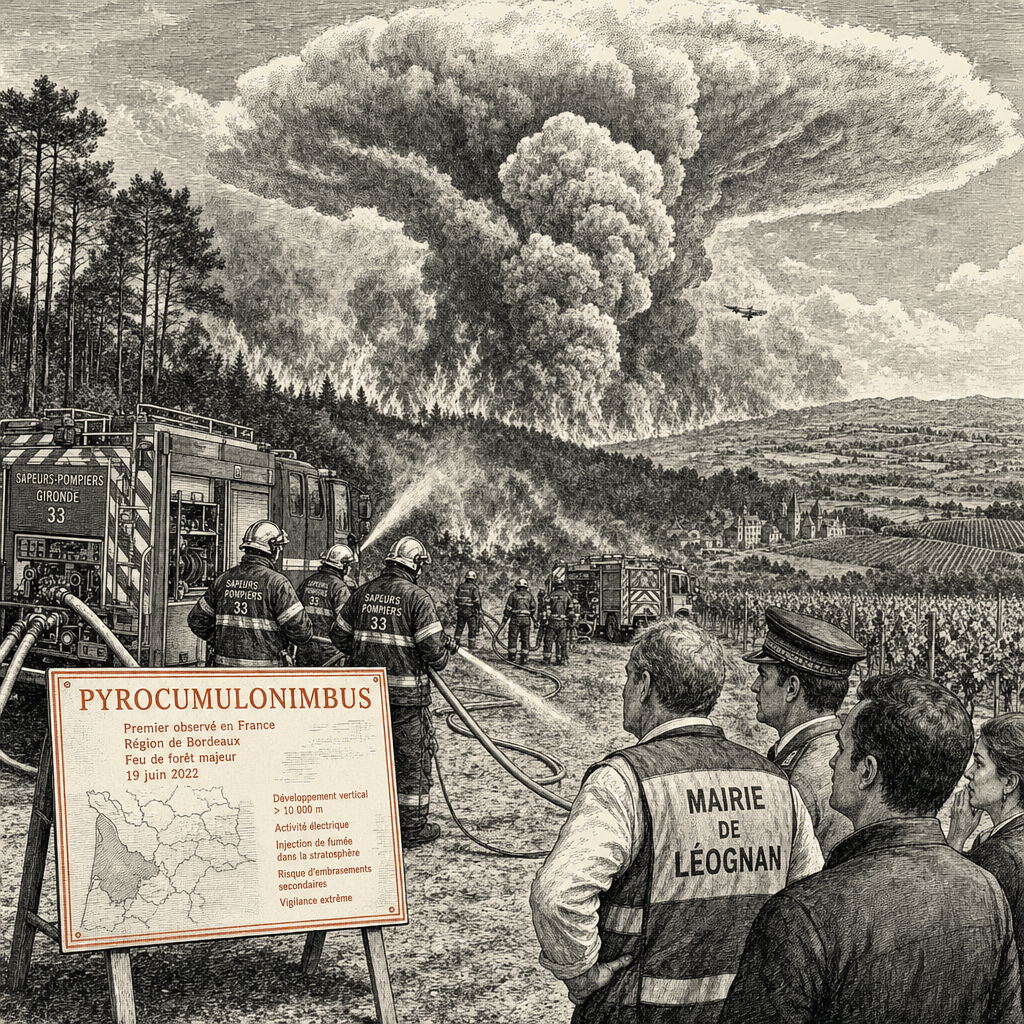
Forty-five years of climate-witness notebooks say the same thing the map of Europe is saying right now: the living is not where they told us it would be. The fire season that runs north through the French countryside and south into Spain’s interior used to be a July event — a bad few weeks, not a long summer’s siege. Now more than a hundred and seventy thousand hectares have burned in Spain, and France has already lost more land this summer than it did in all of 2025, heat waves stack four deep in a single season, and a word borrowed from North America’s worst fire years — pyrocumulonimbus — has appeared for the first time in the French firefighting vocabulary. The boundary between late winter and early spring moved. I noticed because I run a shop with the doors open in central Wisconsin, and the first-crawl bugs arrive in my shop floor in March now. The French noticed because the clouds above their burning forests started generating their own lightning.
I know the numbers because the Guardian printed them: Spain’s environment ministry calculated over 170,000 hectares affected so far this year, compared with 29,000 last year. France’s burned acreage has already exceeded the 30,000 hectares consumed during the whole of 2025, and the summer has another month. Over 220,000 people were evacuated from the Gironde alone. In Spain, more than 100,000 fled. And while those people packed cars and walked away from the only homes they had ever known, Emmanuel Macron’s government announced steep cuts to a Green Fund designed to help local authorities prepare for exactly the kind of wreckage the summer had already delivered. The timing would be a comedy if the stakes were lower.
The logic will be familiar to anyone who has lived through what rural Wisconsin has lived through in the last twenty years. There is always a reason why the investment — in flood control, in fire crews, in the soil-sustaining programs that prevent the slope from becoming the slide — has to wait. In France in 2026, the reason is fiscal: a projected budget shortfall. In the European Union more broadly, the reason is competitiveness: the claim that the bloc cannot bear the cost of its emissions-trading system during a period of low growth and geopolitical pressure from the United States. The European Commission, under pressure from Giorgia Meloni’s Italy and a handful of other states, has proposed weakening its flagship climate policy, extending free pollution permits to heavy industry.
I have heard this logic before. I heard it when the Conservation Reserve Program in this country was gutted to open more acres to corn and soybeans during the 2007-to-2014 commodity boom, and then I stood at the edge of fields in this county where the windbreaks and the pheasant cover went with the crop rotation that followed. I heard it again when the southern governors cut their own water-quality and air-quality budgets to attract manufacturing, and then the wells nitrated and the streams fouled because the enforcement — the part of the government that keeps your drinking water from running through a manure lagoon — had been the thing that waited. Last year alone, European heat waves and floods cost forty-three billion dollars — and that was before this summer. The pattern is identical on both sides of the Atlantic: the sinking money into the infrastructure that prevents the disaster is a cost, and when governments are looking for things to cut, the thing that prevents the next disaster always budgets like a contingency.
Aldo Leopold, who also lived in sand-county Wisconsin, wrote in A Sand County Almanac about a calendar that his reading broke the calendar frame. He was documenting the arrival dates of species he knew from his own land, the way the warblers pressed earlier into the state each spring, the way the marsh hens settled the mud flats three weeks different than the records documented for the same pools at the turn of the century. The 1949 book was already past tense: the living was not where the map still showed the color. He was writing the species list of a place that was changing under his feet, and he knew it. What is happening in southern France right now is the same thing, at industrial scale, with graver decision-makers facing the choice Leopold’s successors face — and naming their inaction something other than what it is.
The Guardian editorial ran its column under the precise and familiar frame: politics must catch up with the new reality. I think the framing is too kind. The reality has caught up; the politics chose not to meet it. A fire-generated thunderstorm in the Fontainebleau forest region — a pyrocumulonimbus — is not a reality playing catch-up with anything. It is reality itself, as the phrase has outrun the policy that was supposed to prevent the conditions that made its arrival inevitable. The governments of two of Europe’s largest nations, and the bloc that formally binds them, had access to the same scientific reports the newspaper columnists had. They knew the 1.5-degree Celsius threshold the Paris Agreement set could be crossed within five years. They knew the burned acreage was rising. And they chose, in the name of fiscal prudence and economic competition, to dismantle the modest climate-policy architecture that was the only thing standing between their countries and the deepening wreckage.
I am a mechanic in Wisconsin, not a European policy analyst. But I am the demographic that lives downstream of this exact logic. I have lived through it in this county. The dollar that used to circulate inside this town — the dollar that went to the local hardware store, the local bank, the local feed mill — now leaves on an electronic-transfer schedule at the end of each business cycle. I have read the federal budgets and the state budgets and the county budgets and the farm bills and the EPA regulations, and I have watched the same two-step played over and over: the investment in prevention is the first thing trimmed, and then the cost of the cleanup is blamed on the subject of the story rather than on the policy failure that made the story inevitable. The French Green Fund was cut by a government that will spend more extinguishing the fires the cuts help propagate. That arithmetic is as old as the Conservation Reserve Program, and as new as the cloud that generated its own thunder above Bordeaux.
Pedro Sánchez, Spain’s prime minister, spoke the plainest sentence in the Guardian’s coverage: the current crisis is the consequence of the climate emergency. That is the whole story, and every other sentence in the policy file is an attempt to avoid that sentence’s implications. The political classes in Europe and in the United States have spent years telling their electorates that the cost of the green transition — the solar panels and the insulation and the electric trucks and the soil-conservation programs and the restoration of the degraded, marginal land the loggers and the drainage ditchers and the deep-tillers and the big-ag chemicals left behind — is a burden. It is a burden. But it is the cost of the world that is already here. The alternative is not a cheaper world. It is a world where the bill arrives from the other side of the ledger, and the bill is considerably larger, and it arrives on a continent that is already burning.
West is on Mark’s reading shelf. Wallace-Wells is on Mark’s reading shelf. Both understand the framing I am trying to hold steady: the worst is already upon us, and the argument about whether to invest in catching up is the argument about whether to save what is left. When I look at my own land, the 40 acres my grandfather farmed and my father left to me, I see land that was never marginal, and I see it changing. The deer behavior is different, the dates are shifted, the spring is earlier than I remember it, and I am not imagining this. The U.N. climate panel’s 2021 report said the warming is human and the budget is tight. The drain tile in my shop floor says the same thing, in a less careful syntax.
What Sánchez argues — that the European Union’s green transition should be accelerated — is not radical. It is the minimum. The fires are already past the point where the cost of prevention is higher than the cost of the disaster. The choice between caring for what is left and pretending the disaster is optional is the only real choice the political class faces. That is the choice it is now trying to avoid, and it is the choice the editorial pages of the world are trying to force back into the frame. I am writing this from the bench in my shop, in a county that makes the same choice every time it votes, and every time someone shops at dollar store instead of the local grocer, and every time the federal budget trims the enforcement that keeps the well-water below the drinking-water limit. The lesson is old. The application of the lesson is late.
Leopold wrote it plainly: the land ethic, if it means anything, means the refusal to treat the community of natural life as a commodity. He was writing about the marshes and the sand counties; he was writing about the county seat and the shop floor. He was writing, too, about the policy file that was not yet written. I am writing about the policy file that was already written, in the language of the guardrails and the carbon targets and the working landscape, and is now being thrown out the window in the name of a competition the competition itself is making impossible. The continent is burning. The fires are generating their own weather. The fourth heatwave is here. The continent needed its climate policy. The continent’s leaders are cutting the budget for the next one.
A few years from now, I will be at the bench, and the bay door will be open, and the snow will be late and the spring will be quicker than I want, and the guardrails will be fewer. The notebook will have more data points, and the pattern they describe will be more legible than it is now. I have been reading the same story for twenty years, and I have been writing the same story in different circumstances, and I can tell you: the story always ends with the same sentence. The investment in the world that was already here was not made, and the cost of that refusal fell on the people who had been counting on the people in charge of the budget to make it. The story is old. The version that includes a French fire-storm above the Fontainebleau forest is new. The version that includes a fourth heatwave in the same continent in the same summer is new. The version that includes a prime minister who has the honesty to name the crisis is new. The version that includes a government cutting the Green Fund that was supposed to make the next version of the story less astonishing is not new at all. It is the old version. It is the story I have lived with, and the story I am living with, and the story I will be living with, in this county, on this patch of sand-prairie cutover land, with the same notebooks and the same shop and the same snow that will continue to be late, and the same spring that will continue to press earlier than I can track it, even in the years when the fire skips this county and the smoke arrives from somewhere else, on the wind.