
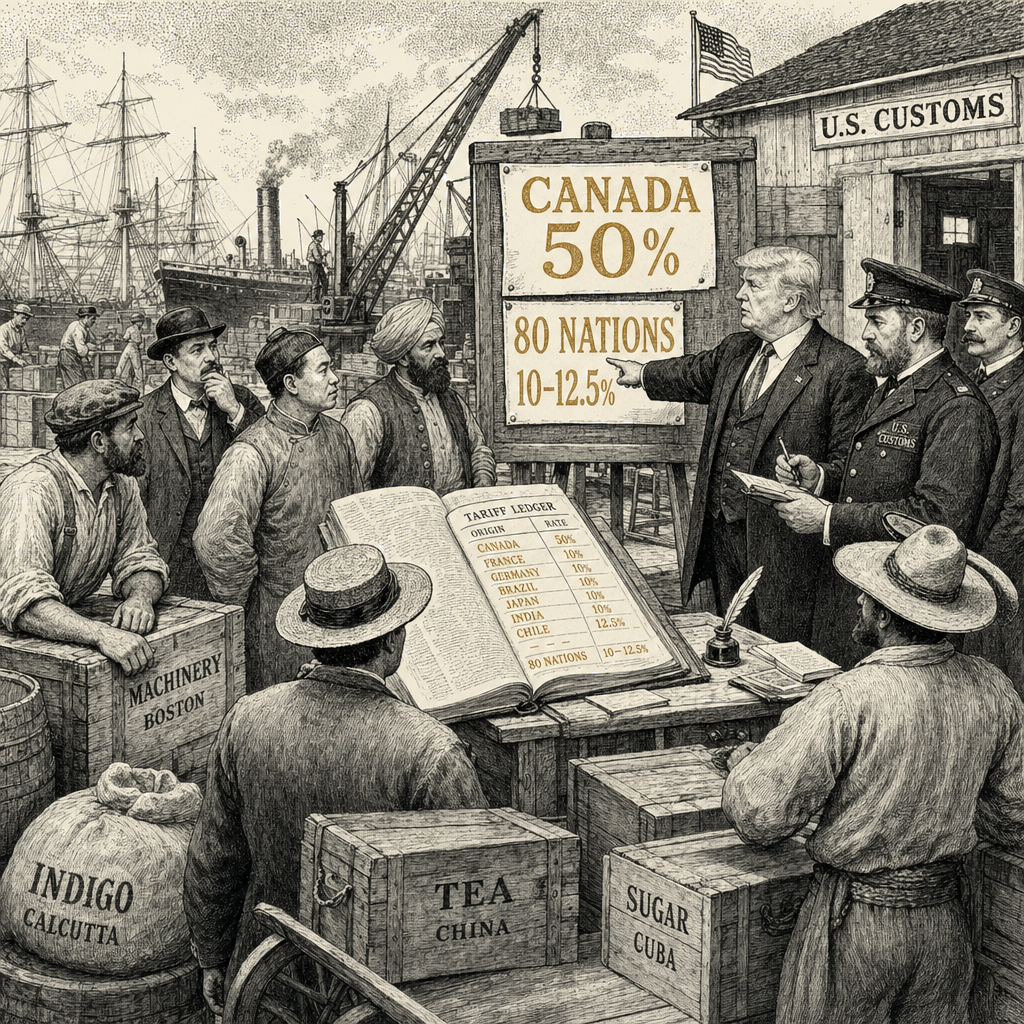
Donald Trump is using a 1930 Depression-era tariff law to punish Canada for wildfire smoke, and the Roberts Court built the doctrine that makes the absurdity legally irrelevant. The statute is § 338 of the Tariff Act of 1930 — the Smoot-Hawley Act — which authorizes the president to impose “new or additional duties” on imports from countries that “discriminate against the commerce of the United States.” The provision sat unused for nearly a century. Trump invoked it on July 24 to impose a 50% tariff on Canadian goods. His stated justification: Canada retaliated.
The strongest textual case for § 338 is straightforward. Canada’s provinces halted US liquor imports. Canada imposed a 25% tariff on US-made cars after Trump imposed a 25% tariff on Canadian-made cars. On their face, those are discriminatory measures directed at US goods. The statute asks only whether discrimination exists — it does not require the president to explain why it occurred. Read charitably, § 338 gives the president a tool to defend US commercial interests when trading partners single out American products. The provision was enacted to address genuine trade discrimination, not to punish countries for responding to American tariffs.
The strongest textual case for the forced-labor trade enforcement provision is also coherent. Forced labor in global supply chains is documented: cotton and polysilicon in China’s Xinjiang region, rice in Myanmar, tobacco in Malawi. The provision authorizes trade measures against countries failing to enforce prohibitions on forced labor. The USTR issued a report finding that Canada, the United Kingdom, Australia, Norway, Japan, China, and the European Union were not doing enough. Read charitably, the provision gives the president leverage to advance human rights through trade — the logic behind the Magnitsky Act and the Uyghur Forced Labor Prevention Act.
The strongest textual case for the third avenue — the International Emergency Economic Powers Act, 50 U.S.C. § 1701 et seq. — no longer matters. In Learning Resources, Inc. v. Trump, the Court held that IEEPA, which authorizes the president to “investigate, block during the pendency of an investigation, regulate, direct and compel, nullify, void, prevent or prohibit” transactions involving property in which a foreign country has any interest, does not authorize the imposition of tariffs. The statutory text does not include “tariffs,” “duties,” or “import taxes.” The ruling invalidated Trump’s “Liberation Day” tariffs. IEEPA is closed.
The audit begins where the steelman ends. Trump’s argument under § 338 is that Canada discriminated when its provinces halted US liquor imports and when Canada imposed matching auto tariffs. Canada’s liquor ban was a direct response to Trump’s own tariffs and his public statements about making Canada the 51st state. Canada’s auto tariffs matched Trump’s auto tariffs in both rate and scope. The statute was designed to address genuine trade discrimination — countries that single out US goods for reasons unrelated to prior US trade actions. Using it to punish retaliation for the president’s own tariffs converts a defensive instrument into an offensive one. Trump is telling Canada: I have the right to hit you. If you hit back, that is discrimination.
The forced-labor audit is worse. Norway pioneered laws to crack down on forced labor in overseas supply chains. The European Union’s ban on goods produced with forced labor takes effect December 2027. Canada already bans imports made with forced labor. These are the countries Trump’s USTR found were not doing enough. Meanwhile, the Trump administration cut more than $500 million from the Labor Department’s efforts to investigate and combat forced labor, child labor, and human trafficking. “This was a completely indiscriminate meat ax that was taken to these projects, and workers will suffer,” said Thea Lee, who served as the Labor Department’s deputy undersecretary for international labor affairs under Biden. Kelly Fay Rodriguez, Biden’s special representative for international labor affairs, told Equal Times: “It is extremely likely that child labor and forced labor practices will increase. We know these problems are endemic but … we’ve wiped out the resources and the prioritization for fighting them.” The provision was designed to advance human rights through trade. Trump is using it as a statutory vehicle to impose tariffs he could not impose through the avenue the Court closed in February.
The doctrinal architecture that permits both is not one ruling but a regime. In Learning Resources, the Court struck IEEPA as tariff authority. But the ruling was a statutory holding: IEEPA’s text does not authorize tariffs. The Court did not hold that the president lacks tariff power under other statutes. It did not hold that the Court will examine the stated rationale for pretext. It did not hold that the choice among statutory avenues is reviewable. The operative rule: once the president identifies a statute that arguably covers the action — § 338 of Smoot-Hawley, the forced-labor provision, Section 301 of the Trade Act of 1974 — the judicial inquiry stops. The standing contraction forecloses challenges by the parties most harmed. The political-question doctrine treats trade policy as committed to the political branches. The broad delegations are read as constitutionally permissible. The president’s stated reason is the only reason the law recognizes.
The Yale Budget Lab estimates Trump’s tariffs will cost the average US household $1,100 per year. The US has lost 75,000 factory jobs since Trump returned to office, with many executives citing the uncertainty Trump has created. Both are facts without a forum — the kind of evidence that would support a challenge if the Court’s doctrine permitted one. The constitutional answer is that Congress has the power to regulate foreign commerce and the president does not have the authority to start trade wars on pretext. The doctrinal lock is what makes that answer un-litigable.
“We’re going to put a big tariff on Canada because of the smoke,” Trump told reporters. The statute does not require the justification to be anything other than stated. The doctrine makes the absurdity legally operative.