
Donald Trump is using a Depression-era tariff law to pursue a tax policy with household costs.
Here is the law. Section 338 of the Smoot-Hawley Tariff Act of 1930 authorizes the president to retaliate against any country that puts the United States “at a disadvantage compared with the commerce of any foreign country.” Once the president finds such a disadvantage, he may “declare such new or additional rate or rates of duty as he shall determine will offset such burden or disadvantage.” The statutory language is broad enough to invite disputes over how many trading partners could be covered. Every country has tariffs, regulations, subsidies, or other policies that affect American exports.
Section 122 of the Trade Act of 1974 and section 301 of the same Act are also in play, but the new method is the same. Section 122 permits tariffs to address balance-of-payments problems for a window of 150 days. That made more sense in 1974, when exchange rates were fixed and a government could face pressure to defend its currency by selling foreign assets. The dollar now floats. A currency that falls makes dollar assets cheaper to foreign buyers, allowing capital inflows to help restore balance. The economic condition that animated the statute is not the condition the administration is describing. The statutory limit remains. The theory has moved on. Section 301 is designed to address specific foreign “acts, policies and practices” that are unreasonable and burden or restrict American companies. A blanket finding that every country enables forced labor would face a serious question under that requirement. It does not become a specific finding because it is printed on White House stationery. The legal rationale appears to have been developed to support a policy whose scope was already chosen.
The provision that matters most is section 338, because it gives the president a legal vocabulary for converting almost any trade grievance into a tariff schedule. Congress left that authority in a 1930 statute and never removed it. Until this administration, section 338 had not been used to impose tariffs. It had functioned mainly as leverage to obtain equal treatment for American products when another country gave preferential access to a trading partner. That was a recognizable trade practice. The current use is different: a dormant provision is being treated as a potentially broad presidential power to decide which foreign conduct counts as a national disadvantage and how much American importers must pay in response.
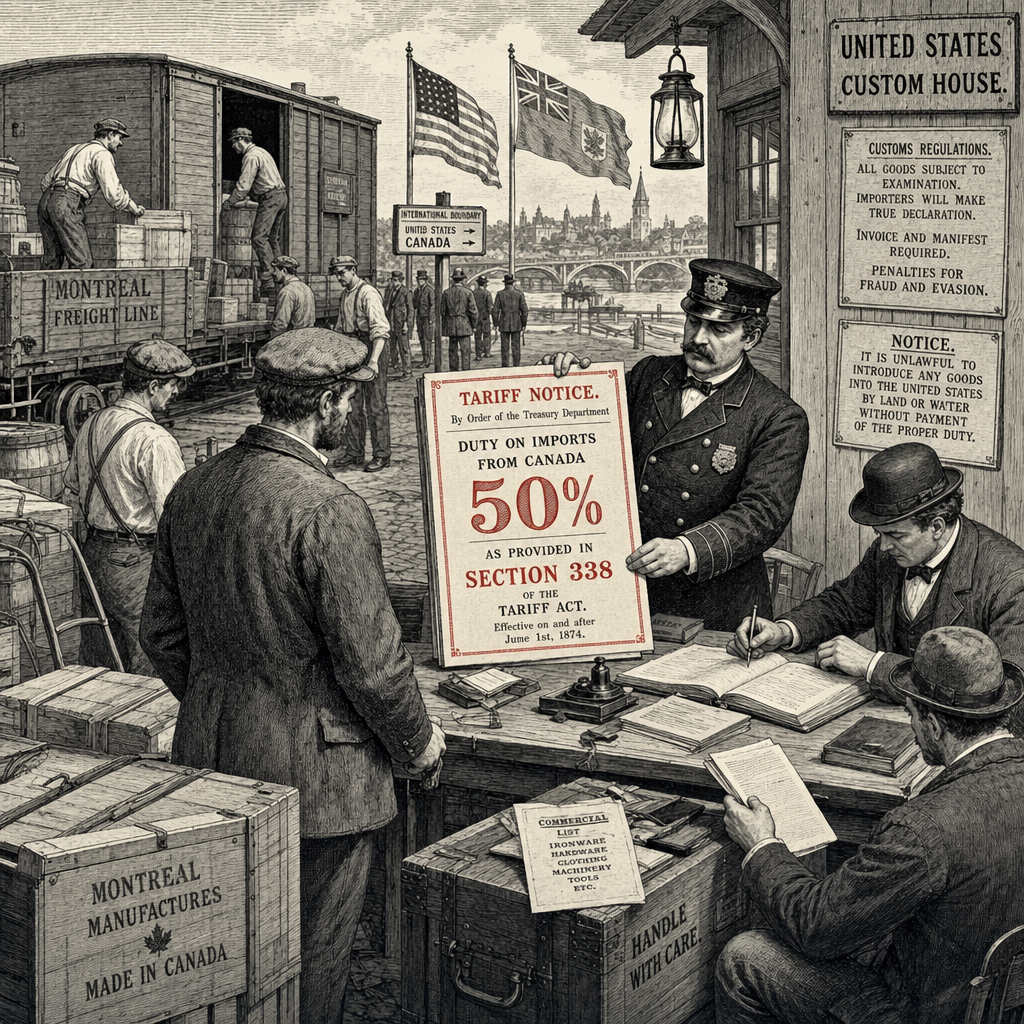
In late July 2026, the administration imposed a 50% tariff on imports from Canada, citing Canadian discrimination against American dairy, alcohol, and automobile producers. The Canada justification is especially thin: the Canadian measures were themselves described as retaliation for earlier Trump tariffs. The administration is using a 1930 law to escalate a trade war of its own creation. The provision was originally a bargaining chip. It is now being used as if it were a blank check.
The economic cost can land on American households. A tariff is collected from American importers at the border. Its economic incidence can then be distributed among importers, foreign suppliers, domestic producers, and consumers through supply chains, prices, and margins. The foreign government receives the diplomatic message. American businesses and buyers receive the bill, in whatever proportion the market permits them to pass it along.
The Supreme Court struck down Trump’s use of the International Economic Emergency Powers Act to impose tariffs in February 2026, in a 6–3 decision that included two justices appointed by Trump. The Court rejected that statutory route, not the administration’s effort to find another one. Since then, the administration has searched the statute books for alternatives. Section 338 is the most consequential because the statute says the president “shall determine” the duty. Congress left substantial discretion in the text, but the extent of that discretion remains the legal question. The immediate test is whether courts will accept the administration’s reading of a Depression-era statute as authority for a broad tariff program. The Smoot-Hawley Act contributed to the collapse in global trade during the Great Depression. The president is now invoking a provision from that law in a manner that tests how far its language can reach.
There is a legitimate case for targeted trade action. Foreign subsidies can disadvantage American producers. Forced labor is a genuine legal and moral concern. National-security restrictions can be necessary. None of those propositions gives the president a general power to impose tariffs whenever a foreign country becomes politically inconvenient. A specific instrument requires a specific finding. A national-security authority requires a national-security record. A retaliation statute requires an identifiable foreign act. The author of the tariff does not get to grade the evidence for it.
The relevant policy is straightforward. Congress should restore clear tariff ceilings, require country- and conduct-specific findings, and prevent the executive from converting emergency statutes into permanent taxing authority. Trade policy requires negotiation, enforcement, and legislative accountability. It does not require a president with a menu of dormant statutes and no durable definition of the offense.
The question is no longer whether Donald Trump wants a trade war. The question is whether section 338 will let American importers finance it. That is a policy choice. The result would be a tax on American households imposed through a statute whose reach Congress has left unusually broad.