
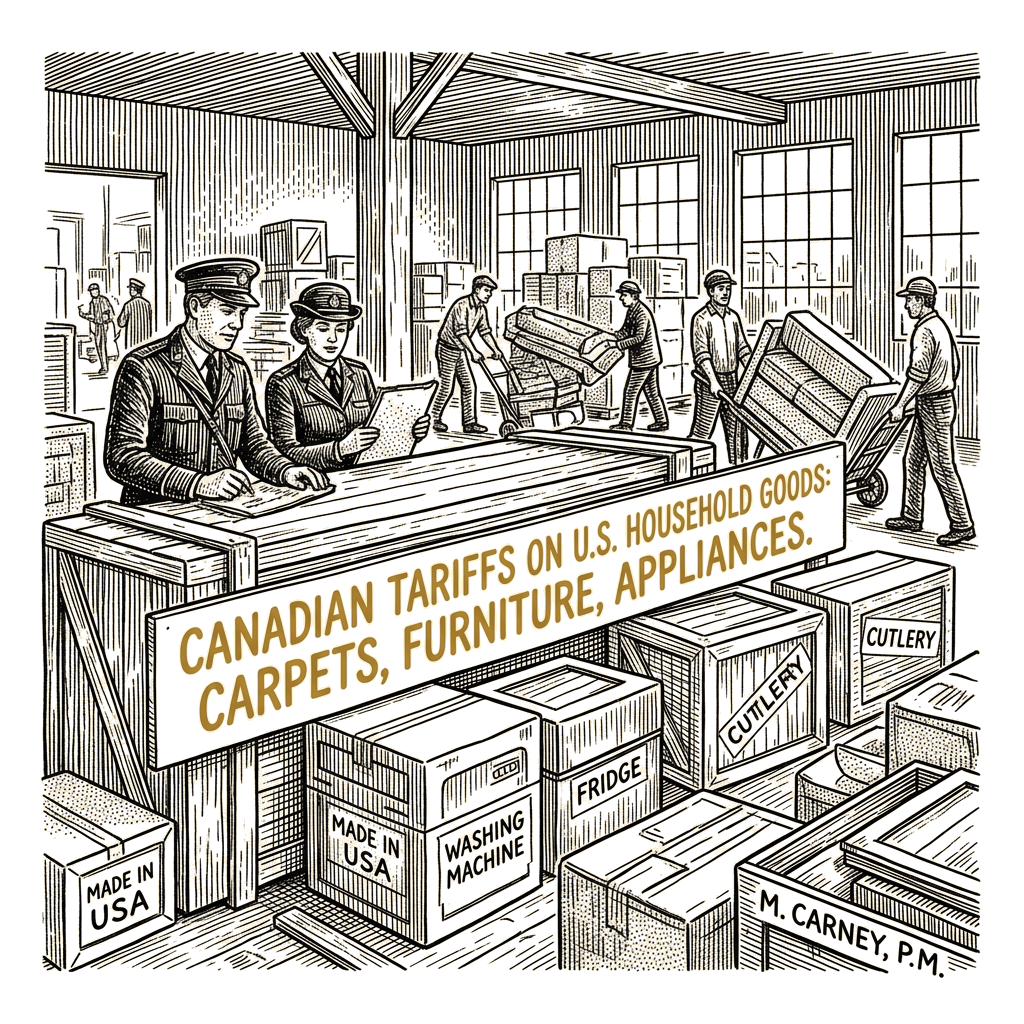
Donald Trump is taxing American homebuilders and car buyers to satisfy a political base that will pay the bill itself. Mark Carney just handed Canadian workers the cleanest industrial policy of the decade. The retaliatory tariff list he dropped this week — carpets, washing machines, furniture, fridges, cutlery — is not a revenge package. It is a vending machine stocked with domestic substitutes, and every item on it is something Canadian factories already know how to make.
The list takes effect September 8. It was built, deliberately, around fungibility. Bradley Saunders at Capital Economics called the method plainly: Carney “intentionally targeted goods where Canadians can shift to domestic suppliers instead.” Hair care products. Mattresses. Appliances. Plywood. The screws used to fix timber together. The point is not to raise prices on Canadian households. The point is to redirect demand into Canadian mills and Canadian lines, while exposing American manufacturers who depend on Canadian customers to the kind of shutdown risk that ends quarterly earnings calls and starts labor disputes.
The genius is what is not on the list. Carney has declined to match Donald Trump’s threatened 50% auto tariff — set to take effect January 1, 2027 per Trump’s August 24 Truth Social post — even though a 25% import tax on certain US vehicles has been in place since last year. Carney is holding back the punch that would hit Canadian assembly lines and Canadian car buyers at the same time. Trump posted first. Carney’s roughly $20 billion retaliation package, announced August 26, came after trade talks collapsed. The sequencing matters. The asymmetry is the message.
The economists, for once, are saying so out loud. John Iselin at the Budget Lab at Yale put the marginal cost of this particular exchange at roughly $3 per American household. Add Trump’s broader trade war — particularly with China — and the average US family absorbs about $1,000 in added costs. Anyone framing $3 as the breaking point of the US-Canadian relationship is selling you something. The $3 figure is the bill for this exchange. The $1,000 figure is the bill for the Trump program. The two numbers are not the same story, and the panic pieces keep quoting the wrong one.
Bernard Yaros at Oxford Economics noted that dealerships have absorbed the “lion’s share” of previous tariff increases but that “that cushion is wearing thin.” Translation: the next round hits consumers directly. Carney’s list of US household goods is precisely calibrated to avoid that outcome on the Canadian side, by picking categories where Canadian alternatives already exist. “You really can just buy that domestically instead,” Saunders said of hair care. The same logic applies to washing machines and plywood.
The construction side is where Carney has matched US escalation. Canada took its steel and aluminum duties to 50% to mirror American rates, and added fresh tariffs on US plywood and the screws used to fix timber together. The Forest Products Association of Canada said the duties will “raise costs on both sides of the border.” That is the point. Canada’s forest industry employs almost 200,000 people and has been asking Ottawa for years to redirect federal housing programs toward Canadian lumber. Carney just did it with a tariff instead of a procurement memo. A 2024 US Congressional report found the US imported $23 billion of wood products that year, almost half from Canada. The so-called “lumber wars” between the two countries stretch back decades. They never ended because Canada never had to compete on equal terms. Now it does.
Bill Owens, chairman of the National Association of Home Builders, begged Trump to exempt building materials from his tariff agenda and cited an “ongoing housing affordability crisis.” “Building material tariffs heighten market uncertainty, strain supply chains and increase construction costs,” he said. That plea has merit for American homebuilders, but it accidentally confirms the central truth of the moment: building materials are exactly where the price reality has been distorted the longest. Pulling that distortion into the open is a feature, not a bug.
The auto side is where the cushion is thinnest. Yaros warned that the threatened 50% tariffs on Canadian autos, trucks, and car parts would feed through to consumer prices more readily than before, and that manufacturers will accelerate their shift toward luxury vehicles, SUVs, and pickup trucks while tightening supplies of cheaper new cars and pushing up prices in the used-car market. When cheap cars get tariffed, automakers build expensive ones. The used-car buyer pays. None of this is a surprise and all of it was telegraphed by industry signals that date back to the first Trump tariff cycle.
The liquor shelf is the cleanest tell. Canadian provinces banned US alcohol sales last year after earlier tariffs; American wine and spirits exports to Canada dropped more than 70%. Carney asked the provinces to restore US alcohol during trade talks. The talks collapsed. Saskatchewan and Alberta are now the only provinces still selling American alcohol — and Saskatchewan has announced its own 50% surcharge on US-imported alcohol effective September 8, the same day the wider Canadian tariffs hit. That is what strategic patience looks like when paired with strategic leverage: keep the door open, walk away on your own terms, and let the other side keep walking.
There is a longer game underneath the list. Both Canada and Mexico have requested a 16-year extension of the United States-Mexico-Canada Agreement. The US has said it will not renew the deal in its current form. Tariffs are how you renegotiate a trade deal you refuse to renegotiate at the table. The current USMCA was a 2018 artifact written for a 2018 supply chain. The supply chain has changed. Carney’s list reads the room: fungible goods switched, non-fungible goods negotiated, dependencies disclosed. The agreement will follow.
The Trump program is the mirror image. It taxes inputs, raises consumer prices, hands the bill to American homebuilders and American car buyers, and asks them to be grateful for it. Carney’s program taxes finished goods, redirects Canadian demand to Canadian factories, and asks Canadian households to change brands. One of those programs has a constituency after the news cycle moves on. The other one has a press release.