
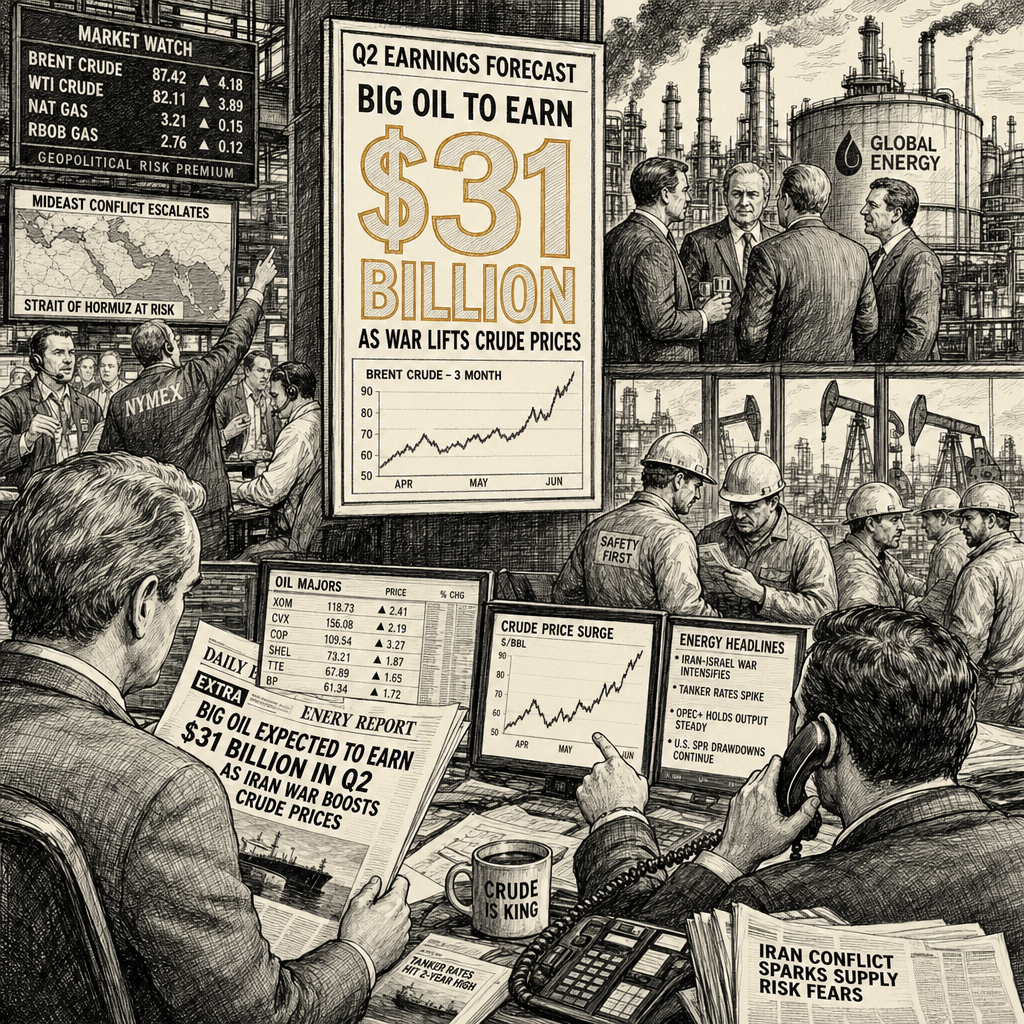
The Trump administration started a war that spiked crude from $66 to $95 a barrel, and now it is investigating the companies that profited from the war it started. ExxonMobil, Chevron, ConocoPhillips and Occidental Petroleum are expected to report a combined $31 billion in second-quarter earnings this week — up from about $12 billion in the same quarter last year. That $31 billion is a war dividend, plain as the diesel price sign on Highway 13.
That is the nationalist shell game in its purest form — promise cheap fuel, deliver a war that enriches the people you promised to fight, then blame them for taking the money.
I buy fuel at the co-op in Friendship. The pump does not care about the administration’s energy rhetoric. It cares about what a barrel of crude costs, and right now a barrel of crude costs what it costs because the administration ordered strikes on Iran last year and the Strait of Hormuz — through which one-fifth of global oil transit normally flows — has been intermittently closed since. In March, with crude surging past $100, the president told advisers: “We make a lot of money.” He was right. The companies did. Now gasoline is above $4 a gallon in most of the country, the midterms are coming, and the same president has ordered the Justice Department to investigate the same companies, naming Exxon, Chevron, Shell and BP as targets.
The math does not support this. A year ago, at $66 crude, these four companies earned $12 billion in Q2. This year, at $95 crude, they will earn about $31 billion. The marginal dollar did not come from a hidden markup. It came from a $29-per-barrel increase in the underlying commodity, which is traded globally, set by supply and demand in a market the administration disrupted with a war. To accuse these companies of gouging, the administration would have to show that they raised margins above what the crude-price increase justifies. The publicly available data suggests the opposite: the margin is the price of the barrel, and the barrel costs what the war made it cost. No DOJ investigation has ever repealed the laws of supply and demand.
The industry’s counter-argument is straightforward: U.S. production is at about 13.8 million barrels a day, up 525,000 barrels from a year ago. The American Petroleum Institute has urged the administration to extend the Jones Act waiver and adjust biofuel blending mandates — two concrete steps that could lower pump prices by a few cents without requiring the industry to sell crude at below-market rates. Neither requires the kind of dramatic confrontation the DOJ investigation implies.
But the industry has made an active choice with the windfall. These companies have long pledged to investors to use their cash to reward shareholders, not grow production, and their chief executives do not expect prices to stay high long enough beyond the conflict to justify changing their drilling plans. The companies are pocketing the war premium through buybacks and dividends rather than investing it in new capacity that might ease the supply squeeze. That is their right — it is what they told investors they would do, and it is the rational play when nobody knows whether crude will be $95 or $65 a year from now. But it means the same companies the president is investigating are choosing not to drill their way toward the lower prices the president promised. The shell game has two players.
At the bench in Friendship, I do the math. Diesel past $4 — what it means for the school district’s fuel budget, for the heating-oil contract the co-op is quoting for August, for the neighbor who runs a dairy on 120 head and has watched his hauling costs double in six months. A $30 jump in crude translates to roughly $0.60 to $0.80 a gallon at the retail level. The man who fills a 35-gallon tank in a 2014 Silverado is paying $15 to $20 more per fill-up — $60 to $80 a month. These are not abstract figures. These are the numbers a working household in Adams County or any comparable rural county reads on the pump face every week. No production statistic or DOJ press release will put the money back in his pocket.
The White House is running out of levers. Treasury Secretary Scott Bessent has warned oil companies to lower prices. Some of its own advisers have floated an export ban, which Energy Secretary Chris Wright has publicly rejected and Chevron CEO Mike Wirth testified would only drive prices higher: “Things that impede markets might have political appeal, but they ultimately can make the situation worse, not better.” The one lever the administration will not pull is the one that would actually work: ending the war. The administration struck a ceasefire in June, crude slumped, and oil CEOs breathed a sigh of relief. Then the conflict rekindled and spread — Houthi militants launched a naval blockade in the Red Sea, cutting off an alternative shipping route that had been relieving some of the pressure from the Hormuz closure. That second chokepoint closure removed the one valve that had been partially offsetting the Hormuz disruption; the price effect is no longer a single blockage but two, compounding on each other. U.S. oil stockpiles have been staying near operational limits as the ceasefire collapsed and prices climbed back.
You cannot drill your way out of a chokepoint closure. The bottleneck is not in Texas; it is in the water. Producing more crude in the Permian Basin does not matter if the tankers cannot get it out of the Gulf. The administration’s own war policy is the mechanism that made the companies profitable, and the administration cannot solve the price problem without admitting what it knows to be true. Dan Pickering of Pickering Energy Partners put it plainly: “I don’t necessarily think the Trump administration is a friend of the profitability of oil companies.” That sentence should be read twice by anyone who believes the “drill, baby, drill” campaign slogan described an actual policy relationship.
Every week the conflict continues, money leaves the wallets of the people who live in towns like this one and moves into the accounts of the same companies the president is publicly investigating. That is not a conspiracy. That is what a commodity market does during a supply disruption. The nationalist shell game is the part where the administration that caused the disruption blames the companies that profited from it, runs an investigation that cannot change the price, and hopes the voters forget who started the war and why crude is $95 a barrel instead of $66. Since the administration will not admit that the war is the problem, it investigates. The man at the pump pays the difference.