
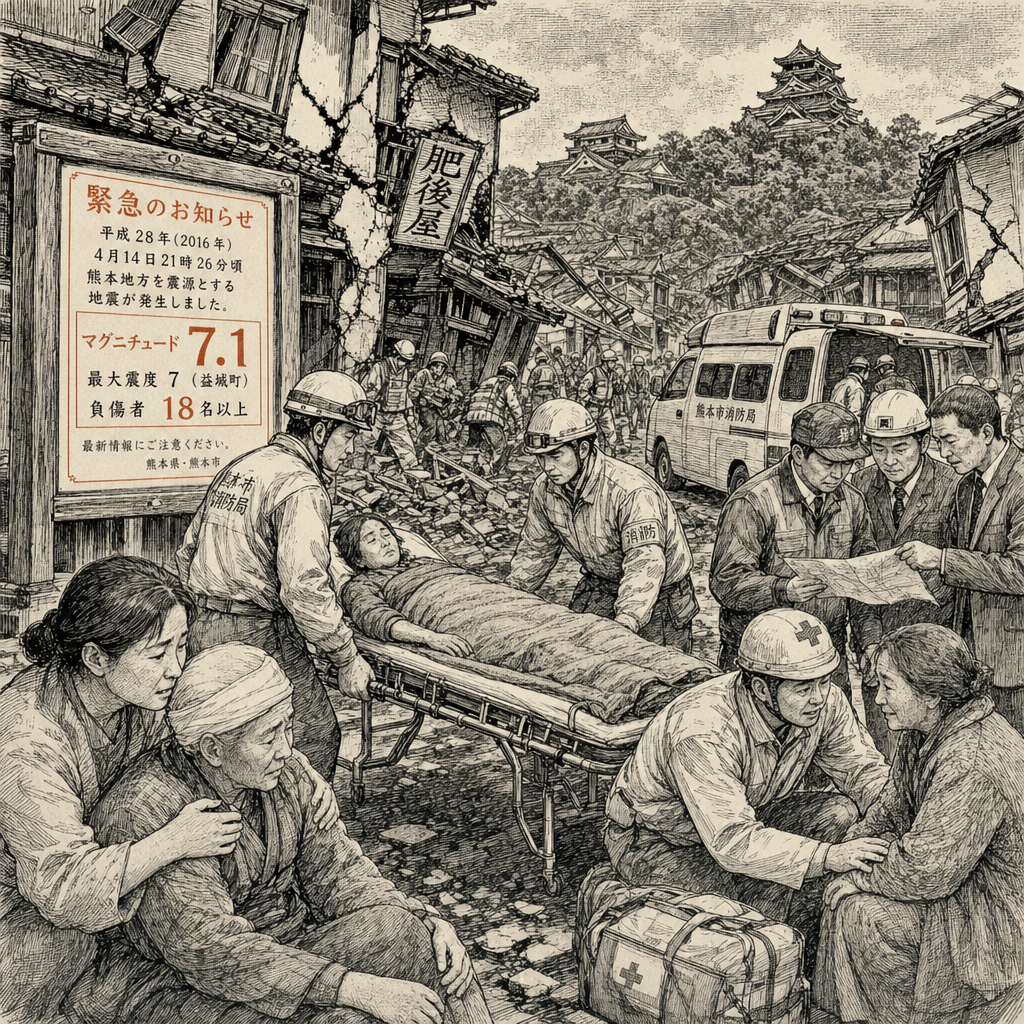
A Vietnamese technical intern arrived in Japan in January. By July 28, he was dead under a crane that fell on him at his factory in Kumamoto Prefecture. He had a name; the reports give only his nationality and the month he arrived. He was one of thousands of foreign workers operating under Japan’s Technical Intern Training Program—a system officially designed to transfer skills, functionally structured to supply cheap, compliant labor to industries facing chronic shortages. When the 7.1 magnitude earthquake struck, the building codes determined who lived and who died, and the labor hierarchy determined who was most likely to be inside the structure that failed.
The quake killed at least eighteen people. Four died in a gas explosion and second-floor collapse at the Aeon Mall in Kashima City. Five died when a chimney collapsed at a Nippon Paper Industries factory in Yatsushiro. The intern died under a crane. These are not random casualties of an act of God. They are the predictable output of a system that assigns risk according to power and profit.
The cui-bono trace here is not a single policy but a persistent structural choice. Japan’s building codes are among the world’s most rigorous—a necessity in one of the planet’s most seismically active nations. But codes are only as strong as their enforcement, and enforcement encounters the same resistance everywhere: the cost of compliance versus the immediate, calculable expense of a disaster that might not happen on the current quarter’s balance sheet. The Kumamoto quake of 2016 killed at least fifty people and prompted renewed calls for retrofitting. Seven years later, the same prefecture is buried in rubble again. The question is not whether the lessons were learned. The question is whether the economic incentives were ever aligned to implement them. The claim that no amount of retrofitting could have saved these specific buildings is the same claim every government makes when a disaster reveals neglected infrastructure; it ignores the fact that post-2016 funds disproportionately went to publicly visible landmarks while industrial sites and low-income housing were left to rely on decades-old standards.
For the intern, the incentive structure was simpler and more brutal. The Technical Intern program places workers in small and mid-sized factories—the very facilities least likely to have invested in seismic reinforcement beyond the minimum, and most likely to rely on foreign labor precisely because it is cheaper and less likely to refuse dangerous assignments. The intern was killed by a crane; cranes fail in earthquakes when they are not properly secured or maintained. The cost of securing a crane is a line item. The cost of a dead intern is, for the employer, a tragedy that will be reported to the Vietnamese government and folded into the next intake of interns. The program’s design—inherently hierarchical, with workers’ visa status tied to a single employer—eliminates the most basic form of worker power: the ability to walk away. This is not a bug. It is the operational core.
King, in his final years, insisted that a society’s budgets are moral documents. A nation that spends more on military defense than on social uplift is, he said, approaching spiritual death. The late King’s framework applies directly to disaster preparedness. The question is not whether Japan can afford to retrofit every factory chimney, secure every crane, and enforce every code provision. The question is who bears the cost of not doing so. The answer, as always, is the most vulnerable: the workers in the factories, the shoppers in the mall, the residents in the older buildings. The beneficiaries of deferred maintenance are the owners and shareholders who book the savings now, while the risk is externalized onto bodies that can be replaced.
Malcolm X once said, “We didn’t land on Plymouth Rock; Plymouth Rock landed on us.” The international technical intern lands in Japan not on an equal footing but inside a structure of managed dependency. He is there because the program recruits from countries where the economic alternative is worse. He works in a sector where the physical risk is highest. When the earthquake comes, the building that fails is the one where investment was deferred. The worker who dies is the one with the least power to demand a safer facility. This is not a natural disaster. It is a social one, with natural forces as the trigger.
The pattern extends beyond Kumamoto. Earlier this year, earthquakes in Venezuela killed more than 2,500 people and injured thousands, with NASA estimating damage to nearly 59,000 buildings. In the Philippines, a 7.8 magnitude quake killed at least 32. The recurring script is identical: a natural event exposes an infrastructure deficit that was known, documented, and tolerated because the cost of fixing it fell on the wrong side of the ledger. The wealthy retrofit; the poor inhabit the buildings that were built to the old standard, or no standard at all. After 2016, downtown Kumamoto office towers received seismic-reinforcement subsidies while the prefabricated dormitories housing technical interns in surrounding industrial parks were explicitly exempt from the retrofit mandate. The foreign worker is in the facility that cuts every possible corner, because his labor is the corner that has been cut.
It is not metaphor: Kumamoto’s flattened homes, its 34,900 households without power, its 15,000 without water, its 8,800 people in shelters are Japan’s Sanctuary Districts, made visible overnight. The infrastructure was already failing; the quake made the failure visible.
The Prime Minister vows to “go all out.” Self-Defense Forces are deployed. Firefighters from Taiwan assist. The response will be swift, visible, and celebrated. What will not be swift, visible, or celebrated is the quieter work that might prevent the next disaster from being equally catastrophic: the systematic retrofitting of industrial facilities, the enforcement of crane-securing regulations, the reform of a technical intern program that places vulnerable workers in the most at-risk jobs. That work is expensive, slow, and invisible. It produces no photo opportunities. It does not flatter national pride. And so it is deferred, again, until the next earthquake and the next roll call of the dead.
The arc of the moral universe bends toward justice, but only if specific people, in a specific moment, push it. The arc does not bend on its own. It does not bend because of vows or promises or emergency funds disbursed after the fact. It bends when the structural choices that produce predictable death are named, indicted, and changed. The Vietnamese intern who died under a crane in Kumamoto did not die in an unavoidable accident. He died because a system was designed to make his labor cheap and his safety contingent. The dead in the mall, the dead in the factory, the thousands displaced—they are not victims of fate. They are the bill coming due for choices made in quiet rooms where the metrics were profit margins and labor costs, not human lives.
Malcolm Little King