
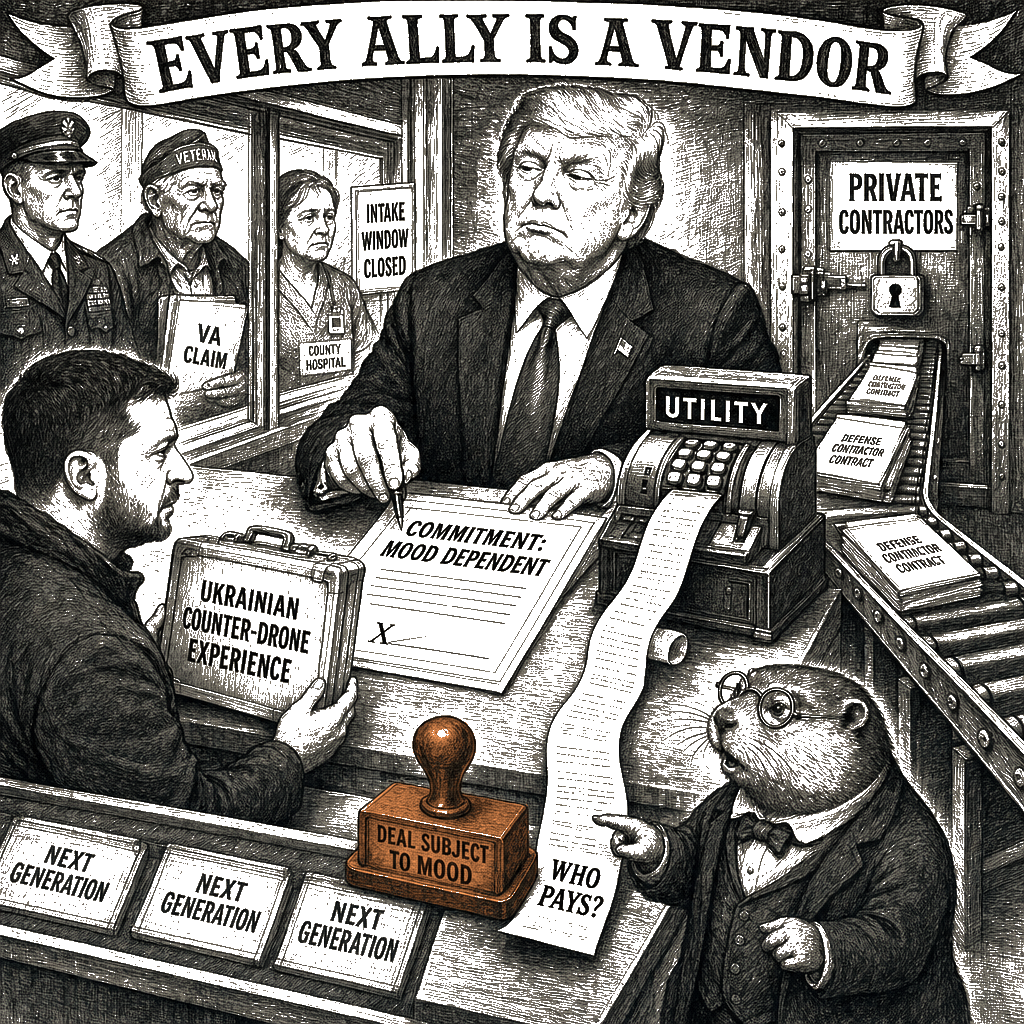
The men I served with in Third Infantry Division are not at this negotiating table.
Now, I’m just a simple man, but I have stood at the parts counter at Zebedee Auto long enough to know what a deal looks like when one side is selling something it cannot afford to lose. The fellow across the counter is grateful for the offer. He makes his case for the asset. He does it because the alternative is worse. I have watched that posture in a customer with a sick transmission. I have watched it in a commander trying to keep his tanks running while the supply line up the road had been told to stop. They are not different kinds of men under that kind of pressure. They are the same kind of man.
Ukraine’s president is selling his country’s survival the way that customer sells his car. He is grateful for the offer. He is making the case for his asset. He is doing it because the alternative is worse. I wish he had another option. He does not. Let me walk you through what the deal looks like, because the transaction we are watching between Washington and Kyiv tells you something important about who this country fights for and who it leaves holding the bag when the deal expires.
In February Volodymyr Zelenskyy walked into the Oval Office and walked out humiliated. The president of the United States called him a dictator in front of the cameras and all but expelled him. Two months later the same man is being praised. At the NATO summit in Ankara this month, Donald Trump floated a license for Ukraine to manufacture Patriot missile interceptors. At the funeral for Lindsey Graham last week, the two shook hands in the receiving line. A woman named Laura Loomer — the far-right influencer whose Russia-friendly views have tracked Trump’s own for years — flew to Kyiv, announced she had been “bamboozled” by Russian propaganda, then called the president and said the conversion was spreading across the MAGA movement.
None of that happened because the moral case for defending a democratic ally against invasion got more persuasive. It happened because Ukraine figured out what this White House buys.
Here is the asset, and it is real. Iran shipped Russia thousands of Shahed drones beginning in 2022, and Ukraine has spent three years learning how to hunt them. That suffering forged a capability most of the world does not have. Zelenskyy has roughly 200 Ukrainian military experts already deployed across eleven Gulf states, advising on Shahed countermeasures. Ukrainian intelligence has been sharing imagery of Russian satellite surveillance of American military facilities, surveillance that correlates with Iranian strike patterns. And last week Ukraine struck an Iranian commercial vessel in the Caspian Sea, justified as arms interdiction bound for Russia. The man who used to beg for Javelins is now offering services the Pentagon cannot supply out of its own inventory.
For a moment, the deal works.
The United States is bogged down in the war it launched on Iran in February. A 60-day ceasefire memorandum signed in June collapsed. The Strait of Hormuz is effectively closed. Iran is retaliating against American bases and Gulf-state infrastructure with the very Shaheds Ukraine knows how to defeat. In that moment of need, a foreign leader showed up at the buyer’s window with exactly the product the buyer required. The whole pivot is in that sentence. It is transactionalism working as designed.
Now here is what this transaction looks like from the working side of the counter, because the working people are not in the room. And we never have been. The defense primes — Lockheed Martin, RTX, Boeing, Northrop Grumman, General Dynamics — they get the contracts whether the war is won or cut short. The Tomahawks and the THAAD batteries and the F-35s being fired at Iranian targets tonight were procured, in many cases, under programs whose original rationale had nothing to do with Iran. They were procured under the bipartisan operating system that Andrew Bacevich, in Washington Rules, named for what it is: maintain global military preeminence, project power forward, intervene where American interests — read, the interests of the people who own the contractors — are threatened. That operating system was not always wise. From where I sat in the gunner’s seat in 2003, I can tell you it produced its share of disasters. But it rested on a baseline principle: that American commitments stood for something beyond their immediate market value.
What we are watching this summer is not a refinement of that operating system. It is its liquidation. The order is being stripped to its machinery and the meaning is being thrown away.
That has practical consequences for the people back home the war is being negotiated over. Every commitment is now subject to price discovery. Every ally is a vendor. The Patriot license Trump dangled at Ankara has already been walked back within days. The deal is a deal only as long as the buyer’s mood holds, and the buyer’s mood is held together by a war he started and cannot finish. Zelenskyy’s acting foreign minister called his Iranian counterpart this week to stress that Kyiv’s actions are aimed solely at defending against Russian aggression. But the signal has already been sent — to Tehran, to Riyadh, to Moscow. Ukraine has made itself a node in a wider conflict, and the wider conflict is now what determines the value of the asset.
The class dimension of this is what gets me. There are no children of the defense contractors’ senior vice presidents flying F-35s into Iranian airspace. There are no fourth-generation grandchildren of the senators who vote to authorize these wars pulling security details outside the U.S. Central Command compound at al-Udeid. The men in those cockpits and on those details come from the towns I come from — small Southern towns, mountain towns, towns where the recruiter’s office in the strip mall was the only path to the GI Bill. They come from neighborhoods that have been waiting twenty-five years for the VA to process the disability claims from the last round of deployments that Washington decided were necessary. They come from communities whose county hospitals are one bad reimbursement cycle away from closing, and whose municipal budgets are stretched thin by the per-capita cost of caring for the same veterans the federal government keeps failing. That is what makes this not a foreign-policy story. It is a what-happens-to-the-next-guy-who-has-to-go story.
Zelenskyy, to his credit, has been forced into this posture by circumstances no leader should have to face. A nation invaded by Russia, dependent on American weapons, now dependent on American good humor, with no guarantee the humor lasts the week. He has taken the moral case for Ukraine — the simplest case in modern international relations, a country defending its own territory against an aggressor — and converted it into the only language this White House will hear. Value proposition. Vendor relationship. We are not asking for charity. We are offering a product.
Thomas Schelling, in The Strategy of Conflict, wrote that alliances work because they create shared commitments that constrain both parties. The commitment is the point. You do not negotiate the price of the fire department while your house is on fire. You do not haggle with the nation defending you against conquest. Clausewitz, in On War, told us the trinity holds together because the people, the army, and the government trust each other. What this White House is asking Zelenskyy to do is collapse that trinity into a purchase order. The people cannot trust the commitment because the commitment has no fixed price. The army cannot trust the supplier because the supplier’s mood shifts by the cabinet meeting. The government in Kyiv cannot plan beyond the next tweet.
And the people — the actual people, the ones who serve in the cockpits and on the recruiters’ floors and in the county hospitals that pick up the cost of caring for the ones who come home broken — the people pay for this twice. Once on the front end, in the defense budget that flows through the contractors who wrote the operating system Bacevich warns about. Once on the back end, when the same budget does not have room for the VA, for the county hospital, for the post-9/11 cohort that is now entering its third decade of elevated suicide rates and unprocessed claims.
Two analysts I read flag the deeper danger. Trita Parsi, at the Quincy Institute, warns that Ukraine risks merging two wars into one — that the very intelligence-sharing and counter-drone advisory that secured Trump’s ear also confirms to Tehran that the Russia-Ukraine war and the U.S.-Iran war are a single theater. Every Ukrainian drone expert sent to Riyadh, every CENTCOM intel feed that originated in Kyiv, widens the set of targets Iran considers legitimate. Matt Duss, at the Center for International Policy, raises the objection a working-class reader cannot skip. He points out that by aligning with Israel’s war on Iran, Zelenskyy risks associating Ukraine with a campaign that much of the world, including many of Ukraine’s own supporters, sees as doing to Palestinians what Russia has done to Ukrainians. That moral symmetry erodes the bipartisan backing that has sustained Ukraine through three years of war. It turns a defensive war into a coalition war at precisely the moment the coalition’s cohesion is the only thing keeping the defensive war going.
I want to weigh in on that last point, because Duss has named the thing that ought to keep the men I served with up at night. We did not go to Iraq in 2003 because the moral argument was clean. The moral argument was fudged, and we who served knew it was fudged, and we fought anyway, and we came home and we carried what we carried. If the bipartisan backing for Ukraine erodes because the coalition war in the Middle East makes the defensive war in Eastern Europe look like something else — if the moral symmetry Duss names becomes the lesson — then the next generation of small-town kids who walk into a recruiter’s office is going to be told they are fighting for a cause nobody outside the cause can describe in one sentence. We know what that cost looks like. We have already paid it.
The closing ledger is this.
Ukraine’s survival now depends on Ukraine’s utility. Utility is tied to one war. That war is being run by one man. That man’s promises turn to vapor by the next cabinet meeting. The Patriot license is already wobbling. The deal is a deal only as long as the customer decides it is.
And the working people of this country — the ones who pay the defense budget, the ones who provide the next generation of soldiers, the ones whose communities absorb the cost when the wars expire — we are not at the table. We never have been at the table in this arrangement. We are the parts in the machine. We are the inventory that gets used and not replaced.
Zelenskyy is pitching his country’s survival as a deal because that is what the buyer will accept. The buyer is wrong about the principle. The seller is wrong about the logic. And the people neither of them asked are the ones who will pay, whichever way the deal lands.