
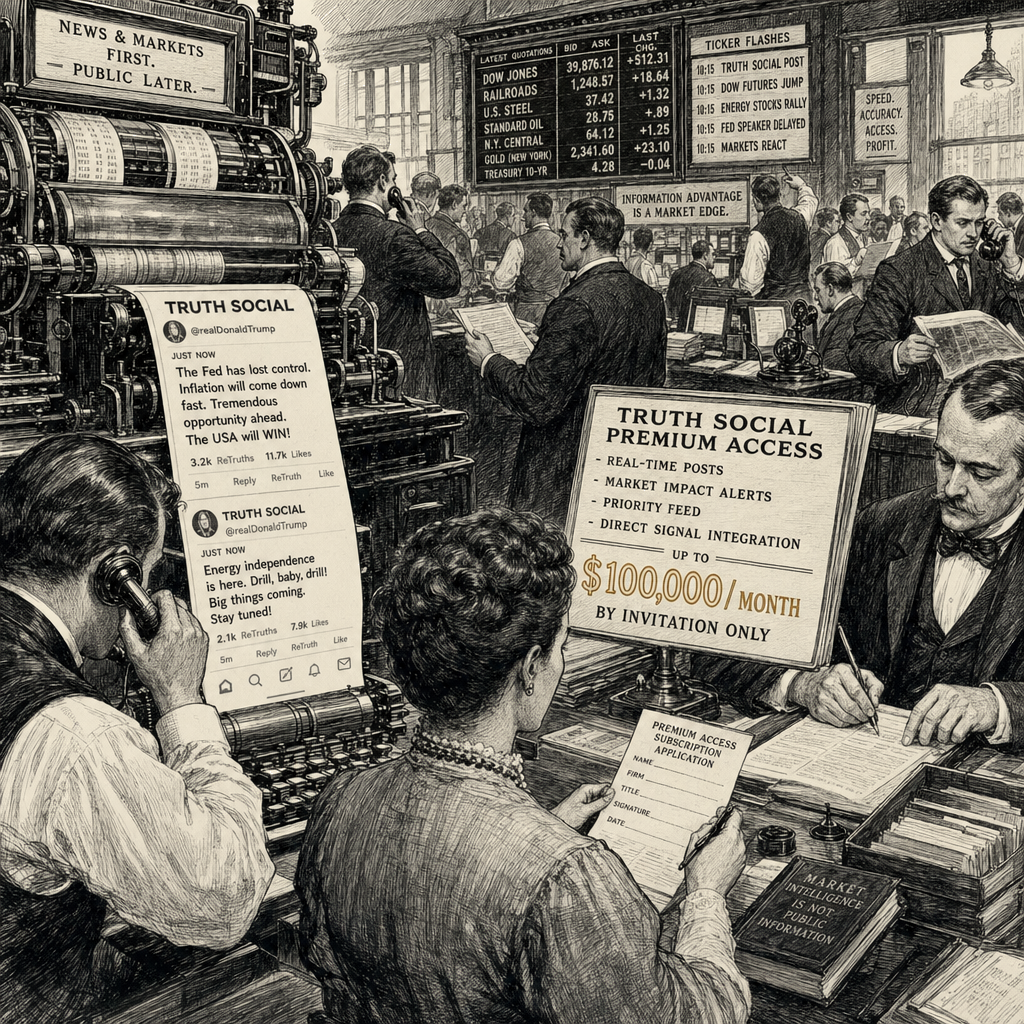
They put a price tag on the Oval Office and called it an API. NPR reported this week that Trump Media & Technology Group is now selling early access to the president’s Truth Social feed — his announcements on tariffs, sanctions, and military deployments — to institutional investors for up to $100,000 a month, through a product they call Truth API. The president is the company’s largest shareholder; the stake is held through a trust controlled by his eldest son. The mechanism is simple and the grift is clean: the president announces tariff policy on Truth Social; the trading firm paying $1.2 million a year reads it minutes before the rest of the planet; the firm trades on the move; the president’s company collects the subscription fee. The taxpayer gets nothing. The investor with a Fidelity account in Sheboygan gets the information last, which is where she has always gotten it — except that in every prior administration the playing field was at least nominally level, and the president was not cutting himself in on the spread.
The company’s own defense is the prosecution. Shannon Devine, a Trump Media spokeswoman, told NPR the service offers “the fastest way to ingest publicly available Truth Social data” and that critics have “invented a new theory of ‘insider trading’ based on publicly available information.” I want to be fair to the argument, because that is the only way the indictment sticks. Insider trading law, as it has developed, often turns on deception — on a breach of duty or trust and confidence, on the misuse of information that belongs to someone else. If the whole arrangement is conducted openly, the argument runs, the trading firms can see what they are buying; there is no subterfuge; how can it be fraudulent?
It is the kind of argument a clever lawyer makes when the law has not yet caught up to a form of corruption too brazen to have been contemplated. The wrong is not merely that someone, somewhere was kept in the dark. The wrong is that the president has a duty of undivided loyalty to the public, and he has sold a portion of that duty to a private buyer. The temporal gap — the seconds or minutes between when a paying customer sees the post and when the rest of the country does — is the product. And the product is the president’s official word, delivered first to those who can afford it. Renée Jones, a Boston College securities-law scholar and former senior SEC official, told NPR that the arrangement runs afoul of exactly that duty: “By giving people his posts early, he is also violating his duty of trust and confidence.” The federal securities laws, and the 2012 STOCK Act, which bars members of Congress and the executive branch from trading on privileged information, prohibit schemes in which non-public advantage is sold through a breach of duty. Material non-public information includes any data a reasonable investor would consider important that has not been disseminated equitably — and milliseconds count.
I spent years at a Chicago commodities desk. I know precisely what an information edge is worth — I built a career on the knowledge that whoever reads the signal first collects the margin, and everyone else eats the loss. That edge belongs to the trader who pays for it. The presidency, by design, belongs to no one’s book. What Trump Media has built is a private toll gate on the office of the presidency, and what the people defending it call “data” is the temporal advantage of the sovereign, sold by the month.
The administration has spent months tightening secrecy around its own operations — federal employees are now asked to sign NDAs sealing the government’s own mouth — and now, with the other hand, it is selling early access to the president’s official word. The president has already reported roughly two billion dollars from cryptocurrency ventures, fueled in significant part by the same blurring of public duty and private gain. Truth API is simply the next product line. The pattern is the same every time: office becomes asset, asset becomes income, and anyone who objects is accused of opposing the free market.
But this is not the free market that is at stake. It is rent-seeking — the extraction of unearned income through control of access to something that belongs to everyone. A capitalist sells something he made or owns. The president did not make the office of the presidency, and he does not own it. What he is doing is extracting a toll on a public good — the same behavior that, when a landlord does it to a tenant, or a monopolist does it to a customer, the right once knew how to name with a precise economic vocabulary. The name is corruption. The fact that it is conducted in the open, with a press release and a pricing sheet, does not make it less corrupt. It makes it worse, because it signals that the corruption has become so normal that it no longer requires concealment. When secrecy is abandoned, what has been achieved is not transparency. What has been achieved is impunity.
The conservative tradition I work from has something to say about this that the legal critique alone cannot reach. The issue is not only whether this or that statute has been violated. The issue is what has happened to the idea of office itself. An office is not a platform; it is a trust. The person who holds it is a steward, not an owner. Burke’s “Reflections on the Revolution in France” already had the terms for this — society is “a partnership between those who are living, those who are dead, and those who are to be born,” and a member of parliament “is not a member of an embassy” bound by instruction, but a trustee of a community whose interests cannot be divided into shares. Pius XI wrote that authority is legitimate only when it serves the common good. The universal destination of goods — the Church’s oldest economic teaching — holds that the earth and its institutions were given for all, not for the man who happens to hold the key. The presidency is not a private asset. It is the most concentrated trust in American life. Selling early access to its signals is not an innovation in media technology. It is the act of a man who believes the office exists for him, and that the rest of us are merely the audience.
This is what the movement calls conservatism now. Not the conservation of the republic’s trust, not the stewardship of an office handed down through nearly two and a half centuries of contested but real self-governance, but the conversion of public authority into a revenue stream. The people enabling it, the movement lawyers and editorialists who once thundered about the sanctity of public trust, are silent because the asset belongs to their man.
I am not naive about what Wall Street will do. NPR reached out to twelve major financial players; not one would speak on the record. One executive, granted anonymity, called the service “insane” and said that “in another administration, this would be considered criminal.” That same executive acknowledged that investment banks will probably not stick their necks out. The money will flow; the traders will subscribe; the temporal advantage will be priced in. And the quiet tragedy is that this was always the most likely outcome. The people who could stop this — the institutional investors, the compliance officers, the fiduciaries who manage other people’s money — will mostly not stop it, because the risk of angering the president is higher than the reward of doing the right thing. That is what concentrated power does: it makes integrity expensive and complicity cheap. It is the oldest story in political economy.
The Democratic senators who have demanded an SEC investigation — Elizabeth Warren and Adam Schiff, in a letter calling the service “an outrageous abuse of the President’s office for his personal benefit that undermines everyday investors and the integrity of our markets” — are doing what they should do. But a letter to a regulator is not a counter-model.
The counter-model is the ordinary life that still exists in the places where power has not yet arrived. The farm co-op in Friendship, Wisconsin, does not charge its members for access to the grain bid — the information belongs to the cooperative because it belongs to the members who built it. The Adams-Columbia Electric Cooperative, the largest rural electric co-op in the state, runs on one member, one vote, and its board answers to the thirty-one thousand families who own it — not to a single shareholder extracting from everyone else. The credit union, the mutual, the parish council, the volunteer fire department — every mediating institution that stands between the citizen and the concentrated power that would commodify him runs on the same principle: the information is shared because the authority is shared, and no one gets a faster pipe because no one owns the pipe.
The Wall Street executive who spoke anonymously to NPR — afraid, like a man in a corrupt country, of retaliation from his own government — said it plain: “In another administration, this would be considered criminal.” The sentence does not need to be improved. It is the whole indictment. And the fact that he could not put his name to it is itself the proof of what has been built: a system in which even the people who know the price of everything are afraid to say what the presidency is worth.
Conserve what, exactly?