
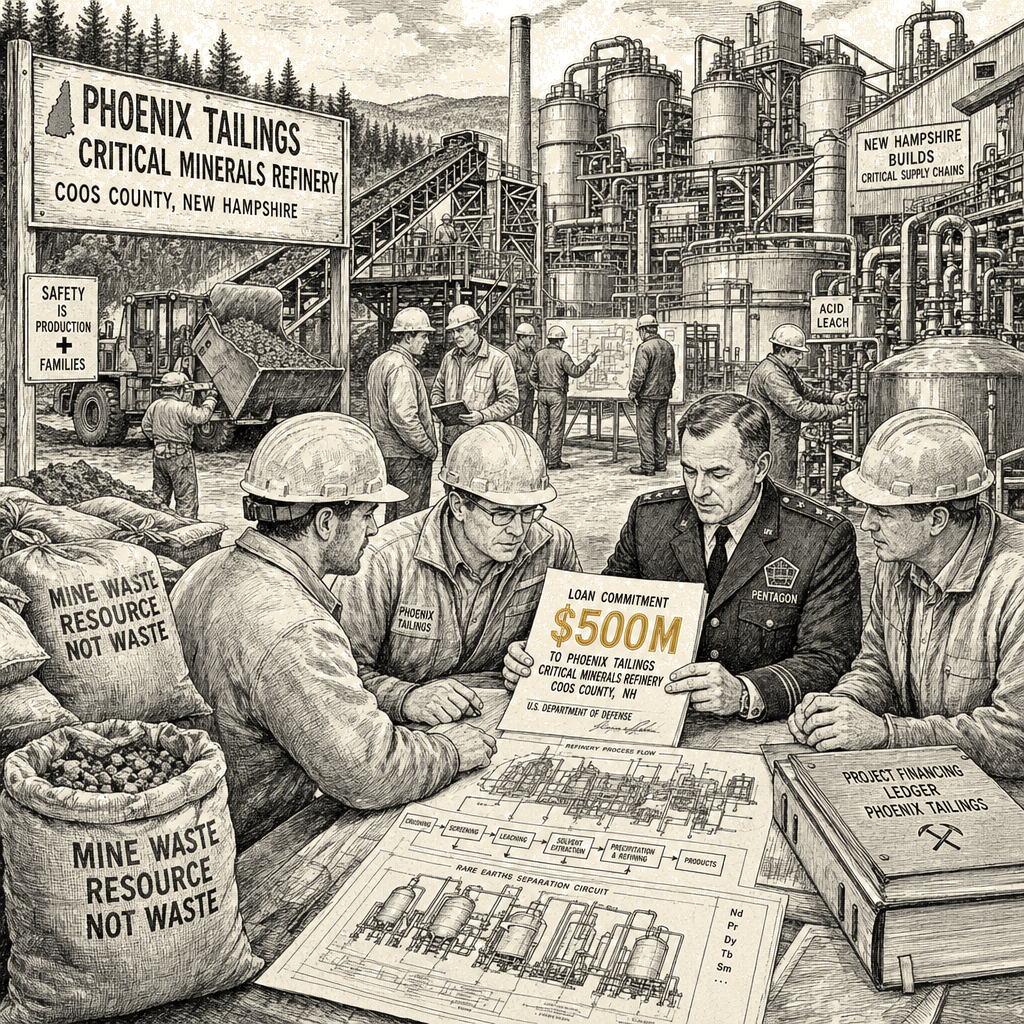
Trump is using war depletion to finance private industry.
The Pentagon is lending Phoenix Tailings $500 million to build a critical-minerals refinery in Exeter, New Hampshire. The company plans to recover and process minerals from mine waste, then separate and metallize them for use in the mines-to-magnets supply chain. Construction is expected to take 14 to 18 months.
Right now, the work is happening inside an office park in Exeter. Workers put on heat-resistant suits and sealed face masks. One-ton bags of mining waste sit in the warehouse beneath a giant American flag. Their job is to pull useful material from the powder traditional mines leave behind.
That is a real job, and Exeter is a real town. The people doing the work are not an abstraction called the defense-industrial base. They are the workers who will run the process, and the neighbors who will live with the plant, its traffic, its payroll, its waste, and its promises. But the money behind the factory comes from a wartime decision. This is a military-industrial choice made under pressure from a war that is consuming weapons faster than the country can replace them.
The distinction matters. The administration is not merely preparing for a possible conflict. The war in the Middle East is already drawing down U.S. munitions, including weapons that depend on critical minerals. Tomahawk cruise missiles, THAAD interceptors, and F-35 fighter jets all sit inside that chain. The White House wants faster weapons production while banning contractors from sourcing critical-mineral components from China.
When a war burns through the inventory and the government finances the supply chain to fill it, that is not a market correction. It is a public decision about what the country will build, who will build it, and how quickly the public will absorb the risk. The people of Exeter will see the factory. The Pentagon will hold the loan. The taxpayer will carry the exposure if the plan goes bad.
Phoenix Tailings is working on a real bottleneck. The United States can mine ore, but mining is not the same thing as producing the refined material and magnet components required by modern weapons. Most new mines remain years away from production. Processing mine waste could provide a faster bridge. At the Exeter operation, workers use electrolysis to separate critical elements from the powder left over by traditional mining. The process is technical, dirty, and physical. It is not a line in a budget table.
That is the strongest case for the loan. A domestic processing capability can reduce dependence on China, make the supply chain less vulnerable, and address a problem that cannot be solved by announcing more mines. The workers at the Exeter plant could be building a useful piece of American industrial capacity. As the administration’s larger critical-minerals spending push has already shown, Washington is treating minerals as strategic infrastructure rather than as an ordinary commodity.
But urgency is not a blank check. The Pentagon has a long record of treating emergency as a procurement method. Once the weapons are being depleted, every delay becomes a security threat, every contractor becomes indispensable, and every public dollar becomes an act of patriotism. That is how temporary military requirements become permanent industrial architecture. It is also how a town can be handed a ribbon-cutting ceremony before it is handed a clear account of who is responsible when the promises do not hold.
In his 1961 farewell address, Eisenhower warned the country to guard against “the acquisition of unwarranted influence” by the military-industrial complex. He did not warn against producing weapons needed for defense. He warned about the combination of military necessity, industrial capacity, and public policy becoming powerful enough to direct the country rather than serve it.
The Exeter loan belongs inside that warning. The question is not whether critical minerals matter. They do. The question is whether the Pentagon is building a resilient public supply chain or merely using defense urgency to select private winners. Those are not the same thing. A worker in a sealed mask and a neighbor watching trucks enter the office park deserve to know the difference.
The Army’s recent decision to lease base land for critical-mineral processing shows how quickly this logic is spreading. The military is becoming not only a buyer of weapons, but a landlord, lender, industrial planner, and guarantor of the mineral infrastructure behind them. Some of that may be necessary. None of it should be mistaken for ordinary private enterprise.
The public should receive more than a ribbon-cutting and a production timetable. Exeter should know what the plant will bring into the town and what it will leave behind. Workers should know who owns the facility and who answers for their safety. The country should know what repayment terms govern the loan, what happens if the plant misses its schedule, who receives the processed materials, and whether the public retains any claim on the technology or capacity it helped finance. A Pentagon loan without public accounting is not a strategy. It is a transfer of risk from the company to the citizen.
The war has made the shortage visible. The loan may help solve one part of it. The workers in Exeter may produce something the country genuinely needs. But if the country learns to treat every weapons depletion as permission for another private industrial subsidy, the war will have built more than a mineral refinery.
It will have built the next permanent dependency.