
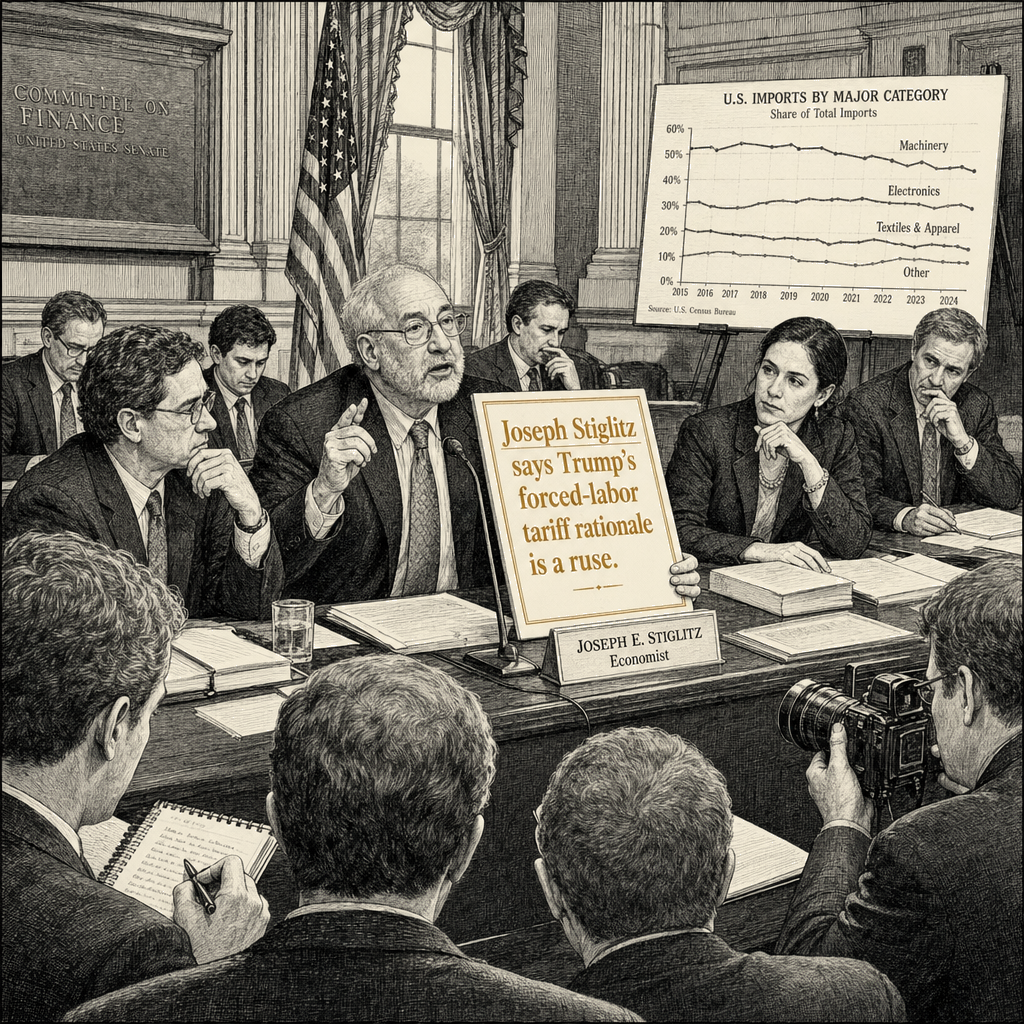
Donald Trump is laundering a trade grab through forced-labor tariffs.
Here are the numbers. US manufacturing employment has fallen by 75,000 since Trump’s second inauguration. The goods trade deficit has reached $1.24 trillion in nominal terms. The tariff schedule has changed; the underlying macroeconomic constraint has not. A country that saves too little and runs record fiscal deficits will not eliminate its multilateral trade deficit by taxing imports. (Joseph Stiglitz, “Trump’s hypocritical new tariffs are a chance for the world to fight back,” Project Syndicate.)
The stated objective is legitimate. Forced labor requires enforcement. The instrument is not. Tariffs are taxes on imported goods, collected through American supply chains and passed through to American consumers and firms. They do not identify the factory, contractor, or subcontractor using forced labor. They tax the country selected by the White House.
The administration’s new schedule resembles the trade-balance politics that shaped Trump’s earlier tariffs, but the available record does not establish that every rate was chosen for one reason. It does establish an unresolved comparison. China, which Stiglitz identifies as a longstanding source of forced-labor concerns, largely escaped the new treatment, while the European Union and Canada faced tariffs. China also controls rare earths and critical minerals important to the United States. That bargaining-power explanation is plausible. It is not a documented finding about the administration’s decision. The defensible conclusion is narrower: the schedule does not show a transparent, uniformly applied labor-enforcement standard.
The domestic record is more direct. The Thirteenth Amendment prohibits slavery and involuntary servitude except as punishment for a crime after conviction. That exception remains part of the legal structure governing prison labor. Fewer than one-quarter of states prohibit forced labor by incarcerated people. The United States contains about 5% of the world’s population and roughly one-quarter of its prisoners. Michael Poyker’s study, as summarized in the originating article, estimated that nearly 1.4 million US prisoners worked in 2005, including about 600,000 in manufacturing. (US Constitution, Thirteenth Amendment; Michael Poyker, study cited by Stiglitz.)
Those figures expose the accounting choice. Forced labor abroad is treated as a reason to tax an entire trading partner. Prison labor at home is treated as an input whose legal exception removes it from the enforcement headline. The foreign practice is being named; the domestic practice is being priced. That is selective enforcement, not a neutral labor standard.
The European comparison requires a legal distinction. The EU Corporate Sustainability Due Diligence Directive, Directive (EU) 2024/1760, imposes due-diligence duties on covered companies concerning adverse human-rights and environmental impacts in their operations and value chains. It is not, by itself, a blanket forced-labor import ban. The separate EU Forced Labour Regulation, Regulation (EU) 2024/3015, prohibits products made with forced labor from being placed or made available on the Union market and prohibits their export from the Union. The distinction matters. One regime requires companies to investigate, prevent, mitigate, and address harms. The other supplies an import-and-market prohibition. Neither is a country-wide tariff.
Howard Lutnick, the US commerce secretary, previously described the EU due-diligence regime as imposing “unnecessary negative burdens” on American companies and said the United States could consider “all conceivable trade tools,” according to the originating article. The contradiction is documented at the level of policy position: European supply-chain obligations were presented as an excessive burden on American firms; forced-labor concerns are now being used to justify a broader tax on European goods. The tariff does not replace the firm-level investigation that the EU measures require.
Canada exposes a related legal inversion. Trump invoked a provision of the Smoot-Hawley Tariff Act of 1930 concerning discriminatory tariffs, while Canada’s tariffs were imposed in response to Trump’s own tariff measures, according to Stiglitz’s account. That does not by itself resolve every question of statutory authority or international-law application. It does show the circular structure of the justification: a retaliatory measure is treated as the originating offense, and the response is then used to defend another tariff.
The policy is straightforward. Prohibit products made with forced labor from entering the market, require traceable supply-chain documentation, protect workers who report violations, and impose penalties on firms that knowingly purchase or conceal the goods. Apply the same standard to prison-made goods produced in the United States. The relevant measure is the transaction and the supply chain, not the nationality of the negotiating partner. Broad tariffs are a regressive tax attached to an enforcement slogan.
The EU forced-labor regulation is the receipt for product-level enforcement. Trump’s country-level tariff schedule is the receipt for a different policy. The record supports the charge that forced labor has been used to launder a trade grab. It does not support pretending that an unproved inference about China’s bargaining power is a settled fact. The tariff is the trade grab; the labor rationale is the laundering operation.