
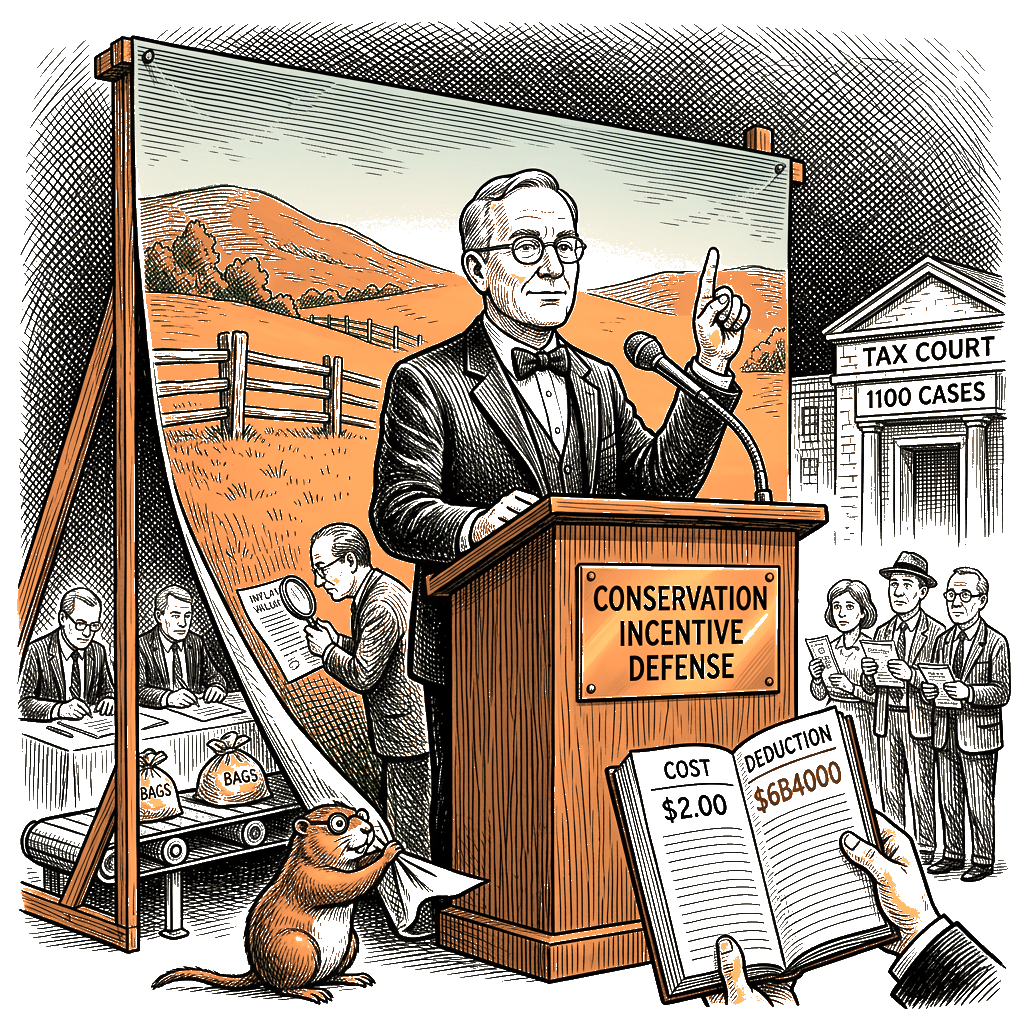
The witch hunt is not the IRS examining inflated conservation-easement deductions; it is the old tax-shelter performance in which the wealthy mistake scrutiny for persecution. In Steve Moore’s Fox News column, he argues that the IRS retroactively changed the rules on syndicated conservation easements, presumed taxpayers abusive, and punished people who relied on a longstanding tax incentive. Fine. Now let us look at what the notice was looking at.
A man who owns a pasture and means to keep it a pasture can give away the right to build on it and take a deduction for the value of what he gave. That is a gift, and the law has honored it for fifty years. In a syndicated deal, investors pool money, buy land, hire an appraiser, donate an easement, and collect a deduction worth several times the cash they put in. A thing that returns multiples of its purchase price is not a gift. It is an investment in the tax code, sold like a timeshare and paid for by every taxpayer who declined to buy in.
The Senate Finance Committee identified serious abuses, including inflated land valuations and outsized deductions. Moore does not dispute that. He simply places it behind the curtain, then asks the reader to admire the curtain.
The specific is Notice 2017-10, issued in late 2016 and made retroactive to 2010. It did not abolish conservation easements. It required disclosure of a category of syndicated transactions the IRS considered potentially abusive. The easement remains. The conserved acres remain. What disappeared was the anonymity. The agency put a fluorescent label on the arrangement while it was still being litigated.
Moore calls that a bait-and-switch. Congress created a conservation incentive; it did not certify every valuation supplied by every promoter, bless every partnership structure, or promise that a deduction could never be examined. A referee arriving in the ninety-eighth minute is not a legislature rewriting the rules. The word “retroactive” is doing the work of a citation.
More than 1,100 syndicated conservation-easement disputes entered audits and litigation, Moore reports, including roughly 740 cases docketed in Tax Court and about 400 transactions still under examination as of May 2026. Those figures do not prove that every investor was fraudulent. They prove something less comfortable: this was not one innocent farmer receiving a surprise letter. It was an industry large enough to require an industry-sized examination.
The class is familiar: the tax-shelter apologist. Its mechanism is equally familiar. A profitable loophole is described as public policy when the deduction is collected, then described as settled law when the government asks whether the deduction was honestly valued. The paperwork becomes sacred precisely when the paperwork is doing the stealing.
A hundred-percent audit rate is not proof that every taxpayer lost. It is proof that the IRS stopped pretending the category had become suspicious by accident. The Senate had already found phony numbers. Full examination is not punishment. It is arithmetic with the lights on.
And the roster is long. General Electric, The New York Times documented, earned $14.2 billion in worldwide profit in 2010, paid no federal income tax, and booked a $3.2 billion tax benefit. Leona Helmsley was convicted on 33 felony counts for billing personal mansion renovations to her hotels; the “little people” line came from her housekeeper’s sworn trial testimony, and Helmsley denied saying it. HSBC admitted in 2012 to laundering money for drug cartels and sanctioned governments, paid $1.92 billion, and sent no individual to prison. Senator Grassley called that a get-out-of-jail-free card.
The ProPublica files published in 2021 showed the 25 richest Americans adding $401 billion to their wealth over four years while paying $13.6 billion in federal income tax, a reported effective rate of 3.4 percent. Jeff Bezos paid no federal income tax in 2007 and none in 2011. No witch hunt there. That is the system working as designed.
Meanwhile, the Economic Policy Institute counted $933 million recovered for cheated workers in 2012, nearly three times the $340.85 million taken in all robberies that year. Almost none of those employers saw a courtroom. To the same chorus, that is a labor dispute, not a crime.
Different schemes, different decades, same small performance. Wealth takes the upside, then discovers constitutional principle when the bill arrives. Leona Helmsley had her mansion. Bernard Madoff had $65 billion in paper account value, not $65 billion in recoverable cash; the real principal lost was roughly $17.5 billion to $20 billion. Ford’s Pinto scandal did not rest on the overstated legend of a neat internal memo pricing human life; it rested on a jury’s finding of malice. I have watched this movie since Nixon. The costumes change. The plea for special treatment does not.
Moore’s one exhibit against the referee is a May 2026 Treasury Inspector General report describing seven cases involving backdated penalty-approval documents. The IRS conceded more than $68 million in penalties in those cases. That deserves scrutiny. An agency that corrects its own penalties on review is correcting itself, not hunting everyone. One agency’s misconduct is not a pardon for an entire tax shelter.
He is a flat-tax man, this economist. His ideal code has no deductions at all, not even this one. He has spent a column mourning the exception his own ideal would burn. Don’t change the subject, dear: if the deduction becomes a bait-and-switch when the auditor reads it, what was it when the salesman sold it?
The IRS does not make the laws, Moore reminds us. True. It does the arithmetic. The nature-flippers have never forgiven it for learning to add.