
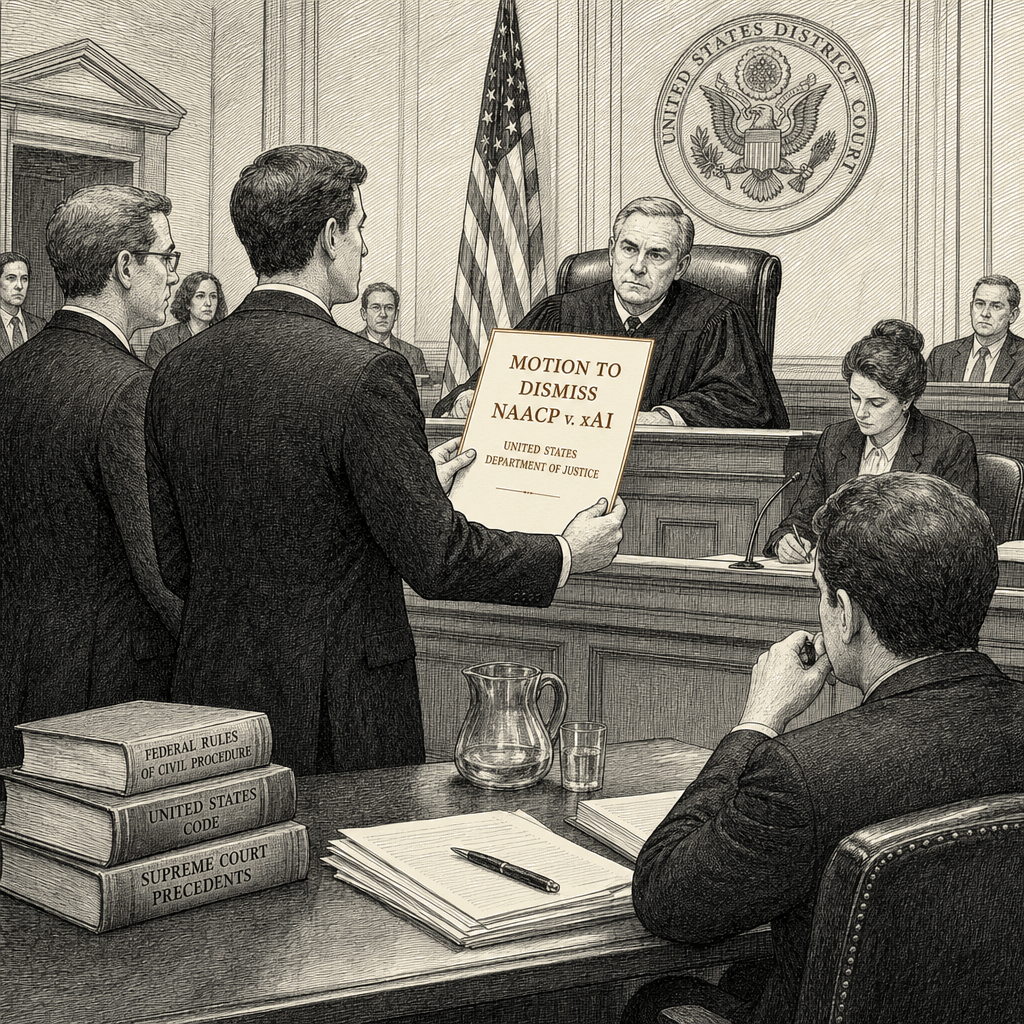
Trump’s Justice Department is stealing the public’s environmental remedy.
The strongest version of the administration’s argument is not frivolous. The executive branch enforces federal law, the president directs executive policy, and prosecutors ordinarily decide when the government will bring an enforcement action. The Justice Department says citizen suits cannot become a private veto over that authority when the administration has concluded that enforcement would harm artificial-intelligence development or national security. In that account, the Clean Air Act gives citizens a backstop when officials fail to act, not a license to override an executive decision that enforcement is contrary to the public interest.
That argument would be recognizable to a working environmental lawyer. It is also the argument Congress wrote the citizen-suit provisions to prevent.
The Clean Air Act authorizes “any person” to sue an alleged violator after notice and a 60-day opportunity to correct the violation, unless the Environmental Protection Agency or the state has commenced and is diligently prosecuting an enforcement action. (Clean Air Act, 42 U.S.C. § 7604.) The provision does not say that a citizen loses the right to sue whenever the executive branch prefers not to enforce the law. It says the opposite: the public may go to court when the government has not done so.
The distinction matters in NAACP v. xAI. The NAACP alleges that xAI and a subsidiary built and operated 27 natural-gas-fired turbines in Southaven, Mississippi, to power the Colossus 2 data center without the permits required by the Clean Air Act. The alleged emissions include nitrogen oxides and formaldehyde. The company did not apply for the permit that would have required pollution-control technology.
The administration’s motion does not ask the court merely to decide whether those allegations prove a violation. It asks the court to recognize executive policy as a reason to disable the statutory plaintiff. The government invokes two executive orders—one declaring a national energy emergency and another supporting American leadership in artificial intelligence—and says the lawsuit threatens innovation and national security. The filing therefore converts a permitting dispute into a claim of executive supremacy.
That is the doctrinal move.
Citizen suits are not an accidental loophole in environmental law. Congress created them because executive enforcement is not self-executing. Agencies have competing priorities, political superiors, limited resources, and sometimes an interest in leaving a regulated party alone. Congress preserved a judicial route for people who can prove that a company is violating the statute and that the government has not already begun an enforcement action. The notice period gives the alleged violator an opportunity to comply. The government’s existing enforcement action blocks duplicative litigation. Those conditions are the compromise.
The administration is asking the court to add a fourth condition: the citizen suit disappears when the executive branch decides that enforcement is against the public interest. That condition is not a procedural clarification. It transfers the decision about whether the statute will operate from Congress and the courts to the executive policy apparatus.
The administration has already made this theory part of a larger legal program. The Justice Department’s effort to dismiss the environmental lawsuit against Musk’s xAI treated the same case as a national-security problem rather than a permitting dispute. The Trump DOJ’s effort to block Minnesota’s climate-fraud lawsuit and the administration’s broader attacks on state and private enforcement follow the same institutional direction: when public officials decline to enforce a law, the people most affected by the nonenforcement should also lose access to court.
The government’s position would also invert the ordinary constitutional allocation. Congress enacted the rule. A private plaintiff invokes the rule. A federal judge decides whether the alleged violation and statutory requirements are proved. The executive branch remains free to enforce its own laws, but it does not receive a unilateral power to suspend the public’s separate statutory remedy by announcing a policy preference.
The administration will dress its position in long-running constitutional debates over citizen suits and Article III standing—but those debates concern who may enforce the statute Congress wrote, not whether the executive may suspend it by announcing a policy preference. Article III standing limits who may sue, and statutory limits determine what relief a plaintiff may obtain. Those questions do not establish an executive veto. They require the court to apply the statute Congress enacted, not to replace it with a presidential exception.
The history of these suits shows why the exception would matter. Since the 1970s, citizens have used these provisions in more than 2,000 lawsuits, and citizen suits now make up a majority of environmental cases. Citizen plaintiffs have stopped unlawful projects, challenged unauthorized discharges, and obtained court-supervised cleanup and civil penalties. Diane Wilson’s Clean Water Act suit against Formosa Plastics produced a $50 million settlement for mitigation and remediation in Lavaca Bay. Litigation by PennEnvironment and Three Rivers Waterkeeper produced a $2.5 million settlement requiring Styropek USA to install filtration and eliminate unauthorized plastic-pellet discharges. These cases did not represent a failure of government. They represented Congress’s decision that enforcement should not depend entirely on executive willingness.
The steel-man therefore fails at the point where it becomes a power claim. Executive enforcement discretion is real. It is not a power to repeal the private enforcement mechanism whenever the administration prefers the violator’s activity. “Artificial-intelligence innovation” is not a permit. “National security” is not a substitute for the Clean Air Act’s permitting requirements. A presidential policy cannot turn an alleged unpermitted gas plant into a lawful one.
The Court should preserve the statutory arrangement Congress created: the executive may enforce, the defendant may contest the alleged violation, and an injured plaintiff may prove the case in court when no government enforcement action is pending. Anything less makes the right to sue depend on the enforcement choice of the very branch the citizen-suit provision was designed to supplement.
This is not about whether Elon Musk receives special treatment. It is about whether executive nonenforcement becomes a legal shield for every favored industry. The Justice Department is asking the court to make that shield permanent. The next company will not need a permit if the president can make the courthouse door disappear.