
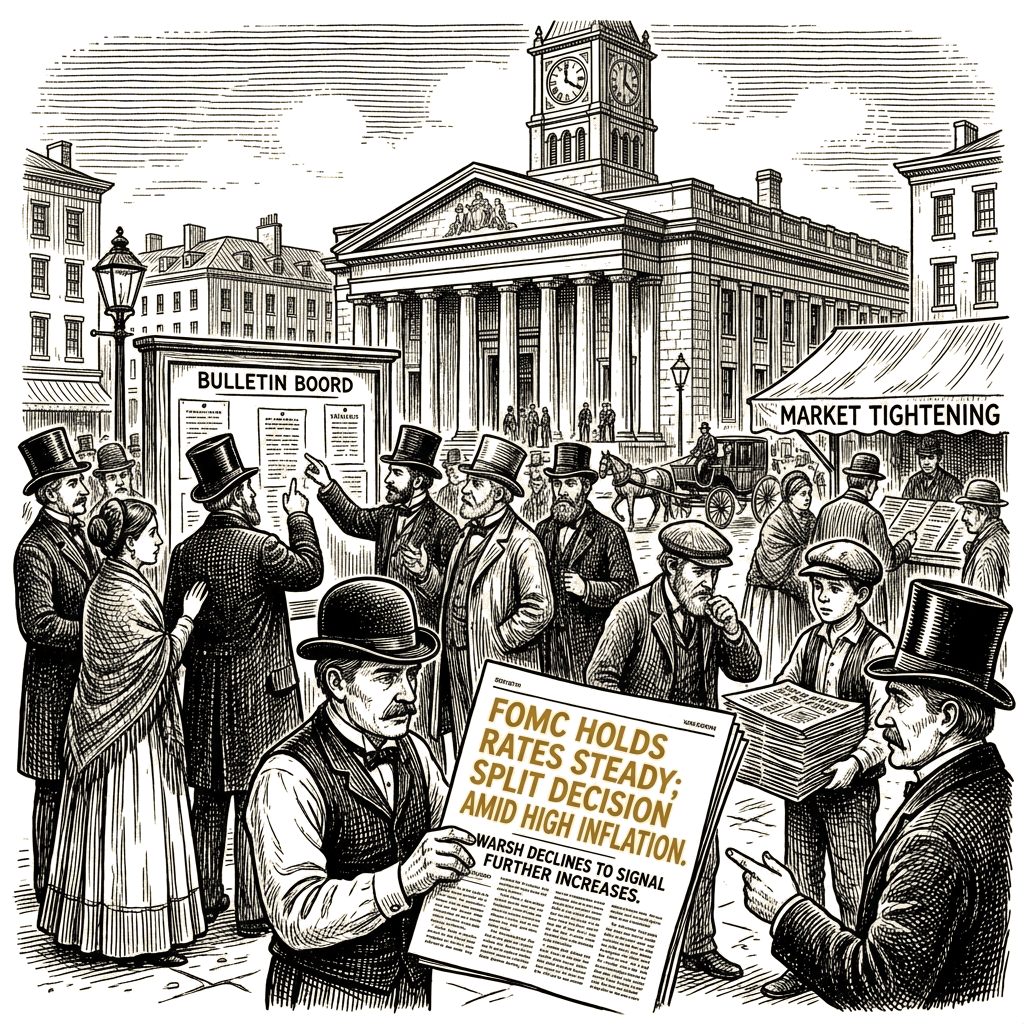
Kevin Warsh is outsourcing inflation control to bond traders and weakening the Fed.
Here are the numbers. The report describes inflation as running at twice the Federal Reserve’s 2 percent goal. The 30-year Treasury yield reached a 19-year high. The 30-year fixed mortgage rate stood at 6.66 percent in early August. Those are not abstract market signals. They are borrowing costs passed through to households, businesses and the federal budget.
The Federal Open Market Committee—the Federal Reserve committee that sets the policy rate—held rates steady in a split decision. Warsh then treated higher long-term yields as evidence that financial conditions were tightening without direct action from the central bank. Financial conditions means the cost and availability of credit across the economy. It is not the same thing as a policy decision. A bond market can raise borrowing costs because investors demand more compensation for inflation risk, fiscal risk or institutional uncertainty. Mortgage rates and corporate borrowing costs can follow, sometimes with a lag, but that tightening can hit credit indiscriminately rather than target the inflation pressure the Fed is supposed to control.
Tighter market conditions can reduce borrowing, spending and demand, and therefore can reduce inflation. They are an indirect and uneven instrument, however. The Fed does not control which borrowers lose access to credit, which investment projects are canceled or how much of a yield increase reflects inflation expectations rather than a risk premium. A market can tighten financial conditions without giving the central bank a reliable measure of the inflation response. Treating that movement as a substitute for monetary policy transfers responsibility from the institution with the mandate to a market without one.
Warsh said the rise in long-term yields had “provided us some comfort.” He added that “the markets have done quite a bit,” even while the Fed had “not done much in 42 days.” That is not a monetary-policy framework. It is a transfer of responsibility from the institution with the mandate to the market without one.
The distinction matters because the market does not answer to the Fed’s dual mandate—the statutory responsibility to pursue stable prices and maximum employment. It does not publish minutes, appear before Congress or explain which part of a yield increase reflects inflation expectations and which part reflects a higher risk premium. The Federal Reserve can and should explain how its mandate shaped the decision and how it would react to changing inflation and employment conditions. The July 28 report on pressure to raise rates documented that pressure. The August 4 decision shows what Warsh did with it: he substituted market movement for a clear explanation of the decision and the reaction function—the conditions that would produce a different policy response.
Warsh attributed the rising yields to “solid” economic output, “strong” business investment and productivity, and “solid” labor markets, while making no mention of the war in Iran. When geopolitical risk inflates a yield increase, the signal is clouded: investors may be pricing in a risk premium the Fed cannot neutralize, making the bond market’s tightening an unreliable stand-in for deliberate policy. Warsh’s comfort therefore rests on a market signal he has not shown the public how to interpret.
The communication proposals are part of the same policy choice. Warsh has floated fewer interest-rate-setting meetings and considered reducing the press conferences held after each meeting. Ben Bernanke introduced those press conferences because public explanation can improve financial stability and democratic accountability. Removing opportunities to explain a contested decision does not make the policy less political. It makes the politics harder to inspect.
Further rate increases would not be free. They would raise mortgage and business-loan costs, weaken interest-sensitive investment and hiring, and place additional pressure on households and firms dependent on refinancing. If credit conditions tighten too far, employment falls and defaults rise. Those costs do not excuse tolerating inflation at twice the target, but they belong in the decision rather than being left to the bond market’s uneven allocation. The Fed should retain a regular meeting schedule, publish its reasoning and use its own instruments when inflation is materially above target, while stating how it will weigh the employment and credit consequences.
Warsh’s “the markets have done quite a bit” is the receipt. The Fed has done less, and the public is paying more. That is a policy choice with identifiable costs, not an unavoidable market verdict.