
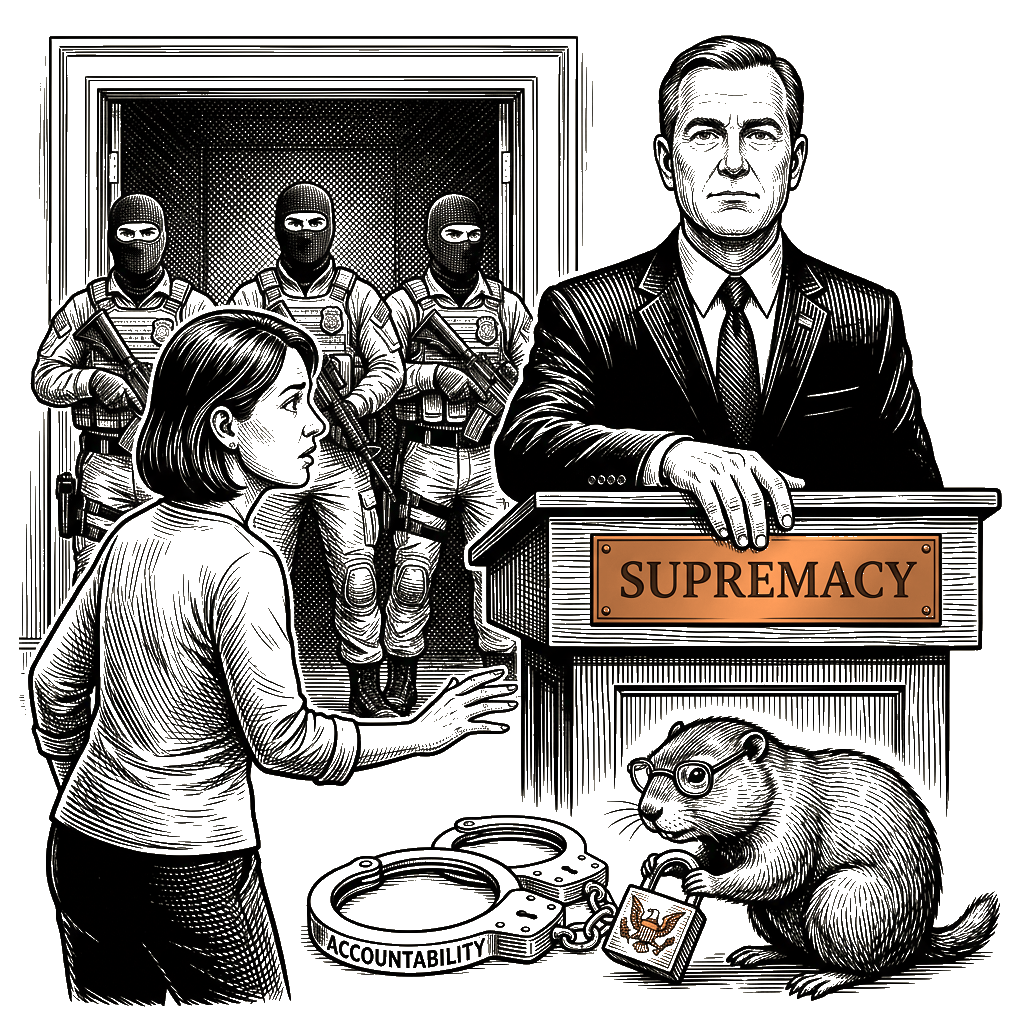
The federal government is using supremacy to shield masked immigration agents from public accountability.
U.S. District Judge Mae D’Agostino of the Northern District of New York ruled that New York could not ban face coverings for federal agents or require them to display visible identification. The federal government argued that the measures likely violate the Supremacy Clause, and the court accepted that position for purposes of the ruling. D’Agostino wrote that New York “appears to be well-intentioned in its pursuit of transparent policing,” but that the court was deciding constitutionality—not “transparency or preferable policy decisions.”
That ruling addresses whether New York may impose these requirements on federal agents. It does not establish that masked federal agents should operate without visible identification, that the federal government has a constitutional right to conceal their identities, or that public oversight is an optional policy preference.
The distinction matters because immigration arrests place the greatest coercive power of the federal government in direct contact with people who often have the least practical ability to resist it. A face covering removes the ordinary visual record of the officer. The absence of visible identification removes the ordinary means of connecting an arrest to a particular public official. The combination transfers the burden of accountability from the officer exercising power to the person subjected to it.
A federal appeals court earlier blocked a similar California law, and the Justice Department has already sued Connecticut over its restrictions on masked and unidentified ICE agents. The government is carrying the same position from state to state: federal agents may identify, detain, and remove people while states are barred from demanding that those agents identify themselves.
That is the institutional consequence of the ruling. The federal government invokes supremacy to defeat state safeguards while offering no substitute safeguard in the record supplied here. The result is not merely a dispute over uniforms. It is a rule under which the government demands the power to identify, detain, and remove people while resisting the public’s ability to identify the officials who do it.
Congress can end this uncertainty. It can require federal immigration agents to display visible identification and prohibit face coverings during ordinary enforcement operations, subject to narrow exceptions for genuine operational necessity. That would place the accountability rule in federal law rather than leave it to a state-by-state contest over preemption.
Until Congress acts, supremacy is being used as a weapon against accountability. New York’s law may be blocked, but the federal government has not thereby earned the right to make its agents unaccountable.