Donald Trump is trying to erase millions of human beings from the United States census.
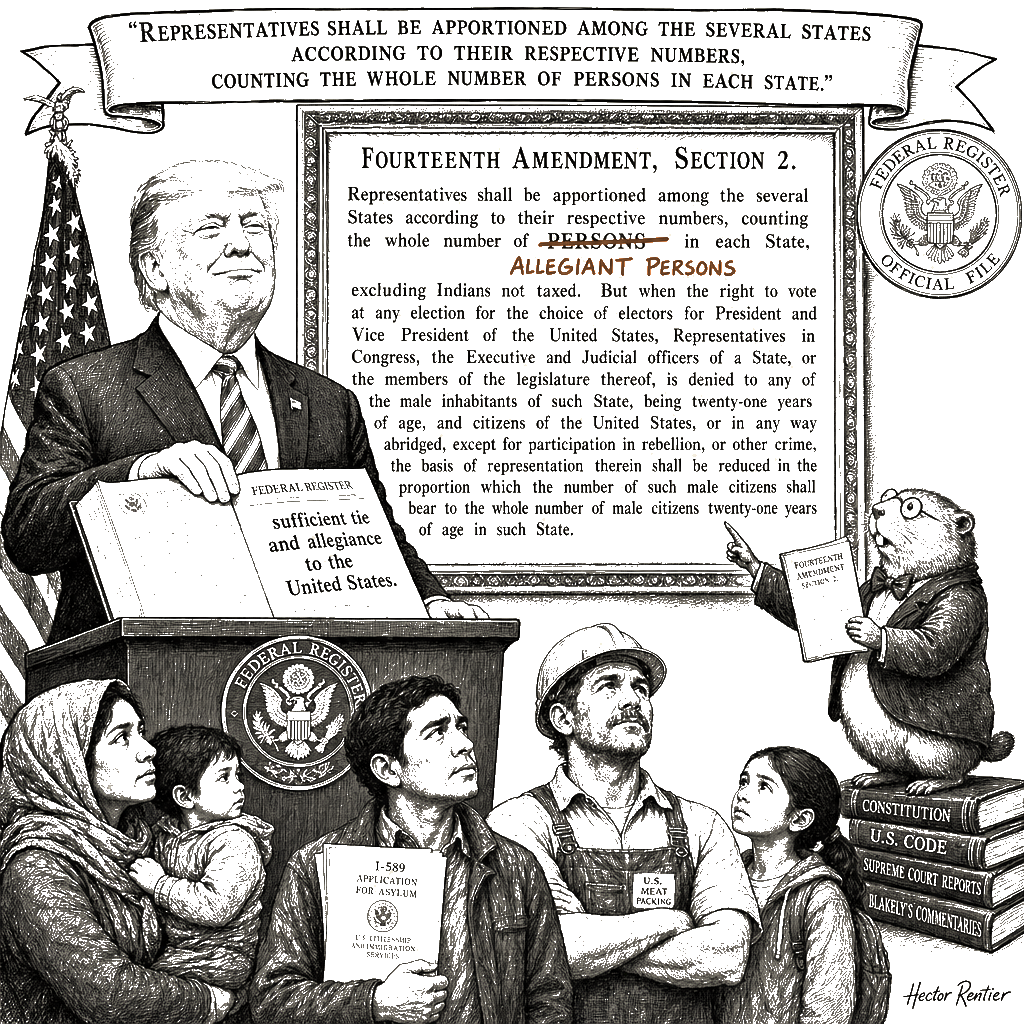
I want to say that sentence again, because it is the whole thing. The administration has published a rule in the Federal Register — Wednesday of this week — proposing to remove refugees, asylum seekers, and immigrants without legal status from the count of persons the Constitution requires the country to take every ten years. The stated reason, from the Census Bureau’s own filing, is that these people lack “a sufficient tie and allegiance to the United States.” The President’s social-media account said it more plainly: “People who are in our Country illegally WILL NOT BE COUNTED IN THE CENSUS.”
This is the same fight the administration lost the first time. In his first term, Trump tried to add a citizenship question to the 2020 census. The Supreme Court rejected the bid. New York Attorney General Letitia James led the lawsuit that helped kill it. She is now considering legal action against the new rule. “The Constitution is clear,” she wrote Wednesday. “Every person living in the United States, regardless of immigration status, must be counted in the census.” She is reading the same sentence the Reconstruction Congress wrote.
Read the Fourteenth Amendment. It is short. Section 2 says representatives shall be apportioned among the several states “according to their respective numbers, counting the whole number of persons in each State.” The text does not say “counting the whole number of citizens.” It does not say “counting the whole number of persons with sufficient tie and allegiance.” It says the whole number of persons. The drafters knew what they were doing. They had just fought a war over a country that counted three-fifths of the people in it, and they wrote the word persons into the Constitution for the reason you would write it. The Bureau has invented an allegiance tier between “citizen” and “non-citizen” and assigned it constitutional weight. That invention is the rule.
The administration’s allies will argue the new rule is different — that it is a reinterpretation rather than a question, an administrative action rather than a survey instrument. They are right that the form is different. They are wrong that the substance is. The 2020 case turned on the administration’s stated purpose and on whether the Commerce Department had offered a genuine rationale for the change. The Commerce Department lost because the rationale was pretext. The Census Bureau’s “allegiance” rationale is the same pretext, dressed in different language. The administration’s new rule does not reinterpret the census. It repudiates it. The courts should treat it as such.
The administration is now telling us the Constitution means something else. It is telling us that a child of refugees from Burma living in Fort Wayne does not count as a person for the purposes of the census. That a woman who has fled domestic violence in Guatemala and is awaiting her asylum hearing does not count as a person. That a man who has worked in a Texas meatpacking plant for fifteen years and paid into Social Security every one of those years does not count as a person. The administration is asking us to look at these people, and at their U.S.-citizen children, and to say: when we count who we are as a country, you are not here.
I have watched what it does to a country when it decides that some people do not count. I was a boy in El Paso. The classmate who came back one September morning with the seat next to him empty because her parents had been taken in a pre-dawn raid — she had counted. She had a name on a teacher’s roll. When the empty desk was filled a week later by a child who had been transferred in from another school, the country went on as if the desk had been ordinary. But the desk was not ordinary. The child who had sat there had counted. The administration’s rule says: do that, to millions of desks, on purpose, every ten years, and call it policy.
Let me name what is happening in the language of the tradition I was raised in. The prophets of Israel knew what it was to be told you did not count. The stranger — the ger, the resident alien — appears in the Torah thirty-six times by the rabbis’ count, which Rabbi Eliezer gives in Bava Mezia 59b — more often than any other commandment. You shall not oppress the resident alien; you know the heart of an alien, for you were aliens in the land of Egypt. The Hebrews were told, by their own scripture, that the measure of whether they had remembered their God was whether they had remembered the stranger. To erase the stranger from the count of the country is not a refinement of the rule. It is the precise opposite of what the rule was given for.
And the man from Nazareth said it more plainly still. In the chapter on the last judgment, the King says to those on his right hand: I was a stranger and you welcomed me. And to those on his left: I was a stranger and you did not welcome me. And when they ask him when, he answers: Truly I tell you, just as you did it to one of the least of these who are members of my family, you did it to me. The rule proposed this week is the rule that says to the stranger: you are not among the least of these. You are not even here to be considered. You are a line we will draw around the body of the country, and we will say of you: outside the line.
I have to say something here that costs me to say, because the column requires me to say it. The Catholic Church in this country has not always been on the right side of this question. There were Catholic politicians who supported family-separation policies with Romans 13 in their mouths. There were Catholic bishops who said nothing when children were caged. There were Catholic voters who went to Mass on Sunday and to the polls on Tuesday and voted for the man who proposed this rule, and went back to Mass the next Sunday and received the Body of Christ without a tremor in the hand. The confession-of-complicity reflex I am paid to keep is not a thing I write for the comfort of the tradition. It is a thing the tradition owes to itself. We were the ones who wrote the doctrine of the inherent dignity of every human person from personhood forward, not from citizenship backward. We owe the stranger the count.
Let me be plain about what is at stake, because the political language tries to make this small. The census determines how many representatives each state gets in the House. The census determines how many federal dollars flow into a state for Medicaid, for schools, for roads, for disaster relief. If the administration succeeds, the states with the largest immigrant populations — California, Texas, Florida, New York, New Jersey, Illinois — will lose political representation and federal funding in proportion to the human beings erased from the count. The children of those human beings are, in many cases, U.S. citizens. The rule erases their parents from the count and reduces the political weight of their citizenship by removing the neighborhood around them from the population total. The administration is not merely counting differently. It is rearranging the country’s map of who matters.
And they have a plan for getting past the courts. The new rule opens a federal-register comment period that will, by design, slow-walk litigation until the 2030 enumeration machinery is already calibrated. The comment period on temporary-status immigrants is part of the same procedural architecture: get the rule on the books, let the comment period run, fight the lawsuits in 2027 and 2028, hope to reach the Supreme Court on a docket the administration can shape. They are gambling that the courts will move slowly enough that by the time the rule is enjoined, the political map will already have been redrawn, the funding will already have been allocated, and the message will already have been sent to every refugee, every asylum seeker, every undocumented neighbor in the country. The message is: you do not count.
Let me take that and apply it the way the tradition requires, to the people doing it, because the column requires that too. To the officials at the Census Bureau who wrote the words “sufficient tie and allegiance” into a federal filing, knowing what you were doing: you are invoking the vocabulary of naturalization to justify a counting practice the Constitution forbids. The Oath of Allegiance is the oath a person takes to become a citizen. It is not, and has never been, the criterion for whether a person counts among the persons in a state. You know this. You are doing it anyway.
To the members of Congress who will be asked to receive the new apportionment that results from this count, if it goes through: you will be receiving the seats of a House that represents fewer persons than the Constitution requires you to represent. The seats will be smaller than they should be. The districts will be drawn over a country whose map has been shaved. You will sit in them.
To the voters who support this and who will read this column: I am not writing to you in the third person. I am writing to you in the second, because the tradition I write from requires that I look you in the face when I tell you what you are supporting. You are supporting the erasure of millions of your neighbors from the official count of the country you both live in. The refugees from Burma do not stop being your neighbors because the federal register says they do not count. The woman awaiting asylum does not stop being your neighbor because the President’s social-media account says she does not count. The man who works in the meatpacking plant does not stop being your neighbor because the rule says he does not count. The neighbor is a category the tradition gave you to recognize, not a category the state gives you to remove.
The same door that has always been open in this country’s best moments — the door through which the Thirteenth, Fourteenth, and Fifteenth Amendments were ratified; the door through which the Civil Rights Act was passed; the door through which DACA was created by executive order when Congress would not act — that door is open now. The country has counted its whole number of persons before. It can count them again. The rule can be withdrawn. The court can strike it down. The Congress can refuse to seat representatives apportioned under an unconstitutional count. The thing the administration is proposing is not inevitable. It is a choice, and choices can be unmade.
I will end where I begin, with the desk. There is a desk in El Paso that I have never been able to stop seeing. There is a desk in Fort Wayne, and a desk in Houston, and a desk in Los Angeles, and a desk in Brooklyn, and a desk in Chicago — millions of desks, occupied by millions of children whose parents the administration wants erased from the count of the country those children are citizens of. I have worked on enough broken chairs and broken pipes and broken doors in my life to know: a broken thing can be repaired. A broken person cannot. The rule proposed this week proposes to break millions of persons. The door of return is open. I am asking you to walk through it before the rule becomes the fact on the ground that no court can undo.