
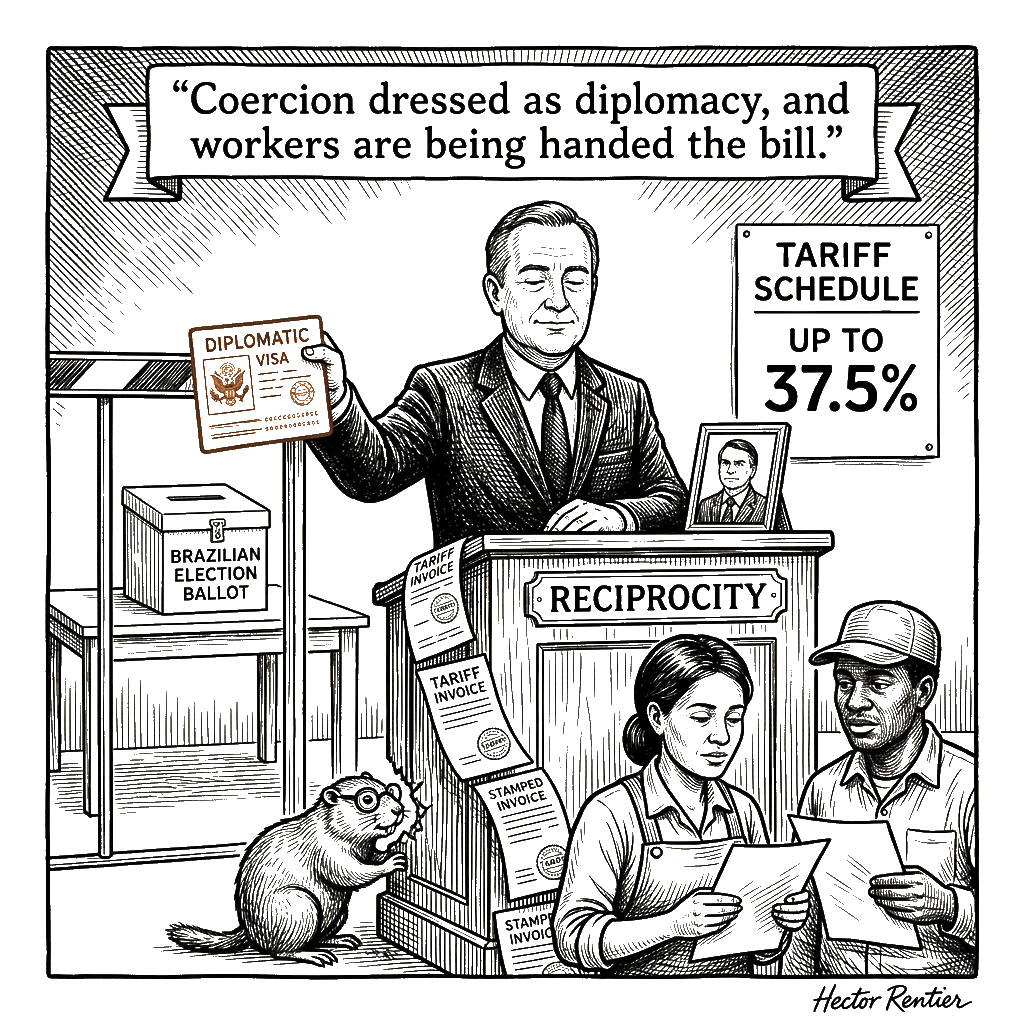
Trump is coercing Brazil to meddle in its election and punish workers.
The State Department revoked the visa of Brazil’s ambassador, Maria Luiza Ribeiro Viotti, after Brasília refused to approve Daniel Perez as Washington’s ambassador and denied visas to two U.S. diplomats. Washington calls the action reciprocal.
That word does too much work.
Brazil denied entry to two officials before an election because Lula’s government said their visit could cast doubt on Brazil’s electronic voting system. The United States revoked Brazil’s ambassador’s visa and tied its restoration to accepting Trump’s nominee.
That is not a dispute over paperwork. It is compellence.
It is also a fight that lands on ordinary people long before it reaches a diplomatic reception. When Washington puts tariffs of up to 37.5 percent on thousands of Brazilian exports, the cost does not remain in a State Department briefing room. It reaches the factory that loses an order, the worker whose shift is cut, the truck driver hauling fewer loads, the port worker handling less cargo, and the family whose paycheck depends on a trade relationship neither it nor its neighbors designed.
American workers do not escape the bill. Importers pass costs along, businesses change suppliers, and families pay more or watch orders move elsewhere. A tariff can be announced in Washington and felt at a kitchen table in Georgia, São Paulo, or Recife.
The nominee at the center of this demand is Daniel Perez, a Florida Republican and close ally of Secretary of State Marco Rubio. Brazil’s October election pits President Luiz Inácio Lula da Silva against Senator Flávio Bolsonaro, son of former president Jair Bolsonaro and a close political ally of Trump.
The sequence matters. Washington announced Perez’s nomination before securing Brasília’s consent. Brazilian officials said they would not decide the appointment before the first round of voting on 4 October. The administration answered that Brazil had no right to interfere with the president’s choice of ambassador.
Then Washington sent two State Department officials to Brasília to discuss election integrity, religious freedom, and freedom of expression. Brazil denied their visas, refusing entry to U.S. officials it accused of trying to interfere in the election.
Now Washington has punished Brazil’s ambassador and offered to reverse the punishment if Brazil approves Perez.
That is the mechanism. Accept the political ally before Brazilians vote, or the ambassador’s diplomatic status remains under punishment.
The visa is not the only lever. The administration imposed tariffs of up to 37.5 percent on thousands of Brazilian exports, citing unfair trade practices and failures to prevent forced labour. It classified Brazil’s two biggest drug-trafficking organisations as foreign terrorist organisations, a move opposed by Lula’s government.
Taken alone, each measure can be given a bureaucratic explanation. Put together, they form a pressure campaign. Diplomatic punishment, tariffs, and terrorist designations become interchangeable tools for forcing Brasília to bend.
And every tool carries a human bill.
A Brazilian worker does not need a seminar on foreign policy to understand what happens when an order disappears. A small exporter does not need a theory of international relations to know that a sudden tariff can turn a profitable contract into a layoff. An American warehouse worker or truck driver does not need a briefing book to understand that disrupted trade means fewer hours.
The people who make, move, load, sell, and buy goods are treated as leverage in a dispute they did not start. That is what power does when officials confuse a country’s economy with a negotiating instrument. They call it pressure. The worker experiences it as uncertainty.
Brazil’s objection to the American officials did not arise from nowhere. Jair Bolsonaro and his supporters have spent years alleging, without evidence, that Brazil’s electronic voting system is vulnerable to fraud. Bolsonaro has been barred from standing for office and was convicted over a plot to overturn his defeat in the 2022 election.
Lula’s government said it blocked the U.S. officials because their proposed visit threatened confidence in that voting system, as Lula’s government blocked the U.S. officials’ visas to prevent what it called election meddling. The administration called that characterization a baseless lie.
Washington can disagree with Brazil’s decision. It can protest. It can recall its own ambassador, suspend cooperation, or ask Congress to review the relationship. Brazil can object to an American nominee. That is sovereignty, not sabotage.
A government may choose its ambassador. It may not pretend that every use of diplomatic power is therefore insulated from political meaning. The question is not whether Trump can nominate Perez. The question is why his administration has made Brazil’s election deadline part of the price of restoring an ambassador’s diplomatic status.
Trump is trying to force Brazil to accept his political ally before Brazilians vote. The word “reciprocal” is being used to cover that charge.
Lula is eighty years old and seeking a fourth term. He has made national sovereignty a central campaign theme, blamed Rubio for some of the administration’s actions, and avoided direct personal confrontation with Trump. The pressure hands him a ready-made argument. Every tariff, visa punishment, and official threat becomes evidence that Washington wants to decide what Brazil is allowed to do inside its own borders.
That does not help Brazilian workers. It does not help American workers. It gives politicians another reason to make working people absorb the cost of a fight conducted for political advantage.
The administration says it wants a “normal, productive, transparent relationship” with Brasília. A government seeking that relationship does not make an ambassador’s diplomatic status conditional on an election-season concession. It does not pile tariffs onto exporters and workers while sending officials to challenge a foreign nation’s voting system. It does not call coercion reciprocity and expect the people paying the bill to stop there.
A constitutional posture would require Congress to examine whether executive power is being used to alter another country’s political conditions without a clear public purpose or meaningful oversight. It would require the administration to separate legitimate diplomatic retaliation from pressure aimed at a foreign electorate and state the difference plainly.
The visa can be restored. The lost orders, shortened shifts, and damaged trust are harder to restore.
Trump has turned an ambassador’s visa into leverage over Brazil’s election. That is coercion dressed as diplomacy, and workers are being handed the bill.