
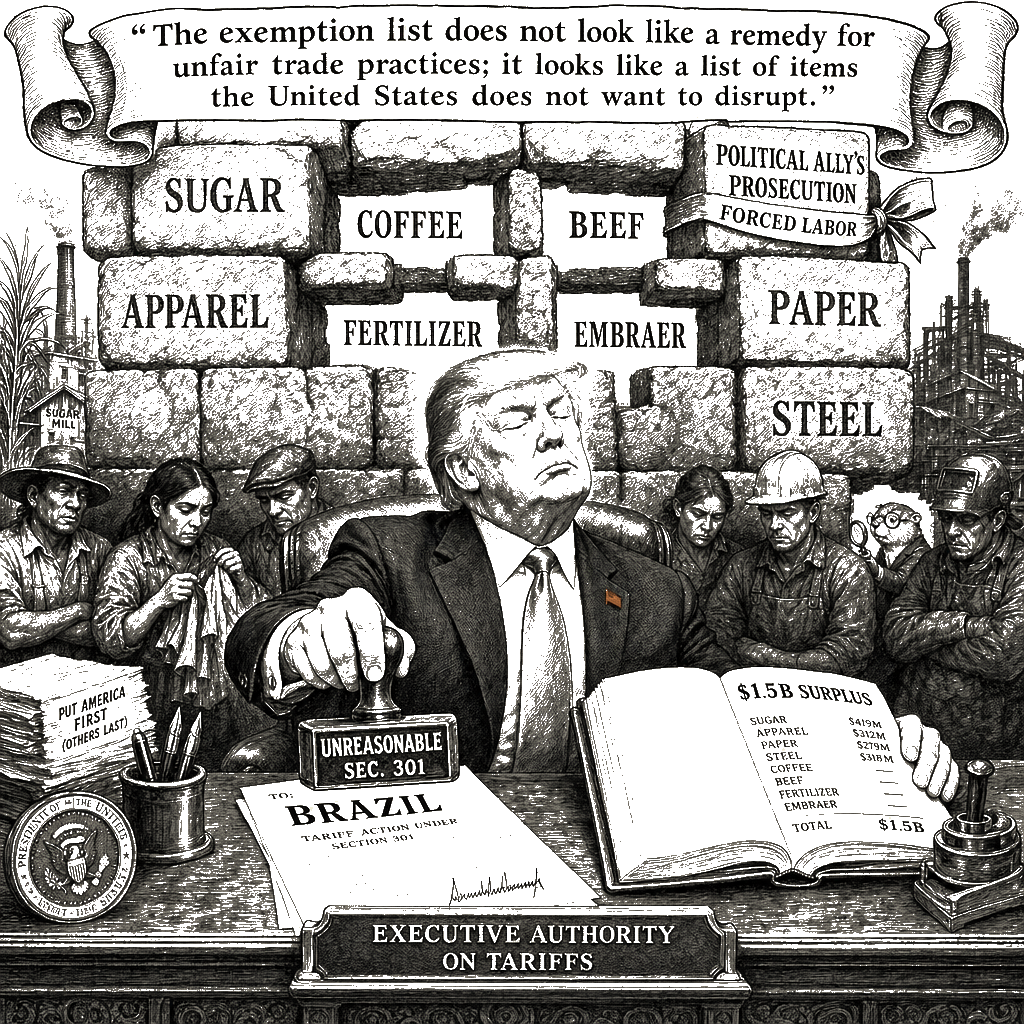
Trump is weaponizing tariff authority to extort Brazil’s courts and voters on Bolsonaro’s behalf.
Here are the numbers. On July 15, 2026, the Office of the U.S. Trade Representative imposed an additional 25% tariff on Brazilian exports covering goods that account for 18% of Brazil’s exports to the United States — about $7.4 billion in annual trade, in August 14 wire reporting on the action. USTR followed in late July with an additional 12.5% on a separate set of products, citing Brazil’s alleged failure to prevent imports of goods produced with forced labor. The combined rate runs to 37.5% on specific product categories — sugar, apparel, paper, steel. On August 14, Brazil’s Foreign Ministry formally initiated a 60-day consultation period under Brazil’s Economic Reciprocity Law, the first procedural step toward countermeasures under a statute Brazil passed in response to this action.
Three things are worth establishing before the talking points arrive.
First, the legal pretext does not match the trade record. USTR’s July 15 finding described “certain Brazilian practices” as “unreasonable” and as “burdening or restricting” U.S. commerce. The United States ran a $1.5 billion trade surplus with Brazil in the first half of 2026. The country invoking the trade-remedy statute against Brazil is the country with the surplus in the named categories; Brazil is the deficit side. Brazil’s government has called the U.S. action “arbitrary, unjustified and illegal” and submitted extensive technical evidence disputing USTR’s claims. Two of these accounts of who is being unreasonable to whom cannot both be correct, and the one with the surplus on the ledger is the one calling the other unreasonable. The U.S. surplus is documented in the same first-half-2026 trade data USTR cites as the basis for action.
Second, the forced-labor rationale was layered on after the political one. The late-July 12.5% tariff came after President Trump publicly linked the original July 15 action to the criminal prosecution of former President Jair Bolsonaro in Brazil — a political ally of the U.S. administration. Twenty-five U.S. states have separately sued the Trump administration over the forced-labor tariff authority, arguing it exceeds the statute. The forced-labor justification is doing legal work for an action whose first stated rationale, on the public record, was tied to a foreign prosecution of the U.S. president’s political ally. Forced labor is a documented harm, and the U.S. statute addressing it has its own procedures. When it is invoked as a second wave against goods already covered by an unrelated political action, the labor finding is the second wrapper, not the second reason.
Third, the exemption pattern confirms the political reading. Of the goods covered by the original July 15 tariff, more than 2,200 items considered “strategic” — coffee, beef, fertilizer, Embraer aircraft — were exempted. The tariff hits sugar, apparel, paper, and steel — categories whose exclusion pattern reads like a map of which Brazilian economic interests the administration chose not to disturb. In São Paulo state, the 37.5% rate lands on sugar mills that already operate on razor margins; in the apparel maquilas of the Northeast, it lands on a workforce the U.S. trade action does not name. The exemption list does not look like a remedy for unfair trade practices; it looks like a list of items the United States does not want to disrupt, applied to a trade action whose first public justification was announced in the same news cycle as explicit political demands on Brazil’s domestic legal proceedings.
The escalation is the receipt. Washington has revoked the visa of Brazil’s ambassador to the United States. A sitting U.S. president used the trade-remedy code to intervene in a foreign country’s prosecution of his political ally, then escalated through the diplomatic channel when the foreign government protested. This is what the trade-remedy statute was designed not to be. The authority exists to address documented injury to U.S. producers competing against unfair foreign practices. When the statute is invoked to coerce a foreign judiciary or influence a foreign election — Lula is seeking re-election in October 2026 against Flávio Bolsonaro, Jair’s son — the procedure is the camouflage and the political purpose is the act.
Brazil’s response is the documented procedure under a statute designed for this circumstance. The Economic Reciprocity Law authorizes proportional countermeasures — suspending concessions, eliminating exemptions, restricting imports of goods or services. Brazil’s government has not yet decided to retaliate; it has put the U.S. action under formal review, with the documentary record as the input. The 60-day consultation period is the procedural discipline that lets a sovereign trading partner test the documentary record before any countermeasure lands. Brazil’s parallel WTO challenge, opened in late July, runs the same evidentiary record through a different procedural forum. The United States’ share of Brazil’s export market has fallen to its lowest level since 1997 regardless of the tariff — the leverage the administration claims to be exercising is operating on a country already diversifying away.
Section 301 of the Trade Act of 1974 — the authority USTR invoked — requires documented injury, calibrated remedy, and procedural findings. American steel mills absorbing Brazilian-product input costs and Brazilian sugar mills absorbing the export rate, on either side of the line, did not produce the injury the statute requires. When those findings are absent, the action is extortion in statutory clothing. Brazil’s reciprocity framework tracks the GATT architecture the United States authored in 1947 and ratified repeatedly since. The administration that abandons the architecture does not get to claim the document when the reciprocity it invited arrives.
The tariff code is not a foreign-policy instrument. The administration is using it as one.
The score is the score. The party that called the foul does not get to officiate.