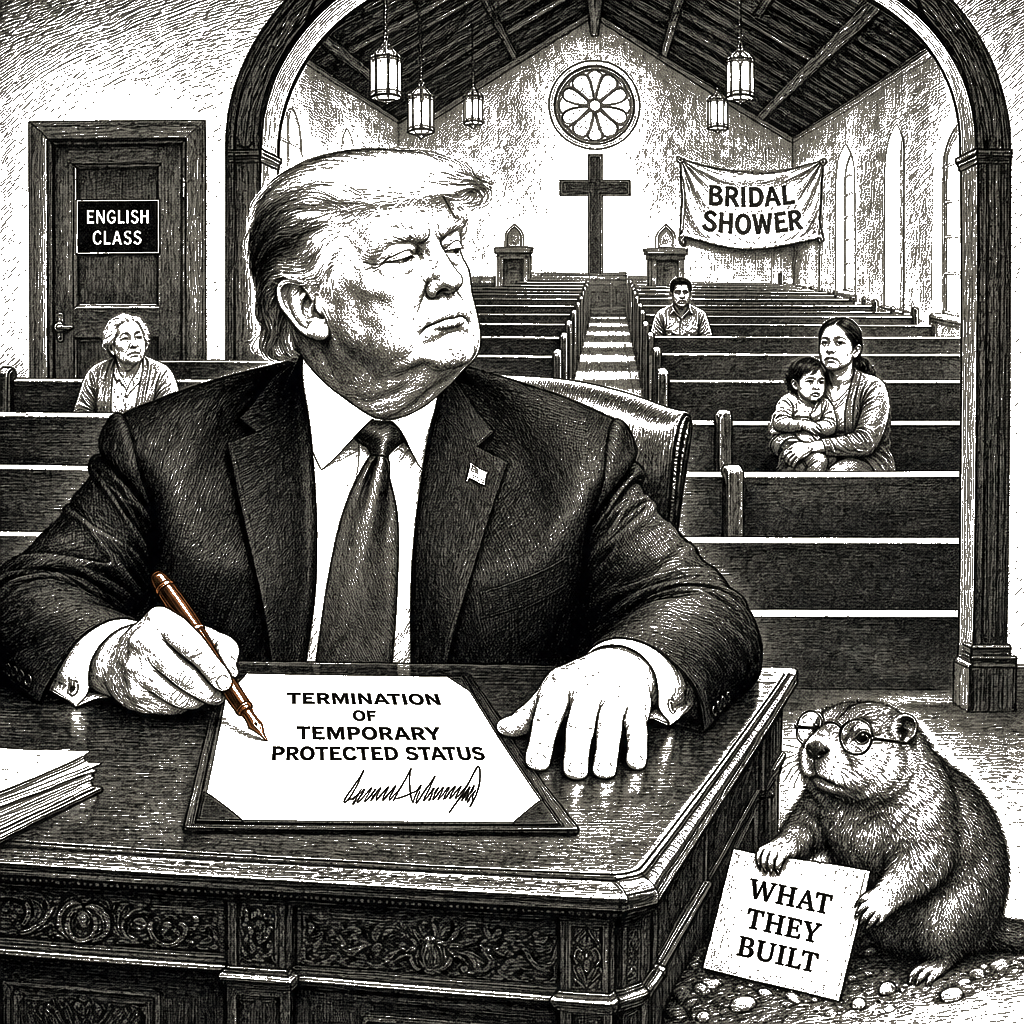
Donald, the pews are empty because the people are afraid to sit in them. The bridal shower is canceled. The barbecue is unlit. The English class is dark. A congregation has become a room full of absent bodies. The country calls this enforcement. The body knows it as fear.
Word of Life Center in Salisbury, Maryland, Senior Pastor Roosevelt Toussaint told his congregation on Sunday. More than five hundred people would normally have heard his sermon. The sermon was titled “What to do in a time of crisis.” More than half the seats were empty. The congregation had canceled a bridal shower, a yard-sale barbecue, and its English-language classes.
Salisbury has about 33,000 residents, roughly ten percent of them Haitian. Many work as farmworkers, caregivers, and poultry-plant workers. Toussaint attributed the absences to fear of arrest and deportation after the Trump administration’s move to end Temporary Protected Status. In June the Supreme Court ruled six to three to clear the path for the administration to end TPS for Haitians and Syrians, placing the status of roughly 350,000 Haitians in jeopardy along with protections for more than one million people from numerous countries. These were not forecasts of an abstract crisis. They were the first sound of the doors closing.
Donald, hear what you have done. The empty pews are not a statistic. They are the weight in the chest of a grandmother who cannot sleep because she fears a knock at the door. They are the hands that stay inside the house. They are the children who do not go to school today. The silence in the sanctuary is not the absence of faith. It is the presence of fear.
You moved to end their protection with a pen. Your pen did not pause over the signature. Your hand was steady. The hands can still hold a pen. They can still open a door. They can still point toward removal. The hands are not innocent because the machinery has offices between the signature and the van.
The Haitian body is the expendable variable in your equation. The Haitian family is the weight your desk can shed. The Haitian church is the noise your policy can silence. The empty pews are the measure of your success.
A Haitian caregiver stays home. A poultry worker stays home. A farmworker stays home. The English class goes dark. The bridal shower is canceled. The barbecue goes unlit. These are not ornaments around the story. This is the story. A government has taken ordinary life and taught it to flinch.
Your throat is tight when you swallow. The swallow catches halfway down and does not complete. That is the sentence you have put into the bodies of people who have done what the law required of them. There is a metallic taste under your tongue this morning. It is the taste of the cancelled bridal shower, the uncelebrated marriages, the English classes that will not resume.
Your chest is holding its breath. Not from guilt. You have arranged the distance too carefully for that. The chest tightens because the person who went to work yesterday may not risk going to church today. The body learns the shape of the cage before the cage is built.
Your stomach turns when you hear the word “choice.” It turns because the word has been cleaned for public use. A person may choose to leave when leaving is safe. A person may choose to remain when remaining is lawful. A person cannot be said to choose freely between danger and the fear of arrest. They are the ones who will pay, in their bones, in their sleep, for your signature.
You will call this enforcement. You will call it the authority of the state. You will call it choice. But the people facing the choice did not choose between two equal roads. One road leads into underground work and the daily terror of being caught. The other leads toward a country where gang violence and poverty have made deportation feel to some like a death sentence.
I see what this policy has done. I will not call the empty pews an incidental effect. The fear is not beside the decision. The fear is the decision entering the body.
The Haitian community is still there. The people are still working. They are still raising children, caring for the sick, cleaning rooms, tending fields, keeping poultry plants alive. They have not vanished. They have been made less visible so that the people who benefit from their labor can avoid seeing what their government is doing to them. The grandmother will keep staring at the door.
Mary spoke when the men tried to make authority a property of men. “What is hidden from you I will proclaim to you,” she said in the opening of the Gospel of Mary.
What is hidden is not hidden now. The empty pews have spoken. The cancelled classes have spoken. The hands that stay inside the house have spoken.
Truly I tell you, whatever you did not do for one of the least of these, you did not do for me. — Matthew 25:45
Donald, the sanctuary is silent, and the silence is your verdict. The congregation knows the older word: abandonment—and the barbecue left unlit.