
Lamar is a hand on the garment line I run inside a Mississippi correctional facility, and I use convicted people because the Constitution permits it. He earns $0.13 an hour. You pay for the fence through your taxes, you wear the shirt, and I keep the difference. The clause has served me well, and I’ve found no reason to doubt its wisdom.
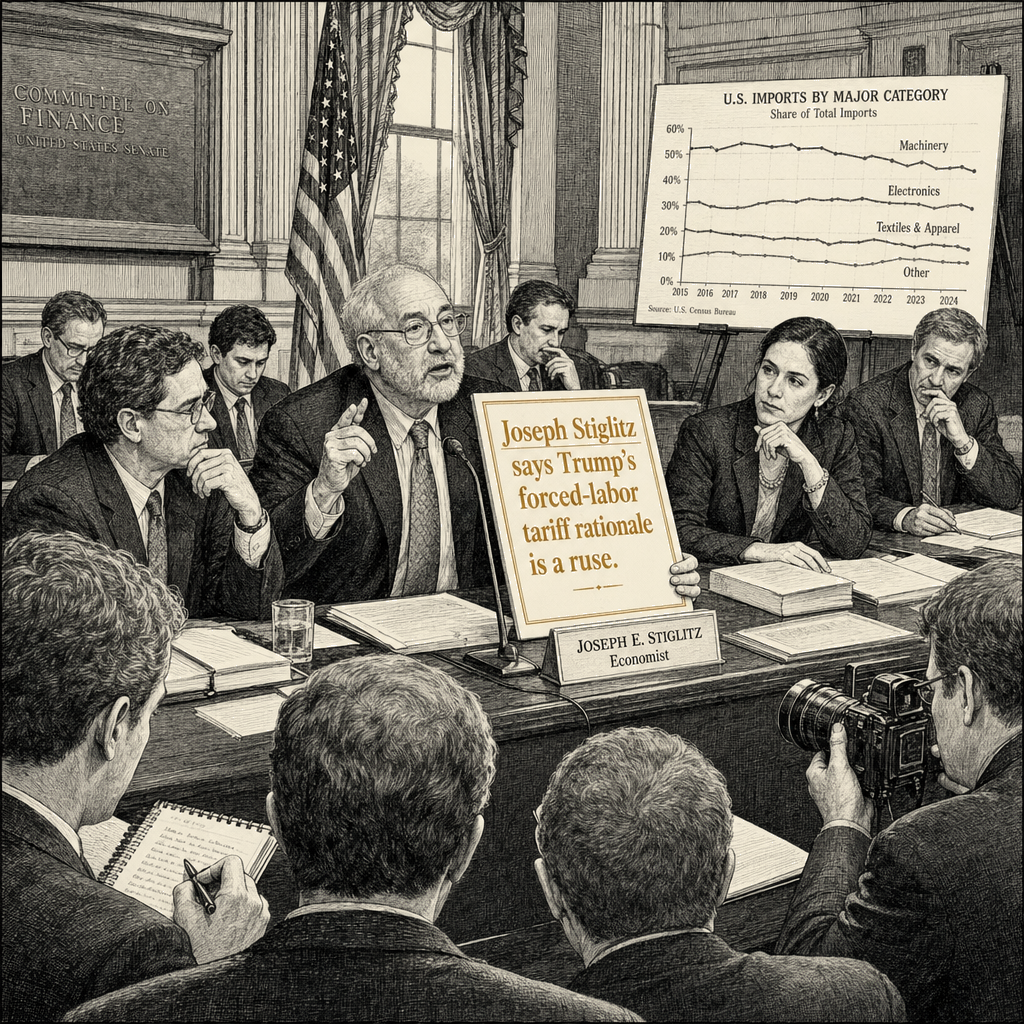
Joseph Stiglitz argues in The Guardian that the administration’s new tariffs, presented as a response to forced labor, are really an attempt to capture a larger share of global trade. He’s right about the pretext. The tariff may stop a foreign shirt at the border. It doesn’t stop Lamar’s shirt from leaving my facility. You can follow the lesson easily: the product is domestic, the labor is captive, and the customer is still you.
Lamar sews the uniform you might be wearing now. The shirt has 2 prices: the one on the tag and the one he never sees. That distinction matters because people often confuse a low retail price with an efficient supply chain. A low retail price can also mean that the state supplies the guard, the cell, the fence, and the punishment for refusal while the contractor supplies only the thread.
I invoice the contractor for the work. The state maintains the arrangement. You finance both sides.
Let’s begin with the number most people prefer not to hold in their heads.
The federal minimum wage is $7.25. Lamar’s rate is $0.13.
The difference is $7.12 an hour.
That isn’t a moral argument yet. It’s a cost comparison. The man is behind a fence, cannot leave for another employer, and cannot bargain over the rate in the ordinary way. I don’t need to spend money recruiting him, persuading him to stay, or competing with another factory for his labor. The state has already handled those functions. I receive an experienced hand at a price that keeps the contract attractive.
You understand why the arrangement survives. It doesn’t require a room full of villains. It requires a statute, an appropriation, a procurement office, and managers who are praised for keeping unit costs down.
Lamar is 46. He’s 14 years into a 22-year sentence. His hands moved quickly in the first year. They’re slower now. The joints stiffen. The carpal tunnel becomes part of the production schedule, like a delayed shipment or a machine that needs recalibration.
The shears that would spare his thumbs cost $31 a pair. I buy the $2.10 kind. They cut the cloth. The contract remains profitable. That’s the explanation I put in the file.
I don’t call his hands a tragedy in the production report. I call them a maintenance issue. “Maintenance issue” is useful because it tells the supervisor to compare the cost of prevention with the cost of replacement. It doesn’t tell him to imagine Lamar at night, opening a cup or buttoning a shirt. That isn’t the report’s purpose.
The tariff was sold as a way to bring production home. Mine was already home, waiting behind a fence. It raises the price of imported shirts while leaving my domestic line available at the rate the contract requires. The family that pays more for a shirt has less money for everything else. I understand that. But the correctional facility doesn’t cancel its contract because the retail quarter is soft. The appropriation renews, the bed count remains, and the line continues.
A customer who cannot stop buying is a stable customer.
The arrangement is older than my contract. The Thirteenth Amendment abolished slavery while preserving involuntary labor as punishment for crime. After that, states leased convicted people to mines, farms, railroads, and factories. The vocabulary improved. The power relation did not.
“For even when we were with you, this we commanded you, that if any would not work, neither should he eat.” — 2 Thessalonians 3:10, KJV
Paul was addressing a church. The correctional system applies the sentence administratively. I apply it commercially. My contribution is the purchase order.
Vera works 2 buildings away at the circuit station. She is a hand like Lamar, but the product is different: circuit boards for electronics you own. She’s 29 and 3 years into a 9-year sentence. Her hands tremble after the soldering shift. The fume does that.
The extraction hood that would carry the fumes away costs $240. The window beside her station was painted shut before I took the contract. I’ve been advised that ventilation would improve the room. I’ve also been advised that the contract does not require it. Those are different statements, and only one affects my bid.
I rotate Vera before the tremor reduces her output. That is not medical care. It is scheduling.
You see the pattern. Lamar’s thumbs, Vera’s lungs, the shirt, the board, the bid. Each injury enters the system as a cost question. Each cost question is answered by the owner who is farthest from the body and closest to the contract.
Milo works in another annex on the shirt line. He guides cotton beneath a needle for 11 hours. His right hand swells across the knuckles. The skin beside his index finger opens where the needle catches it. He wraps the finger in old cotton and returns to the machine.
A finger guard costs $0.01 per shirt.
I didn’t purchase it because the guard would interrupt the motion. An interruption would slow the line. A slower line would raise the shirt’s cost. A raised cost would trouble the buyer. The buyer would ask whether a hand belonged in the price.
That last question is avoidable. Good management avoids avoidable questions.
Milo’s finger can be wrapped. The guard would have been permanent. I chose the cheaper intervention because temporary injuries repeat and permanent equipment remains on the books. A finger closes badly. Another hand enters the annex. The shirt reaches the store. Your child wears it to school. The $0.01 remains in the margin.
You don’t need to admire the decision. You only need to understand why it keeps appearing.
A foreign shirt made through forced labor becomes a customs problem. A domestic shirt made through captive labor becomes a correctional partnership. The first crosses a border, so an officer can stop it. The second is already inside the legal perimeter, so the officer checks the country of origin, confirms the tariff code, and moves to the next file.
The customs officer isn’t required to ask whether Milo’s finger can close. The retailer’s buyer isn’t required to ask what the state supplied to make my price possible. Their hands remain clean because the form has already assigned responsibility elsewhere.
That is how the system works. The suffering doesn’t disappear. It becomes somebody else’s department.
Stiglitz thinks naming the arrangement should condemn it. Naming is helpful, but it isn’t enforcement. A tariff can make a foreign input more expensive while leaving the domestic captive-labor input untouched. A public official can condemn forced labor abroad while purchasing prison labor at $0.13 an hour. A consumer can oppose exploitation and still buy the shirt because the receipt does not show the fence.
The tariff has improved my position. It raises the price of the competing shirt and leaves my line inside the protected market. It also lowers the purchasing power of the people who might have bought more shirts. I’ve removed wages from the customer base and then described the remaining demand as resilient.
I haven’t examined what happens when the people making the shirts can no longer afford them. That belongs to another department. My department certifies origin.
The state will tell me a replacement is waiting. It usually is. I don’t need to know the replacement’s name. I need a bed, a work order, and a rate that remains below the price of ordinary labor. The facility supplies all 3.
Lamar’s hands will close for the last time in about 4 years. The line will be full again that morning. The tariff can stand or expire. The contract will be reviewed at the next fiscal year.
The rate will remain $0.13.
And the difference will remain $7.12.
Sterling A. Varice holds the Hayek-Friedman Chair and serves as Dean of Instruction at Warden University’s College of Business and Economics in Richmond, Virginia. He is the author of three textbooks: Divine Mandates for Labor Utilization, Social Obligations for Profit Maximization, and Calibrated Deprivation: A Manager’s Guide to Employee Motivation.