
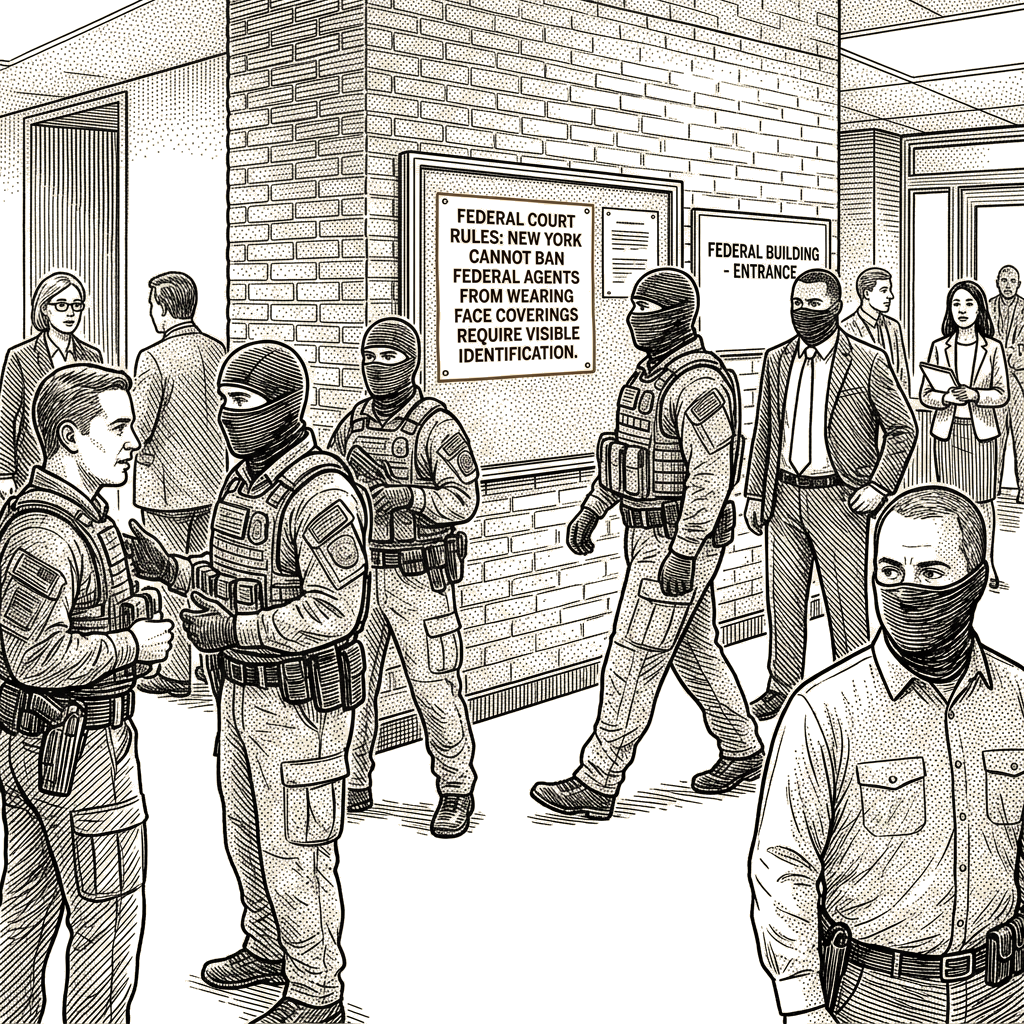
The Trump administration is hiding federal agents from the people they police.
Judge Mae D’Agostino’s ruling rests on a serious constitutional argument. The Supremacy Clause provides that the Constitution, federal laws, and treaties are the supreme law of the land. Under that theory, New York cannot dictate the clothing, identification, or operational procedures of federal agents merely because the state considers those requirements necessary for accountable policing. The federal government has shown a likelihood of success on that claim, D’Agostino found. (U.S. Const. art. VI, cl. 2.)
That is the strongest version of the government’s case. It is also narrower than the administration’s practical position. The question is not whether federal agents may perform federal duties. The question is whether federal power includes a license to make the people subjected to that power unable to identify the officers exercising it.
D’Agostino wrote that New York “appears to be well-intentioned in its pursuit of transparent policing.” She then separated transparency from constitutionality. That separation is doctrinally recognizable. A court applying the Supremacy Clause cannot convert a preferred state policy into a federal command.
But the administration is using that constitutional boundary as an accountability shield. The result is a federal enforcement regime in which agents can enter a community, conceal their faces, refuse visible identification, and invoke federal supremacy when the state tries to make official power legible. The state cannot command federal agents. The federal government therefore claims the power to remain unidentifiable.
That is not a minor dispute about uniforms. Identification is the first condition of a usable complaint, a witness account, a civil-rights investigation, and a later judicial record. A witness to a use-of-force incident needs a way to identify the officer involved. A person stopped or detained by an unidentified agent needs a way to name the actor and establish which officer made which decision. Masking does not merely protect an agent’s face. It transfers the evidentiary burden to the person with less power, less information, and less control over the encounter.
The federal government has carried the same dispute into other states. The ruling follows an earlier federal decision blocking a similar California law, according to the Associated Press. The pattern is now visible across state lines: federal power may operate inside a state, but the state may not require the federal officer to be visible while doing so. Every state that might have served as a laboratory for accountability is reduced to a designation on a federal enforcement map.
The hedge matters. D’Agostino issued a ruling on the government’s likelihood of success, not a final merits judgment. The constitutional question remains contested. But that procedural caution sharpens the administration’s advantage rather than limiting it. The government receives the operational benefits of anonymity immediately, while New York must continue litigating to defend a transparency rule that was blocked at once. Secrecy wins the calendar.
The immediate effect is clear: New York’s transparency requirements are blocked, while the federal government’s operational secrecy remains intact. The court has not held that every federal officer may conceal identity in every enforcement setting, and the source record does not establish the final scope of the ruling. The ruling nevertheless leaves the public confronting federal agents whose authority is visible while their identities are not.
The Supremacy Clause may prevent New York from regulating federal agents. It does not make federal agents unaccountable. Federal law can require identification, and federal agencies can impose disclosure rules. The constitutional boundary does not require federal power to be invisible; it requires federal power to be exercised under rules that make accountability real.
The administration is not merely enforcing immigration law. It is building an enforcement system in which the officer can disappear before the record begins.