The logging company is stripping Pacheedaht territory bare.
Near Port Renfrew on Vancouver Island, about 20 forest defenders slept on a gravel logging road. They came in a five-car caravan, slept in tents and the backs of cars, and put one truck sideways across the road at 3 a.m. The company expected to begin cutting old-growth trees the next morning.
About an hour later, a logging truck appeared. It slowed. It idled. It turned around. Nobody got out. Nobody spoke.
Sometimes the whole argument is contained in a truck turning around in the dark.
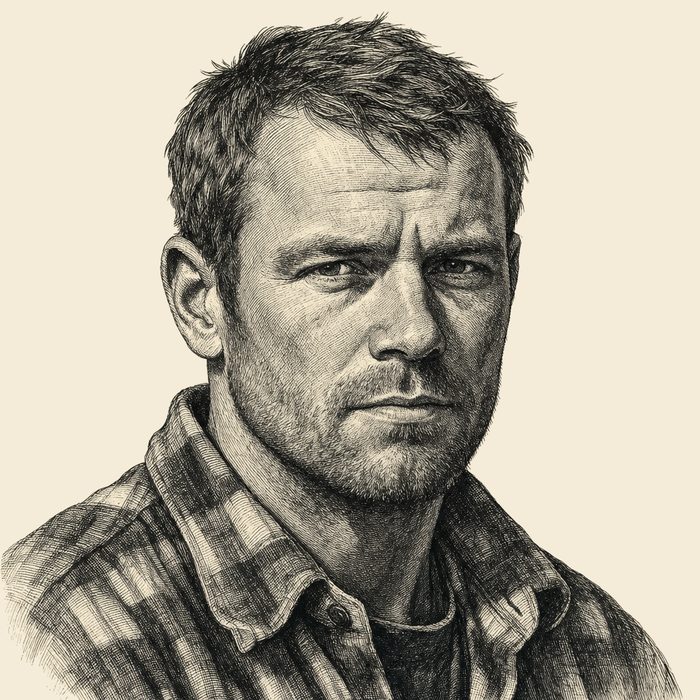
Bill Jones, an 86-year-old elder of the Pacheedaht First Nation, was among the people blocking the road. He began logging at 18, before he understood what he was helping to dismantle. He says the forest on his nation’s territory has been reduced to “few remnants here and there.” He describes the land as “practically naked, bare.”
That is not a dispute between people who like trees and people who like jobs. Jones had the job. He knows what the work is. He knows what the work became when the trees were treated as inventory and the territory was treated as an input.
That is not scenery. It is a record of extraction.
The language around logging makes the machinery disappear. A company “manages timber.” A road “opens access.” A cutting plan “supports jobs.” Those phrases may describe pieces of the operation, but they do not describe who decides what survives. They leave out the elder standing in the road because the elder is not a line item.
This kind of destruction has a name: the extractive mind. It does not ask whether a place can continue to support a community. It asks what can be removed, sold, and replaced with a road, a payment, or a promise that the next cut will be managed better.
The promise arrives after the damage becomes visible.
A forest is called renewable because another forest might grow in its place. That definition leaves out time, old trees, soil, species, water, and the people whose lives were organized around the forest that stood there before the replacement began. A plantation is not an old-growth forest. A payment is not a homeland. A new stand of trees is not the living system that was cut.
Aldo Leopold wrote, “When we see land as a community to which we belong, we may begin to use it with love and respect.” Ownership gives someone authority over land. It does not give them the right to pretend the land has no other members.
The Pacheedaht defenders were not asking the forest to remain untouched by human hands. They were trying to keep the remaining old growth from becoming another empty space in a territory Jones already described as bare. That is a narrow demand because the damage is already broad.
A job matters. A paycheck matters. Communities need work. But work does not excuse destroying the place that makes a community possible. The question is who controls the use, who bears the damage, who gets heard before the cut, and whether the forest can remain a forest afterward.
I know the shape of that bargain from Adams County, Wisconsin. Adams was organized in 1912 as a working-class C&NW division point — crew changes, engine changes, the roundhouse — and the town’s whole working life ran through that yard. The railroad single-tracked the line in 1958, pulled the last passenger train in 1963, and passed to Union Pacific in 1995; the yard jobs went the way of the steam engine. The paper mills up the road closed one after another — Port Edwards in 2008, Whiting in 2010, Wisconsin Rapids idled in 2020 — and the calls were made from somewhere else. The dairy farms went from 16,886 in 2002 to about 6,200 in 2022 while the average herd grew from 55 cows to more than 200, which is consolidation by another name. A company arrives with jobs, access roads, tax promises, and a story about responsible management. The costs arrive later: poorer water, fewer animals, damaged roads, thinner soil, lost recreation, and a local economy still dependent on the next decision made by a distant owner.
Then the company leaves, consolidates, or changes ownership.
The road stays. The cut stays. The community keeps the maintenance bill.
That is the rural political economy of extraction: private control over the useful part, public responsibility for what remains.
The contradiction runs deeper. The same system that praises self-reliance makes local communities dependent on distant firms for the terms of their own survival. The company decides when the road opens. The company decides what counts as usable timber. The company takes the saleable product. The people left behind are expected to repair the social and ecological wreckage with volunteer hours, public funds, and patience.
Public language celebrates community values while the economic system removes the material foundations of community. The forest is described as a resource for the people while the people lose control over what remains of it. The town is praised for being tough while its inheritance is hauled away.
The logs leave by one route. The cost comes back by another.
Old-growth logging threatens biodiversity, climate resilience, watersheds, and habitat. Main Street Independent recently reported that Canada was battling nearly 900 wildfires while smoke became a tariff argument. Smoke crosses borders easily. So does the damage created by treating forests as short-term fuel for distant balance sheets. The people who live beside the cut absorb the disruption, then get told the resulting fire, heat, smoke, and water problems belong to somebody else’s argument.
The company gets the timber.
The public inherits the risk.
Jones’s testimony matters because it does not come from someone untouched by the logging economy. He worked in it. He says he helped dismantle the forest before he understood the work’s full meaning. That is a harder witness than the clean conscience of somebody who never touched a saw. His experience does not make the cutting harmless. It makes the warning harder to dismiss.
He names the system that turns work into dismantling and then calls the dismantling prosperity.
The defenders used the power still available to them. They organized, showed up, and made the road answer to the people who live with what happens beyond it. That is not a rejection of work. It is democratic counterpressure against a private decision already treated as inevitable.
The defenders slept in cars and tents because the trees could not file an appeal. Jones stood there because he knows what the forest looked like before the remnants became the whole account. The truck turned around because, for one morning, the people on the road made the cost visible before the cut began.
Real rural infrastructure protects the water, the forest, the workers, and the community’s power to say no. It puts the long life of the place ahead of the short life of the contract. It leaves children something more durable than a story about what used to stand there.
The woods still hold more than a balance sheet can count. On Pacheedaht territory, an old-growth tree is more than a load waiting for a truck. A community cannot live on remnants forever. It needs the standing forest, the water beneath it, and the authority to say no before the next truck arrives.