
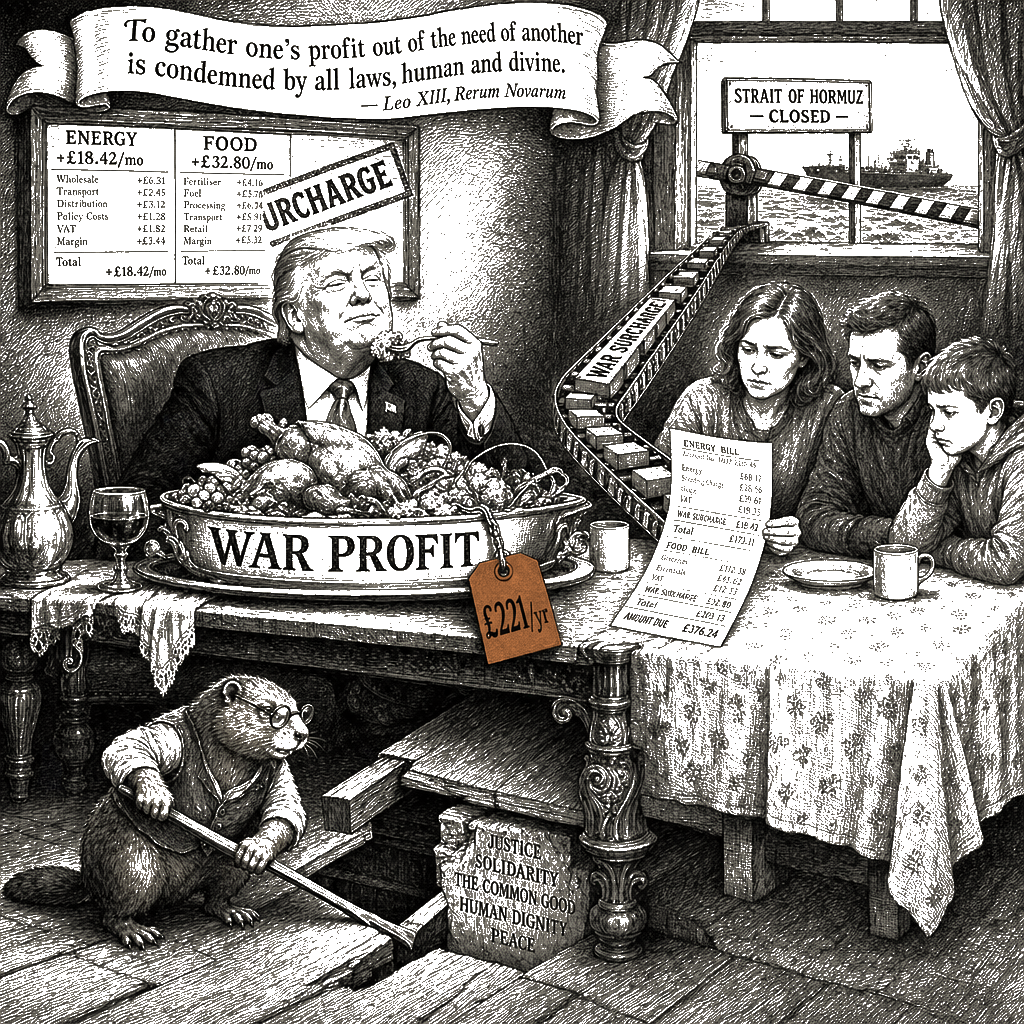
Trump’s war is robbing British families of £221 a year to enrich oil companies.
I moved the numbers between the same two columns at eleven o’clock last night, the way I have every month for years, and there the war sat in both columns: £18.42 a month more for energy that cost less before the bombs, and another £32.80 a month forecast on food while the Strait of Hormuz stays shut. The war never appears on the bill by name. It does not have to. It is in the meter, and it is at the till.
That is not a headline. It is a line item. It lands whether you voted for the war or not, whether you can absorb it or not. The families who cannot absorb it eat it anyway.
The word the government reaches for is “crisis,” as if this were weather. The math shows a transfer. When shipping lanes close and supply tightens, oil companies make enormous profits from the squeeze the war itself manufactured. The cost does not disappear. It moves out of the Gulf and onto the kitchen table in the form of a bill nobody in Britain signed.
Leo XIII named the exact move in Rerum Novarum: to pressure the indigent for the sake of gain, to gather profit out of another person’s need, is condemned by all laws, human and divine. There is nothing accidental about a war that enriches the few and is paid for by everyone else at the checkout and the pump.
Britain is not standing outside this transfer. American strategic bombers, B-52s among them, launch from RAF Fairford and Diego Garcia within range of Iran. The government calls the bases defensive. My meter does not sort by legal category. Defence is a shield; a runway loaded with strategic bombers pointed at Tehran is a sword, and it swings from British territory.
The prime minister said he would call out Trump to defend British interests before he had the job. Now his government has licensed the runway, while the foreign secretary presses Washington to reopen the Strait of Hormuz on one track and the bombers keep leaving from British soil on the other. The distinction does not survive the trip to the kitchen.
Revoking that permission is the single most important thing Britain can do to stop treating this war as a standing tax on every working family on the island. It was a choice to authorize the bases. It is a choice to keep authorizing them. Every week the war continues, the £221 and the £32.80 come out of households that had nothing to do with deciding any of it.
The unions did the math out loud, which is more than the number-crunchers in No. 10 have bothered to do. Ten unions, including Unison, the NEU, the fire brigade and the postal workers, representing 2.3 million workers, put the cost and the cause in the same sentence and sent it to the prime minister. Their demand is not mysterious: end the war, reopen the strait, bring down the price of energy and food, and start by pulling the runway out from under the Americans.
Khem Rogaly, who coordinated the letter, said allowing American strategic bombers to strike Iran from Gloucestershire could make Britain complicit in war crimes. Jonathan Portes, professor at King’s College London and former chief economist at the Cabinet Office, said the government cannot ignore that Trump’s illegal and unnecessary war makes the work of raising living standards much harder. The beneficiaries are named. The costs are numbered. The profits are on the record.
I will say where the burden lands, because it lands hardest where I do not live. I am a professional with a cushion. The poorest households spend the largest share of their income on energy, so every point of this war’s price weighs most heavily on families with nowhere to move the number except between the same two columns.
The government knows one small lever: the electricity VAT cut its own union allies pushed for last month. That may help. But real price control is not a subsidy scheme or a tax cut, welcome as those are. Real price control is refusing to keep funding a war whose business model is making the things people cannot refuse more expensive.
“You’re on your own, kid,” Taylor Swift wrote, and it has functioned as the mission statement of every household that has absorbed somebody else’s war in the price of its own heating. But the union letter proves the title wrong. You are not on your own. There is a runway, there is a permission slip, and there are named human hands holding them. That is the entire difference between a war you suffer and a war you are invoiced for.
Every month I move the same two numbers between the same two columns, and the war’s profit has a permanent seat at that table now. The unsentimental comfort is that the seat was put there by a decision. Decisions are the one thing human hands can let go of.
You’re on your own—unless you decide together not to be.