
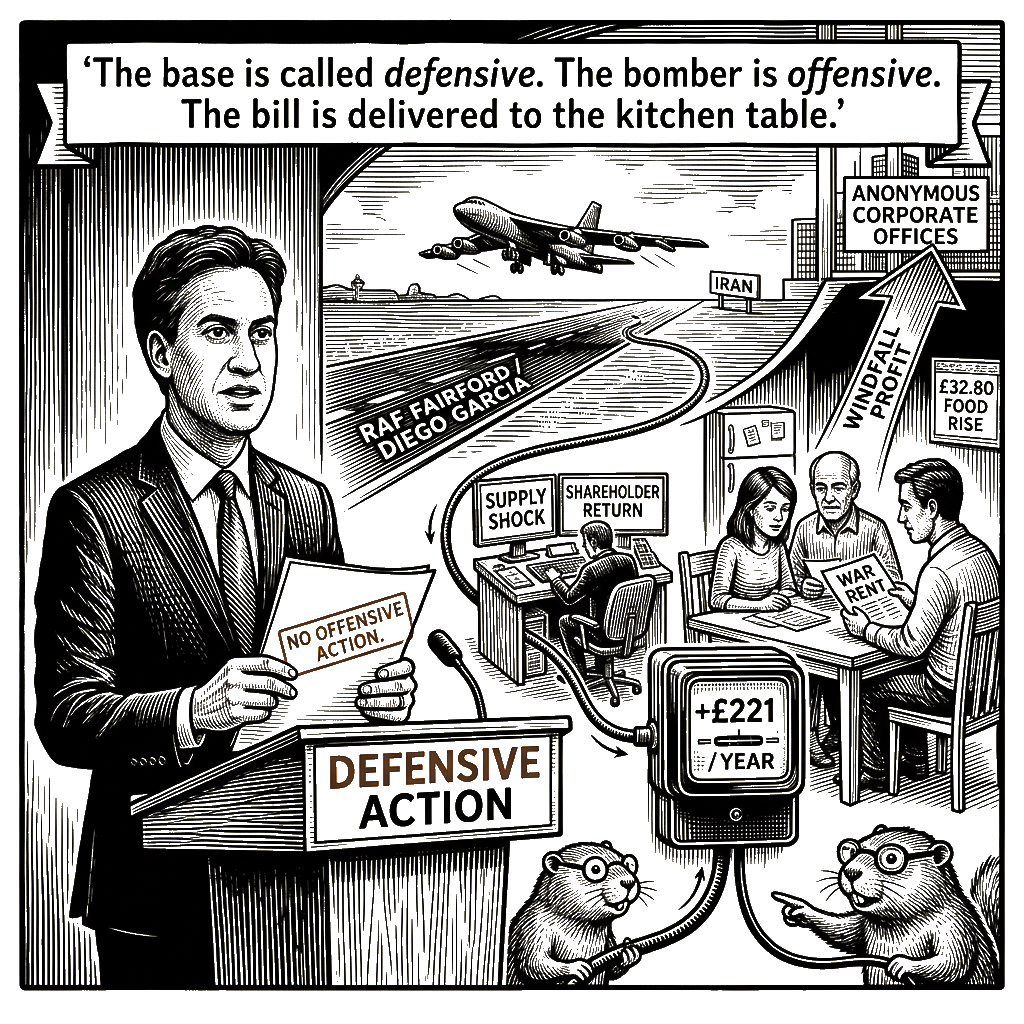
The cost-of-living crisis did not begin at the checkout. It began in a war that closed the shipping lanes, and the war is now the rent on your power bill. Ten British trade unions representing 2.3 million workers — including Unison, the National Education Union, UCU, the FBU, Equity, and the CWU — have written to Prime Minister Andy Burnham saying exactly that: if Britain wants lower energy and fuel costs, it should revoke America’s permission to launch airstrikes on Iran from RAF bases. The Guardian reports. The letter is polite. The arithmetic underneath it is not.
Since the bombing began, the average British household has seen its annual energy bill rise by £221. Monthly food bills are forecast to climb another £32.80. That is not inflation drifting in from the weather. It is the war’s rent, collected at every meter and every till, forever renewable.
Give the government its due first, because the strongest version of its argument is real. The Strait of Hormuz carries roughly a fifth of the world’s oil. A war that disrupts that passage creates genuine supply pressure no British government controls. Britain depends on American intelligence, the Five Eyes architecture, and the nuclear umbrella. A new prime minister with a mandate to fix living standards cannot burn every bridge in his first month.
Miliband is right to pursue a ceasefire. The government’s security argument is not fabricated. It is constrained. That is what makes the rest of the argument so difficult to excuse.
This is also the week Ed Miliband flew to Washington, pressing for the Strait of Hormuz to reopen, before his first meeting with Marco Rubio. Afterward, he said Britain “did not join offensive action in this war” and that the bases were used “for defence by our allies.”
The word is doing exactly the work it was designed to do.
A British territory that launches strategic bombers within range of Iran is a military asset in a war. Calling its contribution defensive does not un-bomb anything. The £221 does not care whether the missile that disrupted the supply chain that raised the price that hit the British consumer was fired offensively or defensively. The cost is the same.
Miliband is a serious man who knows this. That is precisely why the diplomatic vocabulary is the tell.
The unions’ letter names RAF Fairford and Diego Garcia as the specific pieces of leverage Britain holds. Both are “capable of launching strategic bombers,” the letter says, and both have become “increasingly important to the US due to the impact of Iranian counterstrikes on its Middle East bases.” The United States is using British soil to launch heavy bombers at Iran. That is offensive staging. No amount of diplomatic varnish changes the physics of a strategic bomber loaded on a Gloucestershire runway.
Whose security, exactly, is being purchased with £221 from your kitchen table?
Watch where the money travels. The war tightens supply through the Strait of Hormuz. Less oil moves. Prices climb. Oil rises not only on the physical disruption but on the financial machinery layered over it: futures contracts, speculative positions, and algorithmic trading that prices in what is happening, what might happen, and what can be made to look as if it might happen. Every headline gives the trading floor permission to reprice. Every reprice becomes another instalment on the household bill.
The cost did not vanish when the bombs fell. It moved.
It moved off the balance sheets of the firms and onto the family budget. The economists cited by the unions say the big oil companies are making huge profits from the squeezed supply. A few firms pocket the windfall. Millions of households absorb the bill. The government calls the invoice “geopolitics” and asks everyone else to be brave about it.
That is not a market. It is an arrangement somebody designed.
Even if a ceasefire arrives tomorrow, the structural problem remains. Energy markets are not organized to keep household bills low. They are organized to deliver returns to shareholders. The war is the sharpest version of a permanent condition: every pipeline dispute, refinery outage, or speculative bet can widen the gap between what energy costs to produce and what households are charged to consume.
The £221 did not begin with Iran. It is simply the most visible instalment of an arrangement in which energy exists first as a financial asset and second as the thing you need to cook dinner.
You do not fix that with a tax cut alone. The government cut VAT on electricity, and the TUC backed it. Inflation is finally heading down. A tax cut on the price tag is real, and nobody should sneer at five pence that lands in a working family’s pocket.
But a discount on a bill does not survive contact with the thing that writes the bill.
The TUC can endorse the VAT cut and still understand that VAT is not ownership. A discount treats the symptom while leaving the meter connected to the same extraction machine. The government can trim the invoice while permitting the war, the trading floor, and the shareholder return to keep writing it.
This is why the unions’ letter is more interesting than a ceasefire demand. The ceasefire is the immediate ask. Beneath it is leverage.
Britain has leverage. RAF Fairford and Diego Garcia are not symbolic footholds. The United States needs them. Revoking permission would materially constrain American operational flexibility and create pressure for the diplomatic settlement Miliband says he wants. This is not fantasy. It is a card the government owns and has chosen not to use.
The unions are saying: you have a card. You campaigned on the cost of living. Play the card.
And playing it is not an abstraction with a policy name. It is the £221 coming off next year’s bill. It is the £32.80 stopping its climb. The connection between the war and the kitchen table is not a metaphor. It is a line on a bill.
The signatories know this. Daniel Kebede at the NEU, Jo Grady at UCU, and Andrea Egan at Unison represent teachers, nurses, and care workers who watched their real wages flatline while someone else’s profit margin expanded by roughly the amount their energy bill went up. These are not people who send polite letters for the pleasure of being acknowledged.
The same prime minister said last month that he would call out Trump to defend British interests. Declining to be the hired bill-payer is not the weakness he was warned about. It is the first honest sentence of foreign policy a Labour government has written in a generation.
But revoking permission is only the immediate repair. The lasting question is who owns the infrastructure between the source and the socket.
My Norwegian cousins get their pensions from a two-trillion-dollar fund that owns a slice of the whole world because Norway decided the country — not a cluster of firms — would own its oil. When the country owns the windfall, the squeeze hits the firms before it hits the family budget. Norway turned public resource wealth into a public capital fund. Britain can build versions of that principle without pretending the Nordic model is a magic import. The plumbing took decades there. The choice can begin here.
Energy cooperatives, public ownership of distribution, and member-owned models can keep more of the margin local instead of shipping it to a shareholder in Houston. A country can treat essential energy the way it treats a library: everybody pays in, everybody can use it, and nobody is priced out because a war has made a commodity trader optimistic.
That is not the gulag. It is not the strip-mine. It is a market with the trap doors welded shut.
The government should revoke the permission, use the leverage it already has, and break the transfer at its source. If the 2.3 million workers are wrong about where the £221 comes from, London is welcome to show the books. Until then, the card is in the prime minister’s hand.
Play it.