
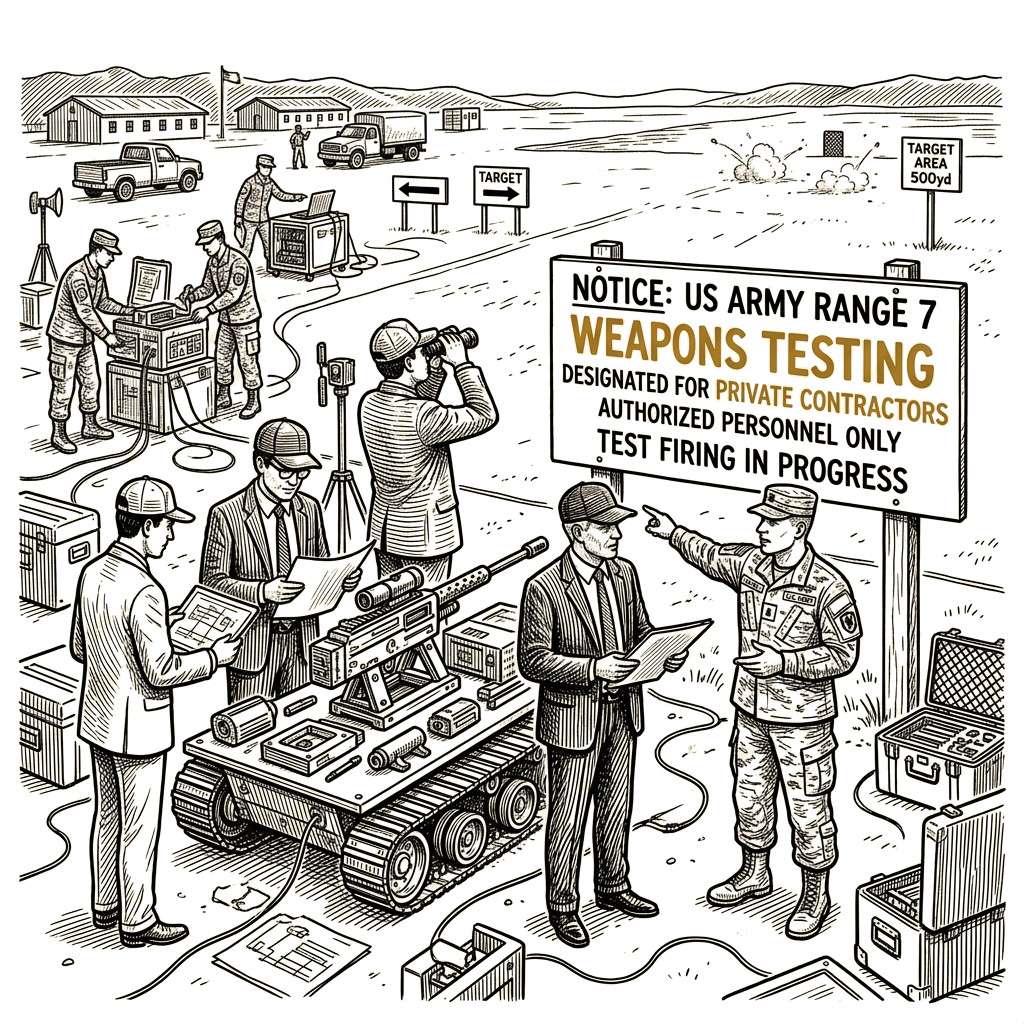
Driscoll is handing soldiers’ test ranges to arms firms to speed the war.
The Army secretary announced it Friday at Camp Grayling, Michigan, on firing lanes where soldiers have trained for generations. Private companies chasing missile, drone, and weapons contracts can request space on a U.S. or allied test range through an online marketplace that went live the same day. The Army promises an answer within 30 days.
Twelve to eighteen months was the old wait to test a weapon, Dan Driscoll said. Thirty days is the wait now.
A man who has spent his time in a gunner’s seat learns to read that kind of schedule plainly. When the shop quotes you a 30-day turnaround, somebody has his hand on the money. Nobody contracted this pace for the soldier’s comfort. It was contracted because the shelves are bare and war is the customer.
The stated purpose is to shorten the road “between weapons development and battlefield procurement.” Give the claim its due. Yes, this is about speed. A soldier wants the thing that works, and wants it before he needs it, not after. The waiting is real. The delay between a unit’s need and a fielded answer can be fatal.
But speed for whom?
The road that shortens runs from the firm’s drawing board to the firm’s contract. The men who carry the gear choose nothing and test nothing. They take what the market sends. A faster clock does not put a single interceptor in the rack of a unit that has fired its last one. It puts a replenishment order in the queue.
Driscoll says the firms should be able to test “the thing that can make a soldier’s life better, that can increase their lethality and that can keep them safer” without waiting twelve to eighteen months.
Here is the thing about that sentence. Lethality is not safety. Lethality is the capacity to do harm. The words do not mean the same thing, and a man who runs them together in one breath is asking you not to notice the difference.
Safety would be the soldier coming home. Safety would be not sending him into a war that has already burned through the arsenal.
What Driscoll is offering is a faster pipeline from factory floor to battlefield, wrapped in the uniform of the man who carries the weapon. That is an old and reliable way to sell a war. I bought it myself once, from men who talked exactly like this. I wanted faster gear because I wanted more of us to come home. I never thought to ask why a machine that could hurry the gear could not hurry the war’s end.
I hear now what I could not hear then. The sentence was the pitch, and I was the one being sold.
The Army’s announcement points to drones in the conflicts where American forces and their partners are fighting. Iran’s Shaheds have buzzed American positions across the Middle East, and the fighting has tested how thin the answers to cheap drone swarms can stretch. Ukraine is building its own drones while defending against invasion. The Pentagon is managing the costs of a war that has run down the long-range missile inventories. The U.S. Army has already used most of its long-range missiles in that fight.
A single interceptor runs into the millions. When the magazines are down, the money follows the firm that can restock them.
The range is rented by the replacement round. The 30-day clock is the procurement cycle compressing itself around the demand. The honest kernel is not the argument. The argument is that the answer to a war consuming missiles at millions of dollars apiece is to build and field more missiles faster.
That is the operating-tempo logic of the machine. The war creates the demand, and the apparatus exists to meet that demand without asking whether the war should be fought at all. The twelve to eighteen months Driscoll wants to cut is the friction the machine was built to eliminate, because every hour shaved off is an hour closer to the next contract and the next company’s share price.
The soldier’s name is on the marketing.
Eisenhower named this in his farewell address of January 17, 1961. “In the councils of government, we must guard against the acquisition of unwarranted influence, whether sought or unsought, by the military-industrial complex.”
He warned in the same speech that the weight of this combination must never be allowed to endanger our liberties or democratic processes. He said only “an alert and knowledgeable citizenry” could compel the proper meshing of the huge industrial and military machinery of defense with our peaceful methods and goals.
Sixty-five years later, here is what that alert citizenry is being asked to do: watch an Army secretary hand public test ranges to private arms makers, put them on a 30-day clock, and call it innovation while a war depletes the public arsenal.
The warning was built for the moment influence arrived. Eisenhower thought it might come unsought, creeping into the councils from outside. Camp Grayling shows the other direction. The Army is not on guard against the complex. It is opening the gate, holding the door, and setting the clock so industry can walk through faster.
The complex does not need to acquire influence anymore.
It is being booked in.
Smedley Butler understood the older version of this traffic. After thirty-three years and four months in uniform, he described himself as “a high-class muscle man for Big Business.” The language is blunt because the arrangement was blunt. Private firms make the weapons. Public institutions provide the ranges, the orders, the money, and the bodies that carry the result.
The men sent to fight are not the men whose companies hold the keys to the ranges, any more than they were the men whose fathers ran the offices. From where I sat in the gunner’s seat, when the magazines ran low they did not open a marketplace. You were told to make do, and to sign your own name to the shortage.
The firm signs its name to the range and the contract.
The stockpile draining now is not measured in serial numbers alone. It is measured in service members who will not come home, and in the ones who do, carrying what the war put inside them.
The answer to drained stockpiles is not a speedier supply line. It is the question the machinery is built never to ask: whether the war is worth the price, whether the authorization still holds, whether the soldiers who fired the last interceptors and the civilians who were under them count as anything more than the cost of doing fast business.
An Army secretary who cannot answer that question has no business speeding up the manufacture that makes the question unnecessary.
The marketplace is live. The ranges are open. The clock is 30 days.
The war is the customer, the firms are the vendors, and the line of the bill carrying the soldier’s name never appears on any contract. Those charges are paid somewhere else, by people who never got to submit a request in thirty days.