
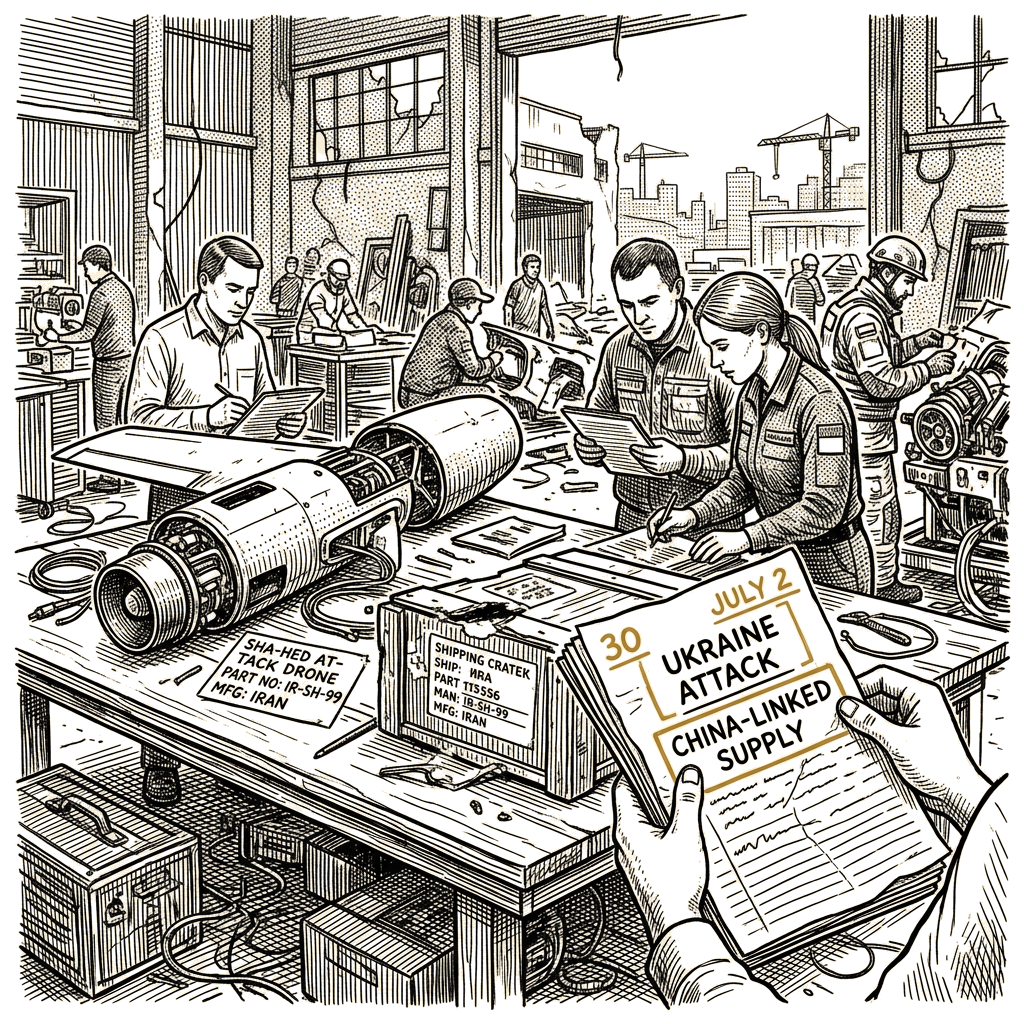
Every Shahed that strikes Kyiv, every Geran that haunts a Ukrainian sky, every turbojet drone that outruns the interceptors sent to kill it — all of it runs on parts that pass through the same global pipeline. The pipeline has a Shenzhen address, a Hong Kong mailbox, and a Texas Instruments part number. It has been operating in the open, in fragments, for years. The latest accounting of how it works should end any pretense that the cheap drone threat is a problem anyone is solving.
What the assembled record shows is not a covert operation but an exposed one. Iranian engineers could not source the high-speed engine that turned a $20,000 piston-propeller drone into a 300-mile-per-hour weapon on their own. The best option was a German design, the L 550 E, made by Limbach Flightmotoren. A 2008 State Department cable described how Iran obtained the engine, possibly with fake documents to throw customs inspectors off the scent. In 2012, a Chinese company began distributing Limbach’s engines; it bought the German firm outright in 2017. Treasury later sanctioned the Chinese affiliate, Xiamen Limbach Aircraft Engine, for supplying engines to Russia for its drone program. The engines kept flowing. Iran eventually reverse-engineered its own version under Oje Parvaz Mado Nafar Company, a firm U.S. officials link to the Revolutionary Guards. That company’s co-owner and chairman, Brig. Gen. Abdollah Mehrabi, was directly responsible for a 2022 deal that sold more than 13,000 Shaheds to Russia for $324 million.
The turbojet engine is the headline. It is also the smallest part of the problem. Treasury investigators found that virtually every American and European part in Iran’s and Russia’s one-way attack drones was diverted through Chinese intermediaries, often via Hong Kong shell companies that order parts from Western suppliers while disguising the ultimate destination. Teardowns have found Texas Instruments microcontrollers and STMicroelectronics linear regulators inside the wreckage. Texas Instruments says it “strongly opposes” the diversion. STMicroelectronics says it “doesn’t support or condone” the misuse. The opposition is a press release. The parts keep moving.
The Chinese government’s stated position is that it strictly regulates the export of dual-use components and rejects unilateral U.S. sanctions punishing unauthorized trading of such parts because they violate international law. Hong Kong’s government says it enforces United Nations sanctions but not those imposed by individual nations. The position is a policy choice that produces documented civilian deaths. Each turbojet Shahed that outruns a Ukrainian interceptor drone and strikes a Kyiv apartment block represents the predictable consequence of that choice being honored in practice. When Beijing frames enforcement of its own laws as illegitimate extraterritoriality, it is asking the defenders of the next city the weapon strikes to accept the absence of any enforcement architecture as the price of doing business with Chinese intermediaries.
The Shenzhen hardware maker identified in the turbojet debris is Telefly Telecommunications Equipment, founded in 2010. Telefly’s website once advertised turbojet engines. After Ukrainian officials publicized the connection, that section disappeared from English-language pages but remained on its Chinese-language pages and at other Chinese vendor sites online. Telefly did not respond to requests for comment. The selective scrubbing of English-language product listings while Chinese-language listings remain live is what the documentary record documents as concealment: the firm removed the public evidence that connects it to a weapons supply chain while preserving the listings its actual customers read. A company that sells turbojet engines capable of propelling a 300-mile-per-hour attack drone, then removes the evidence of that sale when scrutiny arrives, has made a choice about which transactions it will document and which it will not.
A former Treasury Department official framed the shift plainly: “For a long time the focus for making the Shahed was about getting Western parts. They focused on that a lot. Now I think that has shifted as China has become better at manufacturing parts and technology like this.” The shift described is a warning about Beijing’s documented role in the pipeline, not an indictment of Western export discipline alone.
The Shahed-136 is not a theoretical threat. The weapon first killed people in July 2021, when drones struck the MV Mercer Street off the coast of Oman and killed a Romanian captain and a British security officer. The July 2 attack on Kyiv, in which turbojet-powered Shaheds were launched alongside ballistic and cruise missiles, killed some 30 people. The turbojet-powered variants fly at roughly 300 miles per hour, about three times the speed of older versions, and can outrun the interceptor drones Ukraine typically uses to shoot them down. Ukraine ordinarily stops more than 90 percent of the older one-way drones; the new turbojet models must be downed by jet fighters or Ukraine’s limited supply of interceptor missiles. Ukraine’s air force reports Russia has launched Shaheds against Ukrainian cities every night this month, and Moscow has been lining up upgraded drones from Tehran to keep the pipeline full. President Zelensky singled out the turbojet variant after the July 2 attack as a threat that has outpaced the defense. Each unit costs as little as $20,000 to produce; each successful intercept costs the defender orders of magnitude more in sortie hours, interceptor missiles, or the lives of the people who live in the buildings the weapon hits when the intercept fails.
The Ukraine story is one theater. The drone is no longer a Ukraine story. Iran has sold the technology to Venezuela, Syria, and Ethiopia. Russia’s Africa Corps has used the drones in Mali. The weapon helped devastate a U.S. base in Bahrain at the start of the war with Iran. China and India have revealed their own versions. In August, an armed drone was found at a German airport near a Ukrainian jet and traced back to Russia — the same playbook, now reaching NATO territory. A retired Australian major general told reporters “we’re going to see these things everywhere.” The prediction is not in the future tense.
What makes the Shahed era distinctive is not the drone itself but the supply chain behind it. The $20,000 unit cost is a function of the globalized parts market, the willingness of middlemen to launder end users, and the absence of any enforcement architecture that can keep up with the routing. Each new variant — turbojet, more antennas, more modems, more SIM cards correcting flight paths over local cellular networks — draws on the same pipeline. Each new buyer taps the same vendors. The pipeline is the product.
The arms race is lopsided: the attacker iterates on a $20,000 airframe; the defender must escalate to manned fighters or scarce interceptors to bring one down. Each turbojet that forces a fighter scramble burns budget and sortie capacity the defenders do not have. Each new antenna array on a Shahed buys the weapon a longer useful life against electronic countermeasures.
The U.S. military was so impressed by the Shahed’s economics that it developed a low-cost drone of its own for the war with Iran. The lesson American planners took from the weapon was not “stop the supply chain.” It was “build one too.” That is the most honest verdict on what the global response to the Shahed has been: imitation.
The Chinese affiliate that distributed Limbach engines is sanctioned. The Shenzhen hardware maker that built the turbojets is identified. The Hong Kong shell companies are named. The Western chipmakers have issued their statements. The pipeline keeps running. The drones are faster this year than last. They will be smarter next year. The countries buying them now include some of the most unstable on earth. Ukraine has struck at parts of the supply chain where it can reach them — including the Caspian supply-line strikes — but the routing has proven more durable than the interdiction effort. The question is not whether the Shahed era spreads further. The question is what the defenders of the next city it strikes will have left to shoot back with.