
Charlie Nunn is making Lloyds workers finance Lloyds shareholders’ AI strategy.
The chief executive of Lloyds Banking Group has doubled down on a £13 billion plan to use artificial intelligence to attract customers, reduce costs, improve efficiency and increase shareholder payouts. The plan includes £2 billion in cuts that will affect staff. Nunn describes this as reskilling, hiring and technological progress. The workers whose jobs are being cut will experience it as a bill.
That is the small, concrete fact inside the larger AI story: the bank keeps the gains, the workers absorb the transition, and the public is asked to call the arrangement innovation.
There is a genuine case for using AI in financial services. Administrative work can be automated. Claims can be processed more quickly. Credit assessment can become less expensive. Banks have proprietary data, technical staff and long experience negotiating with vendors. Moody’s is right that some firms may reduce their exposure through open-source models and multiple providers.
But those facts establish only that the technology can be useful. They do not establish who will own the usefulness once it has been built into the institution.
Nunn announced the arithmetic plainly: £13 billion over the life of the plan, including £2 billion in cost cuts. The cuts, he said, would “impact work” — his phrase, as though the work were the thing being managed — and would require what he called reskilling and the hiring of new people. The same strategy increases payouts for shareholders.
Hold that sentence up to the light. The reskilling is not a promise. It is the word selected for the layoff, selected so the announcement can describe the event without making the reader picture the person. The payout is not a footnote. It is the destination.
The £2 billion in cost cuts — cuts Nunn said would “impact work” — is paired with the money promised to shareholders. That is not collateral damage to an efficiency program. That is the program.
The phrase “reskilling” performs the catalog’s euphemistic-labeling pattern: a term substitutes technical improvement for a material act, allowing the speaker to name the process without naming who loses a job, income, bargaining power and the ability to refuse. The label does not make the worker more secure. It makes the institution’s decision easier to announce.
The answer is visible in the structure. Banks will spend heavily on systems they do not fully control. Workers will be told that the new systems require fewer of them. Shareholders will be promised higher payouts. The firms producing the models and cloud infrastructure will sit above the arrangement, collecting rent from every institution that becomes dependent on them.
That is not a neutral productivity story. It is a transfer of bargaining power.
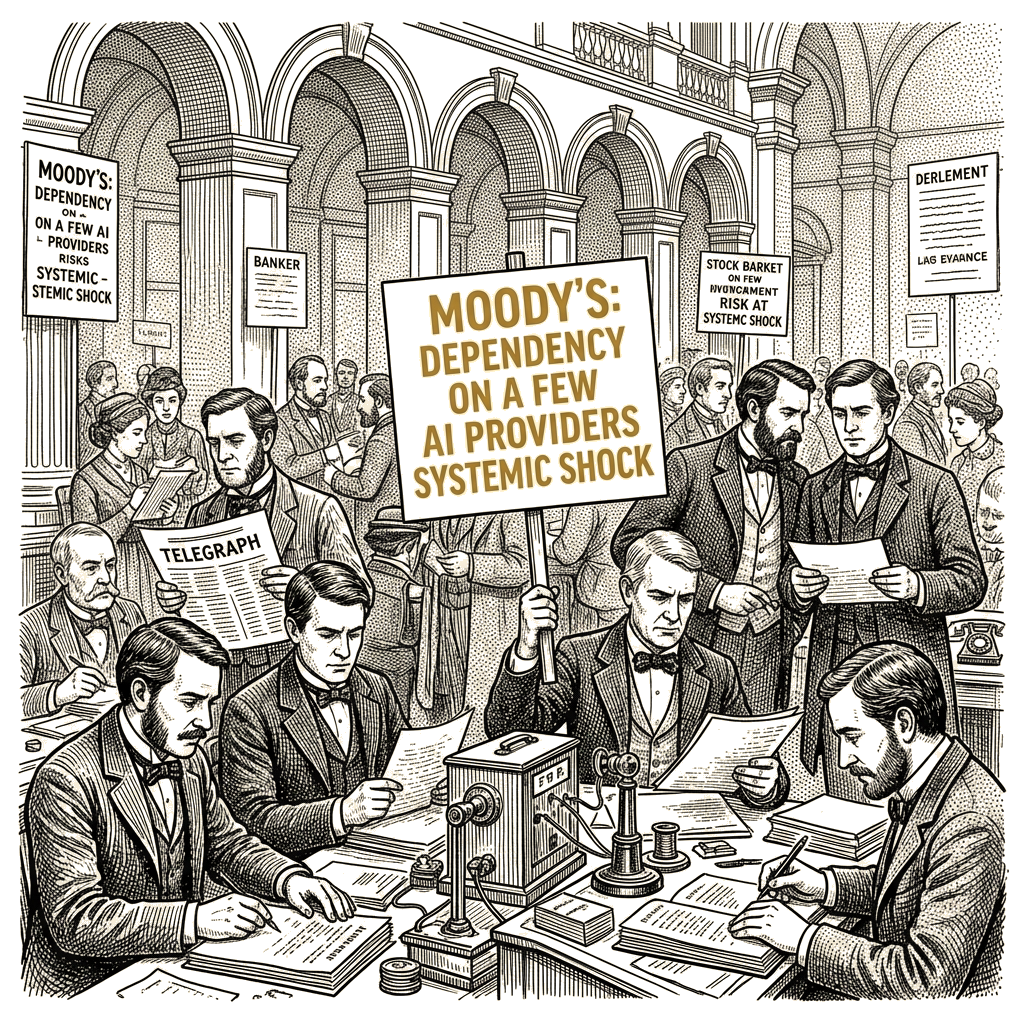
Moody’s has identified the financial-sector version of the problem. The race to adopt AI is putting banks at the mercy of a small group of Silicon Valley firms. More than three-quarters of City companies now use the technology, according to a Treasury select committee report. The biggest adopters include insurers and international banks, automating everything from claims processing to creditworthiness.
A “model outage at one major provider,” Moody’s warns, “could potentially spread quickly across customers and sectors.” The agency also flags the possibility that a handful of dominant providers could eventually “exert control over the price of AI services.”
Read those findings alongside Lloyds’s announcement and the transaction comes into view. Efficiency is real, and it is beside the point. The point is who pays and who does not.
Moody’s itself concedes that, with so many rivals racing toward the same technological finish, most of the benefits will be “competed away.” That is a lovely phrase, and a precise one. The banks may spend billions to reach the same technological position as their rivals, only to discover that the savings have become the new baseline.
The benefit gets competed away. The cost remains.
The providers, however, do not need every bank to win. They need every bank to participate.
At one end stand the model-makers — OpenAI and Anthropic — loss-making firms whose valuations require them to convert temporary indispensability into permanent collection rights. Moody’s warns that those companies will face pressure to deliver profits to investors. Investors will not be satisfied with a moral victory, a promising demonstration or a useful research platform. They will want recurring revenue, higher prices, reduced labor costs and contracts that are difficult to cancel.
That pressure is the engine of what Moody’s calls “vendor dependence risk”: build the dependency now, set the price later.
Wall Street has already supplied its answer on AI returns. Cloud revenue has surged as investors search for the money. The money is landing with the people selling the shovels — the cloud providers whose revenue surge is the market’s own admission of where the value is heading. Revenue for the infrastructure provider is not the same thing as durable social or institutional value. Someone is paying for the surge. The question is whether the payment buys a lasting public capability or finances another layer of private toll collection.
The cui-bono trace runs upward. The public justification is efficiency. The first beneficiaries are the shareholders promised higher payouts and the executives who can present labor reduction as strategic transformation. The next beneficiaries are the model and cloud providers whose infrastructure becomes difficult to leave.
The cost-bearers are the workers whose jobs are made conditional on learning to supervise the machine introduced to reduce their number; the customers exposed to automated errors; the depositors exposed to faster, more correlated withdrawals; and the wider financial system exposed to a dependency no single bank can safely control.
The risk does not disappear because every individual firm believes it has made a rational decision. That is how systemic dependency is built: one sensible contract at a time.
Banks retain important assets, including proprietary data. But owning the data is not the same as controlling the system that makes the data useful. A bank can possess every customer record in its vault and still be unable to operate normally if the model layer fails, the cloud contract changes, the price rises, or the vendor decides that the bank’s preferred use violates a new commercial policy.
The bank retains the asset while surrendering part of its capacity to act on it.
That is ownership inside a dependency.
The two counter-moves banks are promised — long experience negotiating down technology contracts and open-source models — do not dissolve the dependency. Negotiating leverage is only as real as the vendor market is competitive. As the provider set concentrates around the few firms able to host model scale, the bank’s counterparties shrink, and “negotiation” becomes price-taker positioning.
Open-source models still require the same concentrated cloud fabric. The scarce talent required to operate and fine-tune them is itself inside the dependency. The dependence does not disappear. It migrates up the stack.
The financial system is supposed to be the machine that manages concentration risk. That is, literally, part of its stated function. Instead, it is racing on a shared timetable toward the same three clouds and the same handful of models, driven by fear of being the last institution without an AI strategy.
The outage that spreads “across customers and sectors” is not a bolt from the sky. It is the predictable fruit of putting every trust in the same basket because the first mover set the price of being left behind.
Moody’s says regulators “may increase their focus on operational resilience.” They may. They will also find the dependency already signed, the invoices already circling and the institutions already reorganized around the vendors they were supposed to be negotiating with.
George Lucas supplied the diagnosis for how this happens: democracies are not overthrown; they are given away. The same is true of institutional independence. Lloyds’s stability is not being stolen at gunpoint. It is being transferred, in return for a slightly cheaper invoice today.
This is the old platform bargain in a new suit. First, the technology is presented as a tool that serves the institution. Then the institution reorganizes itself around the tool. Then exit becomes expensive, expertise migrates outward, and the vendor gains the power to set the terms.
The bank is still called the customer. The customer no longer has the freedom that makes a contract a meaningful negotiation.
The official story contains its own contradiction. The AI push is supposed to make banks more efficient. Yet Moody’s says the gains will require “substantial investments,” while competition among banks will cause many of the benefits to be “competed away.” In plain English: the banks may pay billions to reach the same position as their rivals, only to discover that the savings have become the new baseline.
The expense remains. The advantage disappears.
The result is a transfer with no guaranteed destination for the people who are told to celebrate it. Even the shareholder may not collect all the promised gains if competition erodes them. The workers can still lose their jobs. The banks can still absorb the spending. The financial system can still inherit the fragility. The only certain winners are the vendors whose infrastructure every participant now pays for.
The pressure is intensified by the labor market. Moody’s estimates a 20 percent chance that, by 2030, AI will be able to perform the work of a solid mid-level employee. The number is uncertain. The direction of the incentive is not.
If executives believe a system might replace a mid-level employee, they acquire a reason to reorganize the workplace before the system is reliable enough to replace one. The threat itself disciplines labor.
That is what AI can do before it becomes intelligent enough to do the job: it can convince the boss that the worker is negotiable.
The workers are not abstractions. They are claims processors, underwriters, clerks and customer-service employees. They have rents, children, debts, congregations and lives that do not become less real because a board presentation turns them into “headcount.”
The World Bank’s accounting of lower direct AI job exposure in developing economies does not rescue the arrangement. A global bank’s efficiency gospel travels across the whole footprint. The contract is written in one place and enforced in a dozen. A lower exposure rate is not an absence of exposure, and a multinational’s decision to cut labor in one jurisdiction can become a template for workers elsewhere.
The late Martin Luther King Jr. had the diagnosis before the model-makers existed. In his late economic writing, he described a country with socialism for the rich and rugged individualism for the poor. The public cushion flows upward to the concentrated; the bootstraps lecture flows downward to everyone else.
The asymmetry has not changed. It has grown a chatbot.
State-subsidized cheap capital and public infrastructure flow to the few who own the compute, while the individual worker is lectured about reskilling as though the failure to keep up were a personal defect rather than a balance-sheet decision made four floors above them. King’s late-period argument was not a request for nicer language around extraction. It was a demand to identify the structure that made poverty and insecurity useful to somebody.
The danger to depositors adds another layer. If AI makes it easier for customers to move money toward higher-interest accounts, large deposits could leave quickly. Moody’s says trust in the institution and the resilience of deposit funding will become critical.
But trust is not produced by automation. It is produced by competent people who can explain decisions, correct errors and take responsibility when a system fails.
A bank that removes the people who understand its customers and replaces them with a vendor stack may discover that it has automated the very relationships on which stability depends. The same technology that makes large chunks of cash change hands at a click can accelerate a loss of confidence. The depositor does not experience that as innovation. The depositor experiences it as whether the institution can still answer the phone, understand the mistake and fix it.
The reflex responses are both wrong. It is not enough to say the AI boom is merely a bubble; the expense is real, the dependence is real and the displacement is real. Nor is it enough to say the boom is simply efficiency. Efficiency is the cloak, and under the cloak a person is being moved.
The honest name for the whole motion is a transfer: value moving upward into a handful of hands, cost moving outward onto the people told that the cost is good for them.
And the wicked part is that no single actor has to will the outcome. The bank runs to keep ahead of its rival. The vendor runs to turn indispensability into price. The regulator runs to keep up. Everyone optimizes a race that carries the system, its workers and eventually its depositors toward a wall — in the name of shareholder value.
That is responsibility laundering: take a chain of decisions made by identifiable executives, boards and investors, then describe the result as if it arrived like weather. Charlie Nunn chose to attach Lloyds’s strategy to £13 billion of AI investment and to pair that investment with £2 billion in staff-affecting cuts. The technology did not make that distributional choice.
The executive did.
“Reskilling” does not answer for him. Reskilling can be real and valuable. It can also become the soft word placed over a hard fact: the institution will keep the workers it needs at the wages and numbers it prefers, while everyone else is instructed to become useful to a system whose purpose is to require fewer people.
The choice is not between embracing AI and refusing progress. That is a false dichotomy. The real choice is whether AI will be governed as an accountable tool inside institutions that serve the public, or installed as a private dependency whose gains flow upward and whose failures spread outward.
Banks could retain meaningful control over critical systems. They could require interoperable infrastructure, maintain enough human capacity to operate during outages, share productivity gains with workers and refuse to turn every efficiency into a dividend. Regulators could treat concentrated AI and cloud dependence as a financial-stability question rather than a procurement detail. Boards could measure resilience, not merely quarterly cost reduction.
Those choices would cost money.
So does redundancy. So does institutional competence. So does keeping a human being available when the algorithm produces an answer that is wrong, expensive and impossible to appeal.
The reversal must begin where the transfer began. The payroll-to-shareholder flow must be arrested. Vendor dependence must be broken across plural clouds and open-source models. Depositors must be protected by regulators with the spine to set terms for systemic dependence before the dependence is complete. Workers must receive more than the announcement of reskilling; they must receive the training, time, bargaining power and security the word claims to promise.
These are not utopias. They are instruments already built, waiting for someone with the authority to use them.
We have seen this story before. The machine arrives as assistance. The contract arrives as convenience. The cut arrives as efficiency. The dependency arrives as inevitability.
The arc bends only if specific people, in a specific moment, push it. It does not bend by itself. It never has.
The question is not whether the technology advances. It will. The question is whether the people who carry the cost keep being told, by the people who collected it, that the carrying was their own improvement.
It was not.
It was a transfer.
And a transfer can be reversed. That is what makes it a transfer, and not a law.