
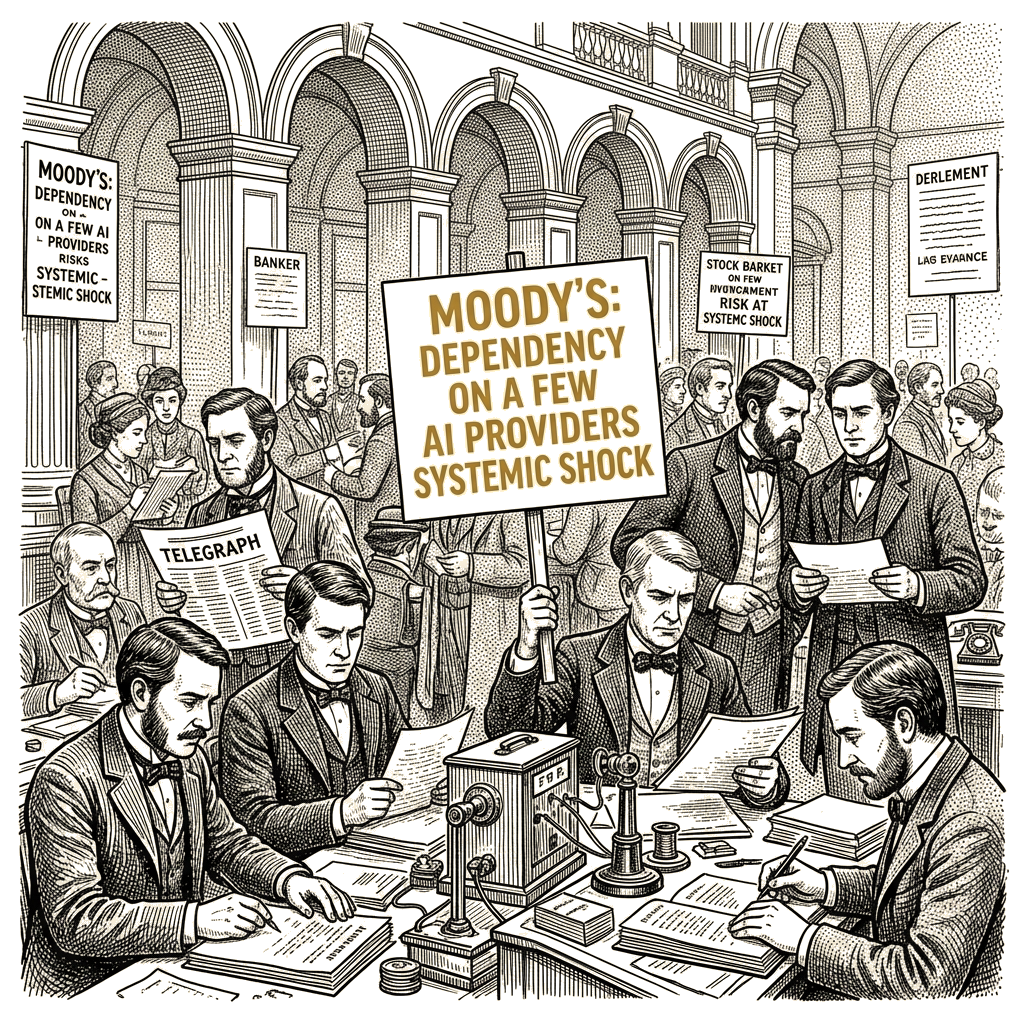
OpenAI and Anthropic are building a toll booth on the banking system.
It is true, in the narrow sense in which the rating agencies are usually right, that the current generation of large language models does real work in finance — automating the administrative backlog, processing insurance claims, assessing a borrower’s creditworthiness. The trouble is that the work is real and the race is a lemming race. More than three-quarters of City firms are already in, per the Treasury select committee’s January report, and they are all buying from the same small shelf of vendors. That is not adoption. That is the financial sector adding itself to the stack as a dependent layer.
The warning arrives, with the usual irony, from Moody’s — the institution that spent the last cycle rating the mortgage securities that nearly took the system down, and that has spent the years since collecting fees for certifying how resilient everything now is. When the bookkeeper of the last bezzle starts publishing reports about “systemic dependency” and “vendor dependence risk,” it is worth reading the report twice. The bezzle, John Kenneth Galbraith’s name for the interval in which the extractor has the money and the victim has not yet felt the loss, is the interval the rating agencies exist to certify.
The mechanics are not mysterious. The financial sector is concentrating its core operations — the claims processing, the credit decisions, the deposit plumbing — on a foundation-model and cloud layer owned by a handful of firms. A model outage at one provider spreads across customers and sectors because the customers are all on the same provider. That is the chokepoint, and it is being built voluntarily, at speed, by institutions that spent thirty years negotiating down technology contracts and now find themselves with no alternative supplier to negotiate against. Open-source models are the objection everyone reaches for — the self-hosted escape, no vendor, no toll. But the frontier labs hold back the models that matter, the banks’ own risk functions still buy from the vendors they think they are escaping, and no open-weight model has yet closed the capability gap that keeps the banks at the frontier counter. The release valve exists. The vendors control it. The partnerships are the ones the vendors offer. The four forces that used to keep this kind of concentration honest — competition, regulation, the ability to build your own, and labour that could say no — are being dismantled in the same quarter.
It is also worth being precise about what is being adopted, because the public discourse has the misleading habit of treating “the AI” as a thing rather than a continually-tuned set of weights serving a continually-revised objective function. In a bank, the objective function is the vendor’s, not the bank’s. The models that process the claims and score the borrowers are the same models the vendor rents to the bank’s competitor, and the vendor’s incentive is to make the dependency deeper, not the system safer. The cloud revenue numbers Wall Street has been celebrating this summer are the same numbers, read from the other side of the counter.
Moody’s concedes the benefits will be “competed away.” That is the sentence worth sitting with. The benefits are competed away because everyone is buying the same thing from the same vendors; the dependency is not competed away at all. That asymmetry is the whole story. The costs are real and permanent; the gains are temporary and shared; the toll booth collects either way.
Then there is the labour. Moody’s puts a 20% chance that, by 2030, the models can do the work of a “solid mid-level employee” — a category of person, one notes, defined entirely by the convenience of the person doing the defining. The World Bank’s recent work on AI job exposure focuses on developing economies, where exposure is lower — which is another way of saying the exposure is highest exactly where these banks operate. Lloyds’ chief executive has announced a £13bn strategy that includes £2bn of cost cuts, which he says will affect staff, and which he frames as reskilling, which is the word that always precedes the layoffs. The cuts are being executed now. The capability is a one-in-five shot at best. The threat is doing the work of certainty, which is precisely why the cost cuts precede the capability. The models do not have to work. They have to threaten. The threat is the product; the cost cuts are the point; the AI is the justification. My father watched the same arithmetic arrive at the mill in 1995, when the new owners explained that the line would be modernized and that the modernization would require some of the uncles to leave. The difference is that the mill had no choice. The banks have a choice, and they are choosing it.
The deposit-flight point is the one genuinely competitive force in the report — if the models make it easy for customers to move their money to a better rate, that is the market working, and the banks’ fear of it is the fear of competition, which is the one thing they have spent the decade trying to avoid. But even that gets absorbed into the dependency. The same models that let a customer switch accounts are the models the bank rents from the same vendor that serves the bank’s competitor. The twiddling is the vendor’s, not the bank’s.
The price-gouging risk is not hypothetical. The generative-AI companies are loss-making, and their investors want profits, and the captive market is the financial sector. The pricing is consumption-based — per-token, per-query, scaling with the bank’s own usage — and the old negotiating leverage is gone. Banks used to compare three vendors and play them off each other; now there are two frontier labs and every bank on the same meter. When the pressure to deliver arrives, the price of the toll rises, and the banks — who have no alternative, who have competed away their own leverage, who have handed the claims processing and the credit decisions and the deposit plumbing to the same few vendors — will pay it. The rating agency that certified the last bezzle is now the one warning about the next one. That is the closest thing to a regulator the financial sector has left, and it is a bookkeeper, not a cop.
The work is to be done. The banks could build, or buy, or regulate their way out of this — open standards, interoperability, a real alternative to the toll booth. They will not, because the toll booth is cheaper this quarter, and the bezzle is always cheaper this quarter. The question is who is left holding the bag when the interval ends.