Texas Pacific, LandBridge and EagleRock are selling the Permian’s commons to AI.
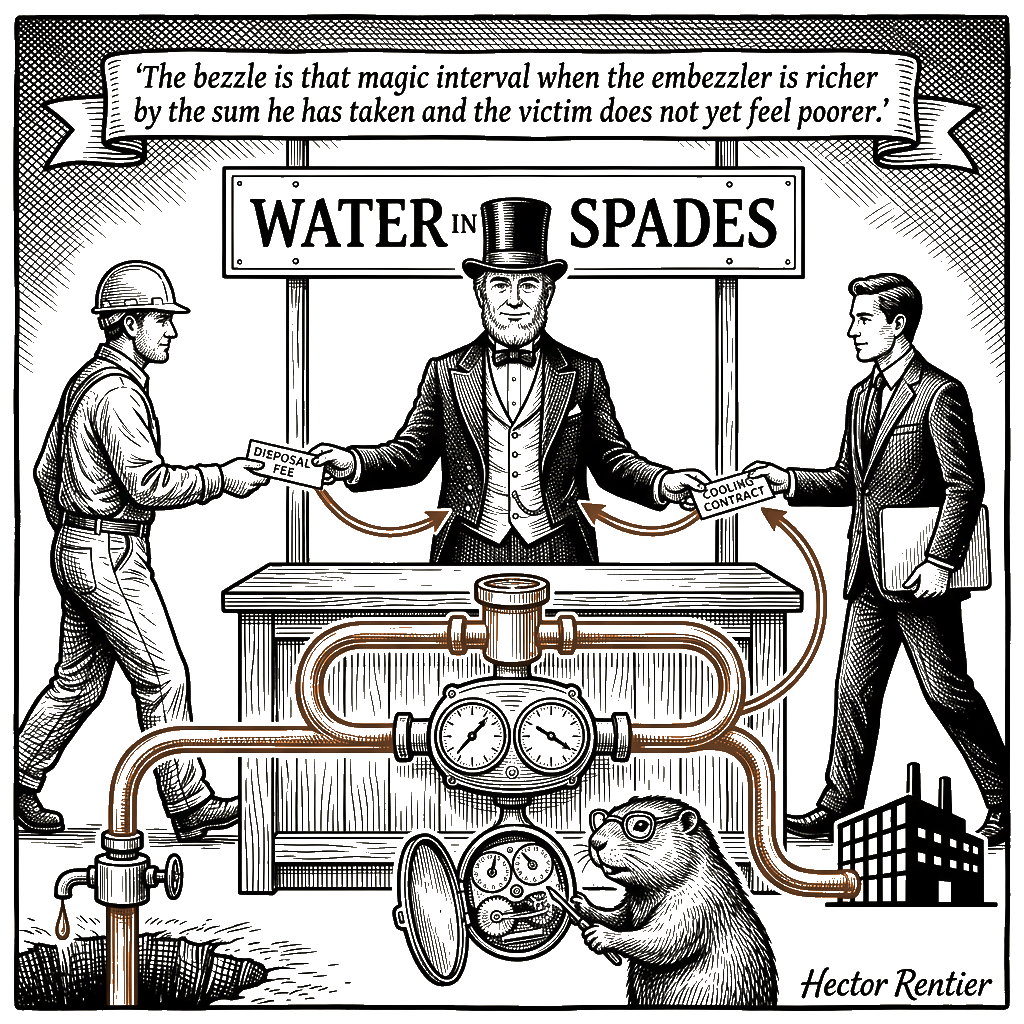
It is true, in the narrow sense in which marketing usually does its work, that the Permian has what data-centre developers say they can no longer find elsewhere: cheap land, cheap power, room on the transmission grid, and a business climate in which nobody much bothers to object. The region has 1.4 million acres across West Texas and New Mexico held by three companies — more than seven times the size of New York City. It has natural gas stranded for years by a shortage of pipelines, now suddenly next door to a customer willing to burn it on the spot. It has water “in spades,” as Greg Pipkin Jr., chief executive of EagleRock, put it, with the enthusiasm of a man who has found a buyer for the thing the industry has been paying to get rid of.
The trouble is what is actually for sale.
Concede the honest half, because it is honest. The producers genuinely do have stranded gas, though new pipelines have recently opened, and a water-disposal bill that climbs as the basin ages. A power plant that burns the one and drinks the other is, on its face, a rational answer to both. The builders are real, and the contracts are real. Chevron has signed a twenty-year agreement to sell electricity to a Microsoft data centre, and the gas-fired plant going up in the Permian to feed the 2.7-gigawatt campus will be built.
But be precise about the water, because the precision is the point.
The Permian has two kinds of water nobody ever wanted. The first is produced water: the brine that comes up the wellbore with oil and gas, heavy with salt and whatever else the formation happened to hold. Operators have spent decades paying to pump it back down into deep injection wells, and its disposal has become a genuine headache. Texas Pacific built a large part of its business on that headache, taking in nearly $386 million last year — almost half its revenue — from selling sand, caliche, the hard limestone gravel used on West Texas roads, and water to drilling operators, while collecting royalties on saltwater disposal.
The second kind is brackish groundwater: saline, undrinkable, but treatable, and present in volumes a data centre’s cooling systems can draw down. Neither is abundance in the sense a resident of a dry state would mean it. Both are liabilities wearing the costume of a resource.
The producers pay Texas Pacific to take the brine away. The data centres will pay for treated water. In the Permian, water has become the rare commodity that pays at both doors: once as a disposal cost, and again as a cooling input. A cost of extraction is doing a second tour as revenue.
The Texas Railroad Commission, which lost its railroads decades ago and kept the oil and gas, spent a century building the machinery that decides where the brine goes. That machinery was built for extraction’s convenience. Nobody has thought to ask whose convenience the water serves now.
There is an engineering cost the brochure leaves out, and engineering costs are the only kind that cannot be argued with for very long. Treating saltwater takes energy. The same gas-fired plants that the treated water is meant to cool will supply that energy. Chevron is building one of those plants on land Texas Pacific has agreed to sell it for $43 million, cooled by brackish groundwater from the same arrangement.
Read the loop. Gas treats the water. Water cools the plant. The plant powers the machines.
A loop is not a surplus. It is a dependency with a meter on it.
And the meter has two registers, which is the part the brochure does not photograph. The water being marketed as abundance has already been billed once as a removal cost. Operators paid Texas Pacific to take the brine off their hands, and those disposal royalties sit inside the $386 million that represents nearly half the company’s revenue. Now the same molecule is meant to be treated and sold back to the facilities it will cool.
One is garbage with a price tag. The other is a commons with a meter on it. The word “spades” exists to hide the difference.
What the three companies own is the ground everything else has to stand on. That is the chokepoint. Cory Doctorow and Rebecca Giblin call the broader arrangement chokepoint capitalism: a gatekeeper collects rent from both sides of a passage it neither built nor maintains. Here, the hyperscaler — the cloud giant, in the industry’s vocabulary — needs a substation. The substation needs land. The land is held by three firms that have decided the AI buildout is their next customer.
LandBridge says its affiliates will build fibre-optic cable and electrical substations, then collect royalties on power plants and water on top of the ground lease. A typical one-gigawatt campus on its land, the company has said, could produce tens of millions of dollars a year in free cash flow once power-plant and water royalties are counted. The occupant pays a landing fee and a watering fee to the same landlord, twice, for water the oil industry used to pay someone to remove.
Texas Pacific says one data-centre project could be worth “multiple hundreds of millions of dollars” over its life, counting land sales, construction materials, and water. It has put $50 million into Bolt, the data-and-energy infrastructure company co-founded by former Google chief executive Eric Schmidt, to make sure the deals find it.
This is not the oil patch diversifying away from extraction. It is extraction finding a new commodity. This time the commodity is the location itself.
The landlord’s arithmetic is the story. Texas Pacific, LandBridge, and EagleRock do not lift the water, build the data centres, or write the software that will run inside them. The data centres will arrive as prefabricated equipment assembled by contractors from elsewhere. What the Permian is being asked to supply is not work but ground, and what the ground is being asked to do is pay rent.
The other asset on the balance sheet is absence.
If the Permian were a state, it would be the least populated in the union: roughly 500,000 residents, fewer than live in Wyoming, spread across a territory larger than many states. Large facilities consuming substantial electricity and water are unlikely, in the Wall Street Journal’s phrase, to “spark local opposition.” The openness is real, too — open in the narrow sense in which a land empire is open, which is to say that its owners are ready to receive applications.
The trouble is what the openness is for.
Developers facing pushback from Maine to Arizona — the same farmers and ranchers who have been organising against data-centre construction on farmland — can route their demand to a place where land is consolidated into three portfolios and people are spread thin enough that objection has no address and no lever. Poolside and CoreWeave have said they will build a massive data-centre complex on a sprawling West Texas ranch, a project that, in a state with a planning board, would measure its approvals in years.
In the Permian, the approval is a lease.
A climate that is business-friendly because there is no one local to be adversarial is not a competitive advantage. It is a population that has been moved off the ledger. The burdens of a new technology are deployed first on the people least able to refuse them, not because the technology has to go there, but because resistance is thinner there.
The oil patch was hollowed out by a century of extraction. Now it is being refilled with machines.
Harold Innis spent his career tracing how the staples economy works: fish, fur, timber, grain, each exported to the metropole on terms the hinterland does not set, each one shaping the institutions, roads, and politics of the place it is pulled from. The Permian is a staples economy all over again, with the staple updated.
The crude leaves as kilowatts. The brine is resold as coolant. The land stays, and the terms leave.
The metropole is wherever the servers are. The terms are written into land leases and power-purchase agreements — the long-term electricity contracts that lock a buyer to a seller for twenty years — and countersigned by three land empires.
My father worked the bar mill at Manitoba Rolling Mills in Selkirk for thirty years. In 1995, when Gerdau of Porto Alegre bought the mill, he kept his job and several of my uncles did not. The rearrangement was invisible in the product: the bar kept rolling, the mill kept its name, and the difference between the uncle who stayed and the uncle who left became a line on a spreadsheet in Porto Alegre.
Extraction does not stop when the commodity stops paying. It finds a new one.
The mill became a financial instrument. The oil patch is becoming a data-centre campus. The water is the water.
Yanis Varoufakis’s distinction between profit and rent names what is being sold. Profit, earned by making something, remains answerable to competition. Rent is extracted for the use of something another person must have, and it is not answerable in the same way. Texas Pacific, LandBridge, and EagleRock own the ground the data centres cannot do without. They need make nothing and compete with no one. They are rentiers in the cleanest sense, and the market has rewarded them accordingly.
The market is faithfully pricing what they are.
The Chevron deal makes the architecture legible. Chevron has a guaranteed customer for gas that once had nowhere to go. Microsoft gets power without building the plant itself. The landowner gets royalties on top of the lease. The water is drawn down, the gas is burned, and the load is connected to the grid. The costs are somebody else’s line items.
That is not a side effect of the deal. It is the deal.
Texas Pacific trades at roughly 37 times projected earnings for the coming year, LandBridge at about 39 times. The two stocks are up 14 percent and 56 percent over the year so far, respectively, and EagleRock has just raised $320 million in its initial public offering. The multiples are not pricing computing capability. They are pricing permission: permission to draw the water, burn the gas, and build where nobody can object, as though permission were a guaranteed annuity.
“There’s so much money,” Bryan Loocke, an energy partner at Vinson & Elkins, told the Journal. “Everybody’s chasing that white whale.”
This is the shape a bezzle takes in infrastructure. J.K. Galbraith called it “the magic interval when a confidence trickster knows he has the money he has appropriated but the victim does not yet understand that he has lost it.” The shareholders are richer. The aquifer has not yet objected.
The loss will show up later, in a gas plant that outlives its contract or an aquifer drawn down past its renewal. It always does.
The levers are ordinary. Charge grid upgrades to the firms whose machines demand them, rather than socialising them onto ratepayers. Price produced water at its true cost and assign that cost to the producers who created it, rather than letting the same brine double as a cooling subsidy. Run the siting, water rights, grid connection, and permits through public process, so the Permian’s 500,000 residents are heard before the meters are set.
None of this requires opposing the buildout. It requires the costs to sit on the same ledger as the revenue.
Before the permits are signed, the Permian’s groundwater deserves what any commons needs: an independent accounting of what the brackish aquifers actually hold, with drawdown metered into a public record rather than priced as a private asset. A ten-year baseline would cost less than a single dry well. The region advertising water “in spades” should have to show the deck.
My father, who kept a steel mill’s repair shop solvent for thirty years, had a rule about any landlord advertising abundance: check the meter before you sign.
The meter on the Permian’s water has not been read aloud, and the men selling it are grading their own homework.
The wells claimed the water first. The brine they left behind is what the market now calls abundance. The tables have not turned; they have been re-leased.
The oil companies spent a century getting that brine out of the ground and paying to be rid of it. The landlords have found a tenant willing to drink it, and they are charging him rent on the glass.