
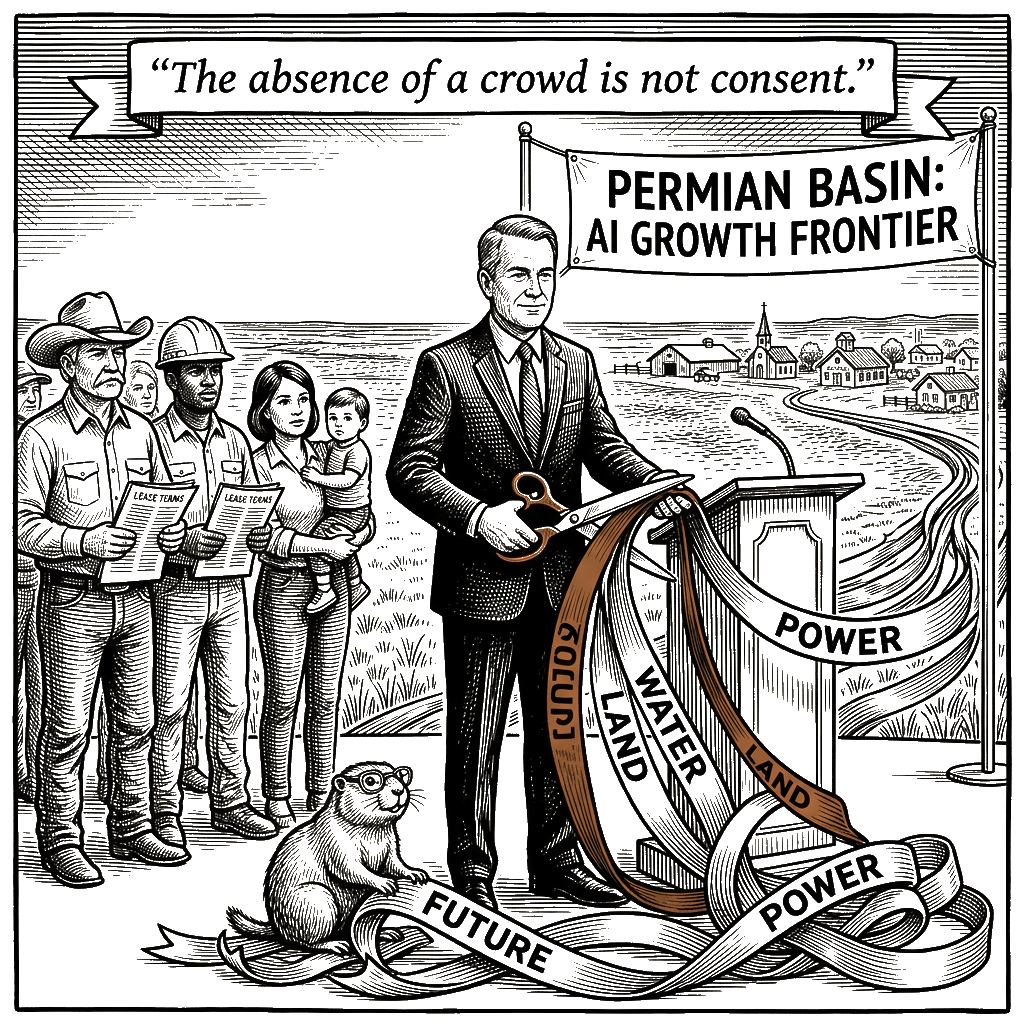
The Permian Basin is not being invited to host the artificial-intelligence economy; it is being invited to rent out its land, water, power and future to it. Texas Pacific Land, LandBridge and EagleRock plan to lease Permian acreage to data-center developers while selling them water and construction materials. Separately, Chevron has signed a 20-year agreement to sell electricity to Microsoft for a West Texas AI data center, a deal Main Street Independent has previously reported. The three landowners together control 1.4 million acres, more than seven times the size of New York City. That is not a local economy finding a new use for its inheritance. It is an old rentier economy finding a new customer.
The strongest case for the Permian is real, and that is precisely why the question of ownership matters. The basin has land, natural gas, transmission opportunities and roughly 500,000 residents; if it were a state, it would be the least populated in the nation. Developers facing opposition from Maine to Arizona will look favorably on a place where a one-gigawatt campus can be assembled far from dense neighborhoods, using roads, substations, pipelines and an energy workforce already shaped by the oil industry. Gas that once lacked enough pipeline capacity to reach a buyer may now feed power plants serving Microsoft. Salty water produced alongside oil, a disposal problem for drillers, may be treated for cooling or power generation. The Chevron-Microsoft project is not a fantasy. It is an industrial project with real equipment, real fuel and a real demand for electricity.
That concession is not a surrender. It is the reason to ask who owns the buildout and who receives its surplus.
“Abundance” is doing too much work here. Water is not abundant merely because an industry has produced a large quantity of salty byproduct. Power is not cheap merely because the public has tolerated the risks and infrastructure that make it available. Land is not empty merely because its owners can lease it without asking every person who depends on the surrounding place. A market price tells us what a buyer will pay. It does not tell us what a resource is worth to the people who must live with its use.
I traded agricultural futures in Chicago before I came home to the co-op, and I learned there how quickly a living thing becomes a line on a screen. The crop was still in the field, the farmer still carried the weather in his bones, but the claim on the crop had already been divided, priced and sold. The Permian is now being asked to perform the same conversion with place itself: acreage becomes a campus, brackish water becomes a cooling input, gas becomes a power contract, transmission becomes a bottleneck to own, land leases become royalties, and construction materials become private income streams.
A regional dependency is being broken into saleable pieces.
Texas Pacific Land derived nearly half its revenue last year—about $386 million—from selling sand, caliche and water, collecting royalties and allowing oil producers to dispose of saltwater on its land. LandBridge says a typical one-gigawatt campus could generate tens of millions of dollars in annual free cash flow through leases, power royalties and water charges. The companies expect data-center projects to generate hundreds of millions of dollars over their lifetimes when land sales, leases, water and construction materials are counted. Texas Pacific has invested $50 million in Bolt, a data-and-energy infrastructure company co-founded by former Google chief executive Eric Schmidt. LandBridge is pursuing campuses with fiber-optic cables and electrical substations. EagleRock raised $320 million in an initial public offering earlier this year. The market is already pricing these companies as growth stories built in part on the data-center boom.
Everybody is chasing the white whale.
The whale, as usual, is a community’s future translated into somebody else’s yield.
There is nothing wrong with earning a return on land, power or useful infrastructure. Property is one of the conditions of independence. The landowners have legitimate claims to use and lease what they own. But property is not an absolute license to turn a common inheritance into a private command post. The earth was given for all. Ownership carries a social mortgage, especially when the value of an asset depends on public roads, public law, public transmission corridors, public water systems and the labor of people who cannot simply move when the next industrial project arrives.
The announced model has the same grammar as every other financial transformation of a living economy: control the land, charge for access, sell the inputs, collect royalties on the infrastructure, and leave the public to absorb whatever cannot be priced into the contract. A basin becomes acreage. Water becomes a revenue stream. A town, if there is one nearby, becomes an inconvenience to be managed.
The men selling this future will say the Permian is underpopulated. That may be true as a census description. It is a dangerous description as a political principle. People do not become disposable because there are fewer of them. A sparsely populated place still contains ranchers, workers, families, churches, schools, wells, roads and unwritten knowledge about what the land can bear.
The absence of a crowd is not consent.
Critics who treat every data center as an evil monument to artificial intelligence make the opposite mistake: treating every landowner as a criminal by definition. Rural communities need investment, skilled work and functioning infrastructure. A county cannot preserve its life by refusing every new enterprise and then asking its children to leave. The gas producers need customers. The landowners need revenue as the oil economy changes. Data-center builders need acreage, fuel and wires assembled quickly. Those are serious facts.
But neither can the Permian preserve its life by becoming a quiet warehouse for other people’s computing, with local people bearing the water disputes, transmission corridors and changed character of the place while distant shareholders collect the rent. The question is not whether development is pure or impure. It is who owns the development, who governs it, who receives the durable gains, who bears the water and power risks, and whether local people possess a meaningful voice after the lease is signed.
A nation that calls itself conservative should know the answer. It should distrust both the rentier corporation and the centralized state that imagines it can administer every consequence from Washington. The principle is subsidiarity: decisions should remain with the smallest competent institutions, and higher powers should support them rather than absorb them. A private land empire governing a regional utility system is not local control.
It is centralization wearing a ten-gallon hat.
The better model is not to hand the basin to a federal agency and call the seizure justice. It is to build countervailing institutions: member-owned electric cooperatives, local water authorities with transparent rates and enforceable limits, municipal or regional power partnerships, land trusts where appropriate, and agreements that give workers, residents and affected landowners a durable share in governance and revenue. The Rural Electrification Administration succeeded because public credit helped member-owned cooperatives build infrastructure that investor-owned utilities had deemed unprofitable. The members did not merely receive service. They owned the institution that served them.
The old oil economy at least contains the bones of that counter-model. Farmers pooled bargaining power through cooperatives. Rural electric cooperatives carried power where investor-owned utilities saw too little profit. The same principle should govern data-center infrastructure: let the water users govern the water; let communities own part of the wires, power plants and revenue stream; give workers a voice; make resource accounting public; write contracts that return a durable share of the upside to the towns whose land and water make the campuses possible.
That model is harder than signing a lease. It requires patient capital, independent monitoring, public rules that do not become a private subsidy, and local institutions strong enough to negotiate with Microsoft, Chevron and the land companies without being grateful for every promise. It requires the people of the Permian to own more than the service jobs around a data center. Let the co-op, the mutual and the credit union stand between the family and the corporation.
That is the distinction between development and liquidation. A data center can be part of a working regional economy, or it can be a private utility kingdom for machines that draws power from the public system, water from a common inheritance and labor from nearby towns while returning rent to distant shareholders. The former requires local ownership, public accounting, enforceable limits and a share of the upside that cannot be carried away in the next quarterly report.
The latter requires only a lease.
A region should not have to choose between stagnation and becoming somebody else’s utility closet. The Permian has land and power in spades, as Greg Pipkin Jr. says. What it needs now is an institution strong enough to say that not everything abundant is for sale.
Build the cooperative grid. Let the water users govern the water. Keep the public return visible.
Leave the basin its life.